
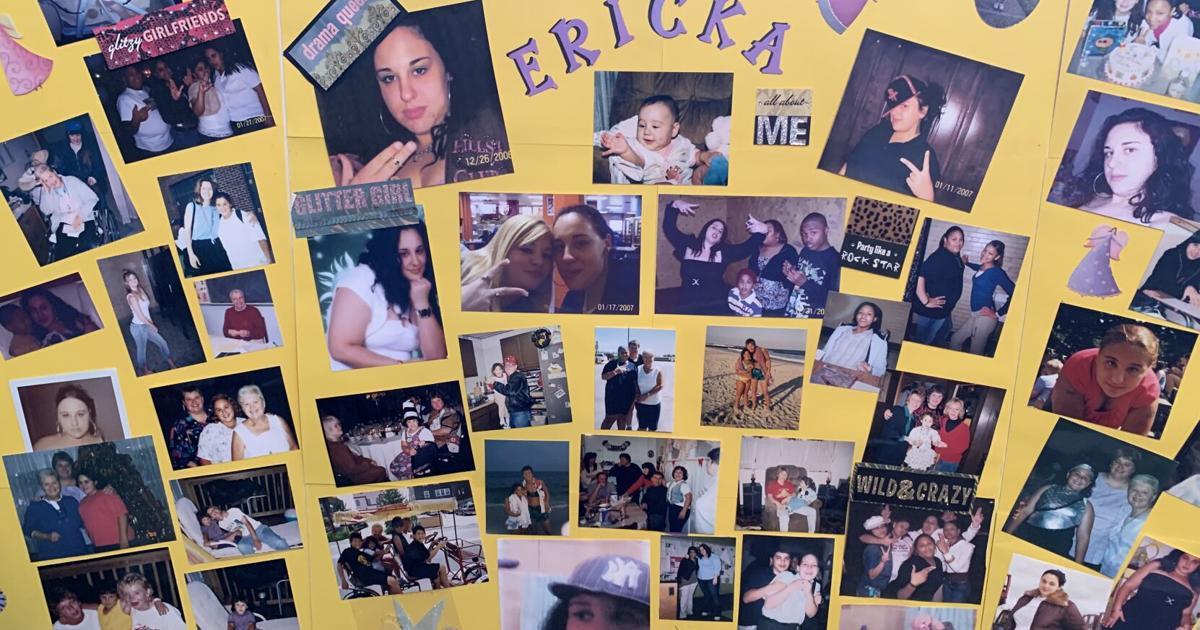
Janice Krause was 53 years old when someone killed her only child. Krause is 73 now.
Nearly 20 years have passed since 18-year-old Ericka Brair disappeared from Philadelphia, and Krause estimates it has been about 10 years since a homicide detective last contacted her about the case. She has moved to Missouri and waited through several detective changes and has been promised a callback.
“Every time I would contact the police, they’d say, ‘Well, so-and-so is not handling it now. Hold on. We’re going to connect you with somebody that does,’” Krause told the Tribune. “I get connected with somebody else, and they say, ‘Well, we know nothing about that case. I’m sorry. We’ll have to check into that and get back to you,’ and they never do.”
Philadelphia enters the 20th year of a mother’s wait as its Police Department solves homicides at a rate the city has not seen in nearly four decades. A department spokesperson confirmed that the homicide clearance rate has reached 82%, up from 41.8% in 2021, and police are clearing more than 40% of nonfatal shootings.
But success in more recent cases coexists with a much older problem – homicide cases that remain unsolved after decades.
The Philadelphia Police Department told the Tribune that its computerized database lists 4,952 unsolved homicides dating back to 1988. We found the actual number is higher. Dozens more cases stretch back to at least 1972.
Unsolved murders before 1988 are stored in older files and would require a physical review to be counted, according to Cpl. Jasmine Colón-Reilly of the department’s Office of Media Relations and Public Affairs.
Colón-Reilly also said that nearly every homicide investigator carries at least one cold case alongside other responsibilities.
Over the past five years, PPD records show that at least seven homicides that are at least 10 years old have been solved.
According to PPD, approximately 20 unsolved cases have been reexamined using newer DNA or forensic technology, and more than half have been resolved with genetic genealogy to identify victims.
Detectives are clearing a large share of the killings now, while thousands of murders accumulated over decades remain unsolved.
For Krause, she eventually stopped calling because “I would get madder and madder, and more upset and more upset” she said, explaining that police officials either didn’t have answers or didn’t return her calls.
She’s not the only person hoping for police to solve cases of a murdered loved one.
Francis “Franny” Klein, a 47-year-old father of three daughters, was standing in the back of a bar in the 2100 block of South 65th Street on Aug. 1, 1981, when a man entered through the back door and fired a single shot.
“Our father, better known as Franny and in some circles ‘Whitey,’ was a very caring man who would do anything for anyone, especially those who could not do for themselves,” his daughters wrote in an appeal on PPD’s unsolved murders website.
His daughters grew up, married and had children without him present.
“His murder was devastating alone, but not having it solved has made the weight of our loss last longer for far too long,” they wrote.
Myrna Williams was 41 when she was found dead in 2004 on the living room floor of a home in the 6000 block of North 16th Street.
Her family remembered a mother of four who seemed to know everyone as she entered a room.
“Myrna was the life of the party,” they wrote.
Her children reject the idea that the years necessarily make violent loss easier.
“Some say that it gets easier with time, in which over the years I find that hard to believe because it’s gotten harder,” the family wrote. “We just want our mother to be able to rest in peace with her killer behind bars.”
What science can recover
Old homicide investigations face problems that cannot be reversed. Witnesses die. Memories fade. Suspects disappear or die. Evidence collected before DNA testing existed may have deteriorated or may not have been preserved in a condition suitable for testing decades later.
But Philadelphia has also seen what can happen when old evidence meets technology.
For generations, the child found dead in Fox Chase in 1957 was known only as the “Boy in the Box.”

Philadelphia police are solving homicides at their highest rate in decades, but thousands of cold cases like Briar’s remain unsolved. — SUBMITTED
Forensic genealogy helped investigators finally identify him. In 2022, Philadelphia learned his name was Joseph Augustus Zarelli.
Genetic genealogy also helped investigators identify a suspect in the 2003 killing of Rebecca Park, one of the victims linked to the man police called the Fairmount Park Rapist.
PPD said it has reexamined about 20 unsolved cases using newer DNA or forensic technology. More than half used forensic genetic genealogy to identify victims.
The department also cited a review of juvenile deaths that led to two arrests.
Those cases demonstrate that age alone does not necessarily make a homicide unsolvable.
Families who still cling to the hope that their loved ones’ cases will eventually be solved have asked which files should be reexamined.
PPD told The Tribune that there is no formal requirement to review every cold homicide at prescribed intervals. Reviews do occur, and nearly every homicide investigator has at least one cold case.
“Is someone still trying?”
At least seven 10-year-old homicide cases have been solved over the past five years, meaning seven families have received answers that thousands of others are still waiting for.
For Krause, that work includes her daughter.
Ericka disappeared on March 16, 2007, from the 1400 block of East Cheltenham Avenue. A month later, her body was found in a wooded area in the 5200 block of Kubach Street. The Medical Examiner determined that she had been stabbed multiple times.
Krause said there was once a detective on the case whom she considered a “go-getter.” She believed he was pursuing the person responsible for her daughter’s death.
Then she said he was removed from the investigation. PPD did not say why.
If Krause could sit across from Police Commissioner Kevin Bethel today, she would already know what to ask.
“Why will they not put anyone on it?” Krause said. “Why did they take my detective off?”
For police, whether a decades-old homicide can still be solved may depend on evidence, witnesses, and what advances in science can recover.
Krause has a question she has waited years for someone to answer.
“Is someone still trying?”
What PPD says
Bethel acknowledged that PPD has struggled to communicate with families, particularly as homicide cases age and detectives change.
“They’re right,” Bethel told The Tribune when asked about relatives who reported that contact with investigators diminished or disappeared over time.
Bethel told the Tribune that PPD has changed how it communicates with homicide victims’ families, creating a system to help relatives maintain their connection to the department when detectives leave, transfer, or retire.
The department created the Office of Victim Advocates about two years ago. Executive Director Ayanna Greene leads a staff of 10 victim advocates, he said.
“What we do now after every homicide, the victim advocate reaches out to the family,” Bethel said. “They become a point of contact.”
The advocate, he said, is supposed to remain with the family regardless of what happens to the detective assigned to the investigation.
“Even if the detective retired, the victim advocate never leaves,” Bethel said.
Ericka Brair was killed in 2007 when she was 18 years old. For nearly 20 years, her mother has waited for answers, holding on to hope that the case will one day be solved. — SUBMITTED
Bethel said PPD also has case followers and case holders, providing relatives with another way to seek information about an investigation.
“Today, there should be no family unable to communicate with PPD about a homicide or shooting investigation,” he said.
The department is also trying to reconnect with relatives from older cases when they contact police, Bethel stated.
“We are working hard to make sure that doesn’t happen moving forward,” he added. “And also trying our best to go back so when families do reach out, we are connecting with them to make sure that they have the information they need.”
“We have some work to do, but we’re far better than we were two years ago,” Bethel determined. “And we’re going to grow and make it even better.”
A mother’s texts
More than a year after Amya Devlin was killed, her cellphone is still connected. Her mother pays the bill.
“Every once in a while, I’ll send her a text, just telling her I miss her,” Devlin’s mother, Ryan Brunson, said. “I don’t think I would ever get her cell phone cut off.”
Devlin’s sisters sometimes text her, too.
It is one way a Philadelphia family lives with a homicide that has produced no arrests. Eleven people were shot in the 800 block of Lemon Hill Drive on Memorial Day night in 2025. Devlin, 23, and Mikhail Bowers, 21, died.
Brunson said she does not believe anyone is actively investigating her daughter’s murder. “No, no,” she told The Tribune. “None at all. None at all. I don’t believe it.”
Devlin’s father, Will Devlin, said he once heard from a homicide detective shortly after his daughter’s death. “I haven’t heard from a detective since, probably, the first week my daughter passed away,” he said. “I haven’t heard from anybody.”
Both parents praised a Philadelphia Police Department employee who has continued to reach out to the family with resources and support. What they say they have not received is regular updates from homicide investigators on the investigation’s progress.
That leaves them with just their memories of their last time seeing their daughter.
Brunson spoke with Amya around 4:30 that afternoon. Her daughter was excited to go to a cookout.
They talked. They laughed.
“She just seemed so happy,” Brunson said.
Will Devlin saw her that day, too. His daughter stopped by for about five minutes before returning to her friends.
Asked what he misses most about his daughter, Devlin did not need many words to say it. “I just wish I could see her and talk to her,” he offered.
“Lot of work to be done”
The police commissioner pointed to the extraordinary number of killings Philadelphia saw during the city’s recent surge in violence.
“We recognize, I mean, you went through a period, we had almost 2,000 homicides in a four-year period,” Bethel said. “And many of those cases still remain unsolved. So there’s still a lot of work to be done.”
Over the years, Krause said she has collected phone records, searched for phone numbers and addresses and investigated people herself. Police officers she knew tried to help her obtain information, but those efforts led to dead ends.
She still watches shows about unsolved murders.
“My head’s always going there,” Krause said.
Krause does not know what career her daughter would have chosen, where she might have lived, whether the teenager fascinated by forensics would have pursued investigative work or what the intervening 20 years might have brought.
She knows she once had an 18-year-old daughter who liked helping other kids with their problems.
She knows that somebody killed her. And she still does not know who.
“I haven’t lost it yet,” Krause said of growing older while waiting for an answer. “I’d like to hear this before I do lose it.”
Then she returned to the wish that has endured for nearly two decades.
“I’d like to go to my grave knowing this is settled,” she said.
Stay informed and connected — subscribe to The Philadelphia Tribune NOW! Click Here