
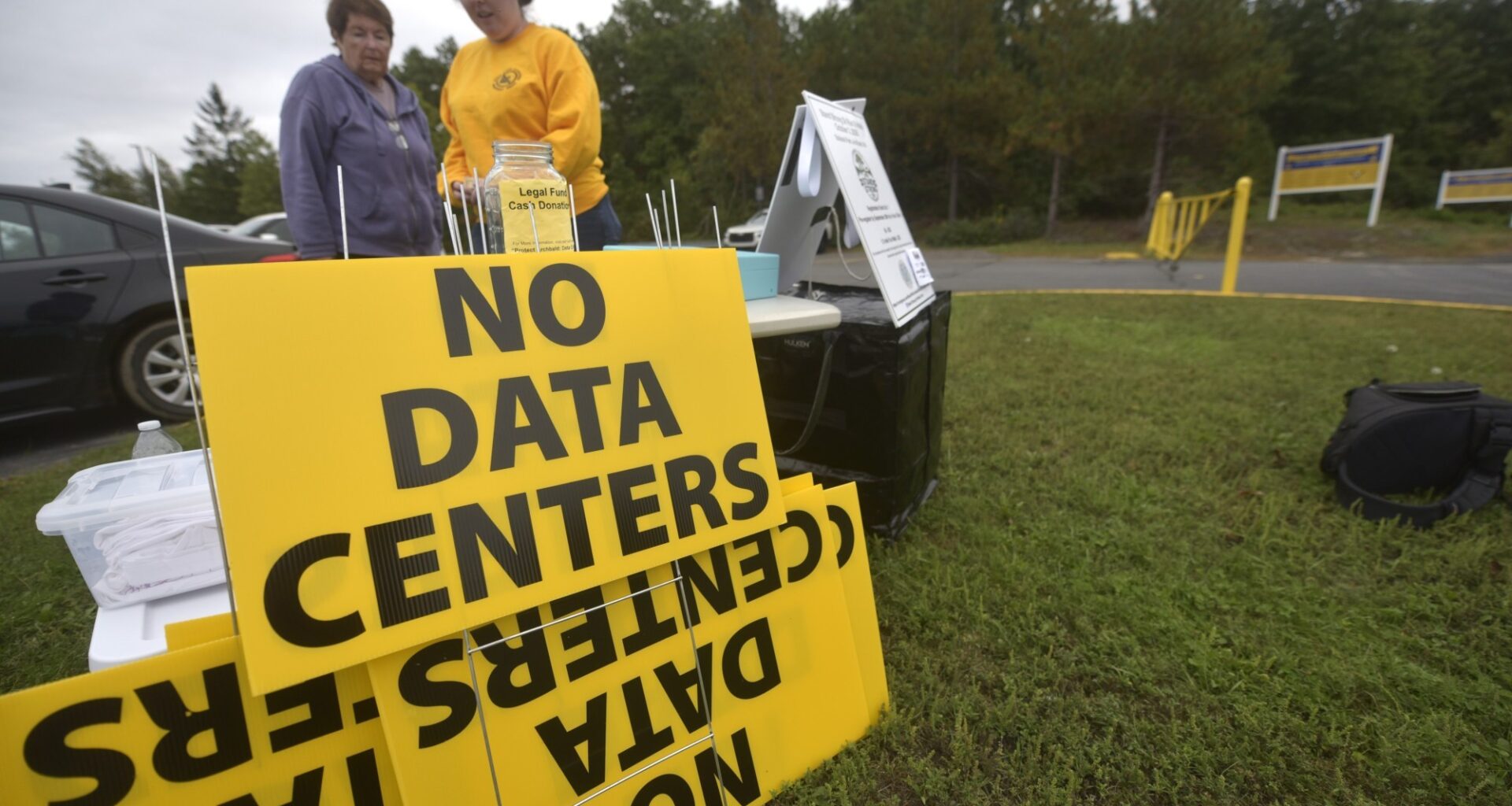
Sugarloaf Twp. resident John Zola doesn’t remember a single issue in his lifetime that’s galvanized and united people from across the political spectrum as much as opposition to hyperscale data center development has in his bucolic Luzerne County community and across Northeast Pennsylvania.
“The pulse of the people is very simple,” said Zola, 63, a retired businessman and conservative Republican whose land is being targeted via eminent domain for a high-voltage power line that would supply proposed data centers. “They are completely opposed to these hyperscale data centers being put inside of their communities very close to where they live, and anyone, any politician, that is remotely associated with being pro-data center, they’re not voting for them. They don’t care if they’re Democrat or Republican, they’re not voting for them.”
His was a common sentiment among prospective voters who identified data center development as a major issue coloring politics during this highly consequential midterm election cycle. And it’s one that’s unifying unusual political allies often quick to accuse politicians, regardless of party, of being late to the game or failing to meet the moment on the data center front.
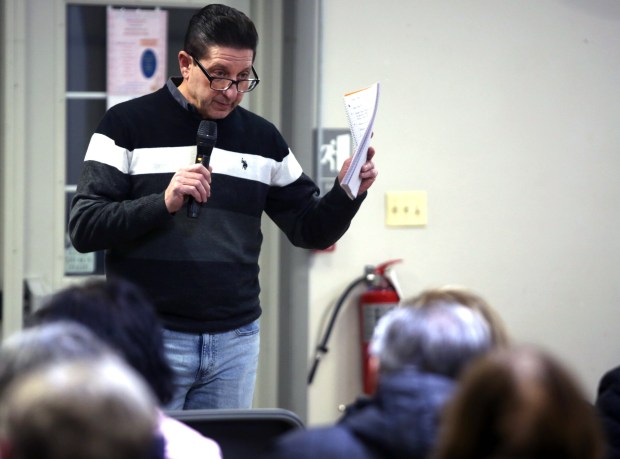 John Zola, of Alliance to Stop the Line, talks about PPL’s proposed 500 kilovolt power line project and data centers during a town hall hosted by state Rep. Jamie Walsh R-117 on Tuesday, Feb. 24, 2026 at the Sugarloaf Fire Company. (John Haeger / Staff Photographer)
A pair of federal House races are playing out against that backdrop in local counties: the toss-up race in the 8th Congressional District between incumbent Republican U.S. Rep. Rob Bresnahan and Democratic Scranton Mayor Paige Cognetti, and the less-competitive race in the Republican-heavy 9th Congressional District between incumbent GOP U.S. Rep. Dan Meuser and Democratic challenger Rachel Wallace.
Political disquiet over data centers at the grassroots level is often pervasive in both districts, where proposals to construct massive data center campuses, power plants and related infrastructure have generated fierce backlash from opponents racked with anxieties about the industry’s potential impact on their environment, utility bills, health and happiness. Practical concerns about land use, pollution and quality of life abound, sometimes complementing more philosophical objections to and misgivings about the rapid proliferation of artificial intelligence and the big-money interests behind it.
All of the above is making the electoral landscape precarious for politicians navigating the data center issue in the face of bipartisan opposition. An NPR/PBS News/Marist Poll released last month shows 82% of Democrats, 72% of independents and 44% of Republicans either oppose or strongly oppose the construction of a data center in their community. The same poll found 43% of national registered voters strongly oppose such construction where they live, compared to just 7% who strongly favor it.
“I personally think, without naming seats, I think there are going to be some seats lost in this upcoming election, and the main reason is data centers,” said Zola, the founder and president of the nonprofit grassroots Alliance to Stop the Line fighting PPL Electric Utilities’ proposed 500 kilovolt line that would cut through the townships of Nescopeck, Black Creek, Sugarloaf and Hazle. “The politicians just have not listened to the people. They’ve heard them, I’m quite sure of it. There would be no choice but to hear all the outcry with this, but no significant action was taken.”
Voter skepticism
Several data center critics accused Republican and Democratic politicians alike of paying lip service to the opposition. Some said they haven’t been very impressed with and question the sincerity of candidates when it comes to data centers, even if they plan to vote for a particular candidate for other reasons.
“I think both here locally and what I’m seeing nationally is that (data center opposition) is one of the few bipartisan unifying issues, and is one of the defining issues of this election,” Archbald Democrat Ann Beynon, 44, said immediately before joining other data center opponents at a recent public hearing on the 400-megawatt Essential Energy LLC natural gas power plant proposed in the borough. “Unfortunately it feels like neither party is really helping, at least to a degree that we would like, so there’s no clear winner when it comes to candidates in a lot of people’s minds, which is frustrating because this is a time when we need people to help us who are in power. And I think there’s a lot of confusion about who are the good candidates — of course they’re all saying they’re good — but if you know anything about what’s been happening some of it seems kind of shallow.”
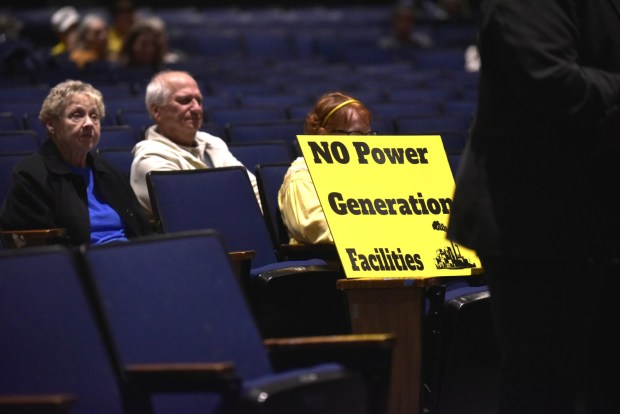 A sign reading “No Power Generation” is seen at an Essential Energy hearing at Valley View High School on Tuesday, Sept. 29, 2026. (CHAD SEBRING/STAFF PHOTO)
Beynon said she’s leaning toward Cognetti in the 8th District race, “mainly for reasons other than data centers,” but did credit the Scranton mayor for showing up at multiple data center public hearings in Archbald, ground zero for the industry in Lackawanna County.
“She has shown at least some interest in coming here,” Beynon said. “(Bresnahan) uses us in his commercial, but I don’t think he really knows what’s going on here.”
At the same time, she’s considering writing in Chester County Democratic state Sen. Katie Muth’s name for governor, as opposed to voting for incumbent Democratic Gov. Josh Shapiro, and hasn’t yet decided how she’ll vote in the 40th state Senate District race between incumbent Republican state Sen. Rosemary Brown and Democratic challenger Brian Wrightson.
While Shapiro’s posture toward data centers has shifted dramatically — he issued an executive order in August imposing strict requirements on data center development — many continue to hold his early support for the industry against him.
Muth, who introduced a bill that Brown co-sponsored calling for a three-year statewide moratorium on data center development, is one of several politicians local data center opponents praised in recent interviews. Others include Democratic Lackawanna County Commissioner Bill Gaughan and Republican state Rep. Jamie Walsh, who seeks reelection in the 117th state House District against Democratic challenger Jeremy Benscoter.
Sugarloaf Twp. resident Erika Cook, 42, an ally of Zola’s and fellow leader of the Alliance to Stop the Line who’s also fighting an eminent domain application to accommodate that project, credited both Muth, her write-in choice for governor, and Walsh, her state representative, with “doing fantastic” on the data center front. She agreed the issue will be a big driver this election cycle, but said there are otherwise few politicians she trusts on the subject.
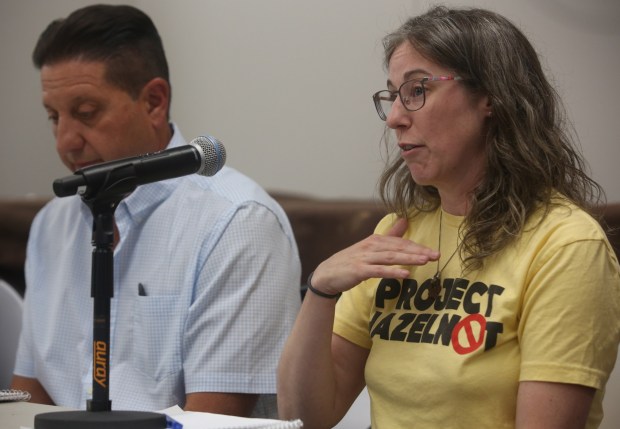 Erika Cook makes a brief statement during the beginning of during the Pennsylvania Public Utilities Commission hearing held at Penn State Hazleton on Tuesday, June 30, 2026.(John Haeger / Staff Photographer)
“There’s very few that I actually feel comfortable with,” she said. “It’s frustrating, because anything higher up than your local townships, you can’t get anywhere.”
Cook doesn’t consider herself a “party-line person” and still hasn’t decided whom she’ll support in the 9th District race between Meuser and Wallace, but plans to scrutinize both on data centers over the coming weeks.
“I think I’m waiting until the last minute to really make my decision because things are changing so frequently,” she said. “I think it’s really important to wait and see what happens.”
Back in the 8th District, Democrat John Mellow, 76, an Archbald resident and retired state Department of Environmental Protection licensed professional geologist, was still “waffling” late last month on whether to support Cognetti or Bresnahan. Interviewed outside the same public hearing Beynon attended, Mellow credited Bresnahan’s office with being very reachable and “easily accessible,” but wasn’t yet sold on either candidate.
“I don’t quite believe all the PR that’s being put out,” he said. “I’m skeptical of both of them. They may mean well. I’m still kind of debating which one I’d prefer on the data center issue.”
‘Balls of fire’
Dunmore resident Aline Browning, 46, a member of the Stop Olyphant Data Centers movement in Lackawanna County, said she doesn’t “adhere to the two-party construct.” While she traditionally voted for Democrats, members of both parties have disappointed her in recent years as she’s worked to prove a cancer cluster exists in the region from chemical exposures at the former Specialty Records/WEA Manufacturing/Cinram plant in Olyphant, where her father worked for decades before succumbing to lung cancer in 2023.
With the exception of Gaughan and Muth, politicians have not impressed Browning when it comes to data centers.
“We’re looking for balls of fire who aren’t afraid to stand up to this thing,” said Browning, who doesn’t see either Cognetti or Bresnahan as that. “The general public has no idea the scope of what is coming.”
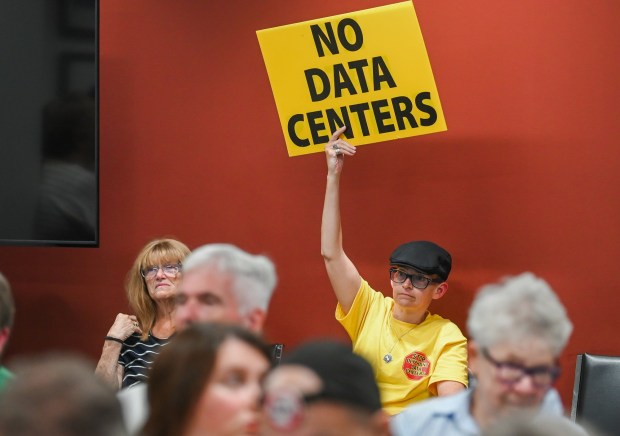 Founder of Lackawanna Citizens’ Overwatch Project Aline Browning holds up a sign during the Lackawanna County commissioners’ meeting on Aug. 5. (SEAN MCKEAG / SCRANTON TIMES)
But, after voting for Bresnahan two years ago, she’s going to vote for Cognetti, describing it as a “punishment vote” against Bresnahan over his stock trading controversy, Medicaid cuts included in last year’s Republican megabill and other issues. It’s one of several punishment votes Browning plans to dole out this cycle.
She’ll also write-in Muth’s name for governor and vote for Republican Sharon Soltis Sparano in the 22nd state Senate District race, describing those as “punishment” votes against Shapiro and incumbent Democratic state Sen. Marty Flynn over data centers.
Browning, a gay woman, believes elected Democrats are generally better on social and equal-rights issues, but said the potential impacts of data center development on public health make it by far the most important political issue this cycle.
“If I had to throw it back to 1992 and scrap in the street for my liberties as a gay woman to keep everybody else safe and healthy, I’ll do that,” she said. “This is about everyone. Everyone is going to get sick.”
‘Talking points’
Jenkins Twp. resident Dino Rodeghiero, a 51-year-old political independent, is worried about the potential impact of pollution tied to the data center industry, particularly on the local water supply. While smaller data centers might make sense on former strip mine or industrial sites under certain conditions, he’s adamantly opposed to hyperscale projects in or near residential neighborhoods, which “should never be considered,” he said.
Rodeghiero also sees the pushback to data center development as bipartisan, driven by citizens from both sides of the political spectrum whose concern transcends traditional political divides. He’s among those less than thrilled with his options in the 8th District race, describing Bresnahan and Cognetti as “both very poor on data centers” while noting his belief that “anything that they say (about data centers) is just talking points.”
But Rodeghiero also cited controlling illegal immigration as an important issue and supports voter ID policies backed by Republicans. He called Cognetti a “carpetbagger” trying to use her position as mayor of Scranton as a steppingstone for higher office, among other criticisms, and is likely to vote for Bresnahan.
That’s not how Leah Casner, a 70-year-old resident of the rural Wayne County village of Equinunk, plans to vote.
Describing herself as “very, very left-wing,” Casner, a registered Democrat and monthly humor columnist for The River Reporter, said she’s “ashamed” that Bresnahan is her congressman and is enthusiastic in her support for Cognetti for a plethora of reasons. But she also said both parties came out against data centers too late, noting she was disappointed with Cognetti in that regard and continues to be disappointed in Shapiro.
“I have to admit, I was going to vote the same way I’m going to vote now,” Casner said when asked how the data center issue informed her vote. “It really hasn’t affected it because now everybody seems to be on the side I’ve been on all along, which is nice. Everybody is jumping on the anti-data center bandwagon, but I’ve always been there. … I’m not into big business. I do not like the tax benefits to the rich, particularly with data centers.”
‘Being present’
Among voters and the general public, not everyone wary of data center development is outright opposed to it.
Republican Chris Melusky, 49, a resident of and elected auditor for Norwegian Twp. in Schuylkill County, does not consider himself “anti-data center,” but said rapid changes in technology and exploding demand for computing capacity fueling the hyperscale data center push must be met with responsible decision-making.
“I look at it from an aspect of they have to be in the right location and they have to be operating under the right conditions,” he said. “So when we talk about where should we place them, of course I oppose them next to communities direct to neighborhoods. I am for former industrial sites, brownfields (and) old industrial infrastructure.”
Melusky acknowledged the jobs and tax revenues data centers can produce for local governments, but said responsible regulation must take into account the potential environmental, noise, light, stormwater and other impacts of massive campuses.
He also agreed that data center concern is motivating voters this cycle and presenting challenges for incumbent politicians, and thinks that dynamic will benefit Wallace, at least in Schuylkill County, where she lives and has roots. Despite voting for Meuser and President Donald Trump in 2024, Melusky is throwing his support behind Wallace this time around, largely because he feels she’s been more present in and attentive to Schuylkill County on data centers and other issues.
“Wallace is homegrown, Wallace is from this area, Wallace is going to take an interest in the community, and this particular area is very opposed to the data centers coming in,” he said. “Meuser … has utilized his local offices to make impacts to our community, but at the same time he shows a lack of being present with the people in our community, and I think that’s what’s striking a lot of people right now with this race. And a lot of people are shifting their weight towards Wallace, because they know she’s homegrown.”
Whether that’s enough to make Wallace truly competitive in the sprawling district where Republicans maintain a voter registration advantage over Democrats of more than 157,000 remains to be seen, as does the ultimate impact of data center backlash on the midterm elections more broadly.
Data center opposition is far from the only politically potent issue energizing voters and informing votes this cycle, but it may be the most bipartisan in this polarized period of American politics.
James Bosha, 68, a Scranton Democrat and Cognetti supporter also quoted in a recent election-focused article on affordability challenges coloring politics this cycle, said the public is “driving sentiment on this issue of data centers specifically (and) AI as a spill-out.”
“And politicians can do one of two things,” he said. “They can agree and try to show themselves as a champion of the anti-data center, skeptical-of-AI movement — that organic movement — or they can lose.”
Candidates on the issues
We sent a questionnaire on data centers and energy infrastructure to candidates running in the Nov. 3 election in the 8th and 9th Congressional Districts. The candidates’ responses appear below. Republican U.S. Rep. Dan Meuser did not respond.