
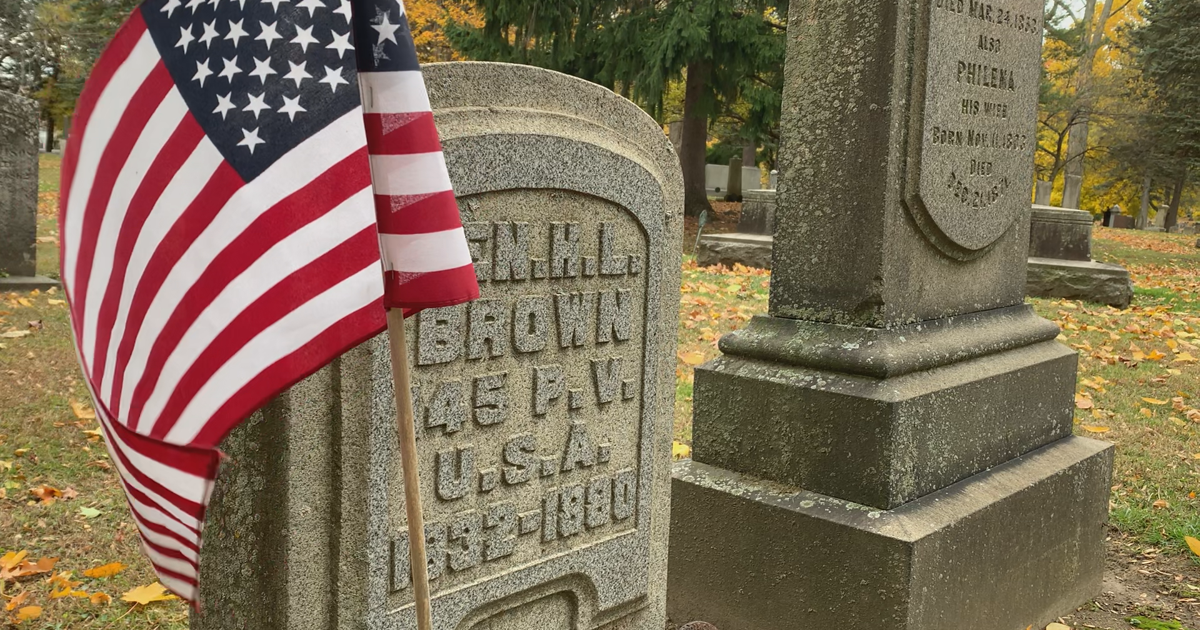
John Last visits the Erie Cemetery where many veterans are buried in honor of Veteran’s Day.
I’ve chosen to observe the Veterans Day holiday this year with a visit to Erie Cemetery. Many veterans are buried here, and it is a special time to visit some of the graves. It’s my salute to the veterans of the past.
I’ve asked Betsy MacKrell, the manager of sales and business development at the cemetery, to tell me about some of the veterans interred here. I am not the only person who has shown interest.
“People take walks here to see the veterans all the time,” says Betsy. “They’ll ask for the locations of the famous veterans, and we’ll give them directions to the graves.”
Betsy takes me to the gravesites of two well-known heroes of the Civil War, Colonel Strong Vincent and General John W. McLane. They have schools named after them. However, there is a grave of another Civil War hero that Betsy wants me to see. It’s the grave of General Hiram Loomis Brown. He was wounded in action three times. He was wounded at Gaines Mill, Virginia, at Fredericksburg, and at Gettysburg.
“We have, of course, Strong Vincent. We have General McLane. Hiram Loomis Brown kind of falls third on that list,” says Betsy. “He’s not the most famous but he definitely served and fought throughout the whole war.”
We now arrive at the grave of Seth Read, a colonel in the Revolutionary War. He served in the Battle of Lexington and Concord and at Bunker Hill. He’s one of many Revolutionary War soldiers buried at Erie Cemetery.
“There are veterans in Erie Cemetery that go from the Revolutionary War through every war up to the Global War on Terrorism,” Betsy says.
Colonel Read also has the distinction of being the first settler in Erie. He built a cabin in 1795.
We move on, to the grave of Henry C. Thompson. Betsy tells me about his life.
“He joined the Navy in 1894 as a steward which was the only role available to him as an African American man at that time,” she says.
The sailor known as “Harry” also served as a personal aide to President Theodore Roosevelt. He later was one of a group of African Americans who organized the first community center in Erie. That center is now named the Booker T. Washington Center.
We come to a monument to honor Reid T. Stewart, a cavalryman killed by Apache Indians in the Arizona Territory in 1872. Images of his boots, belt, gloves, rifle, and sword are crafted onto the stone. I leave here with pride in everyone who has served.