
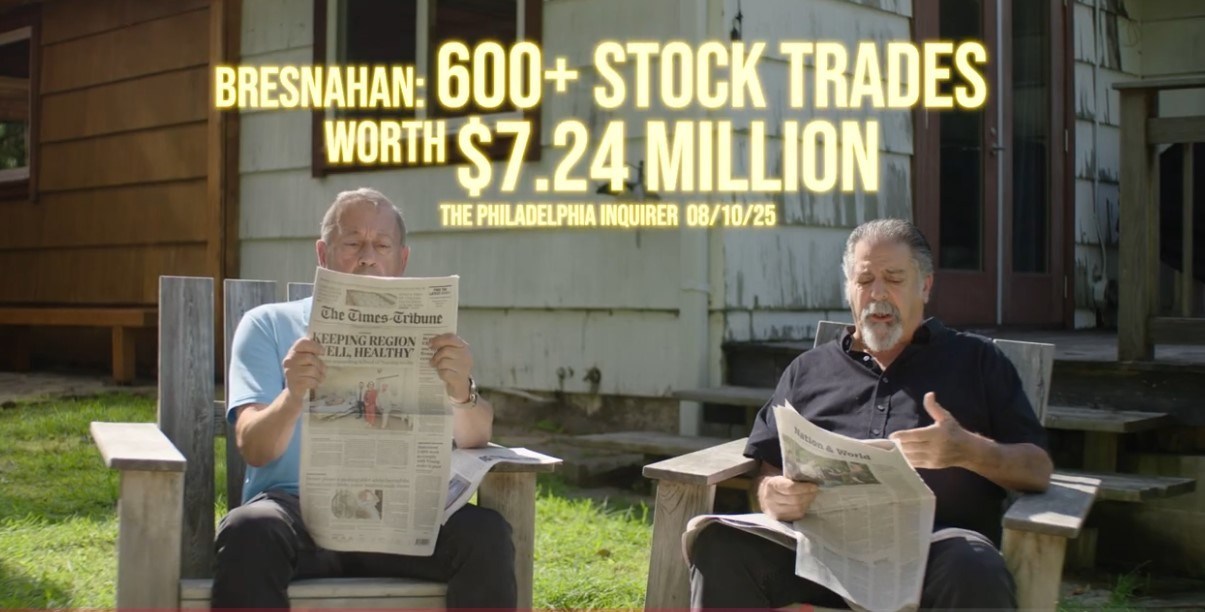
Editor’s note: We are publishing a series of fact-checks of advertisements in the Pennsylvania 8th Congressional District race between incumbent Republican Congressman Rob Bresnahan of Dallas Twp. and Democratic challenger, Scranton Mayor Paige Cognetti. The election is key for both major parties’ hopes of holding a House majority the next two years.
The 30-second ad is paid for by Paige For PA, Cognetti’s official campaign committee. It was approved by the candidate.
The scene opens with two men sitting in Adirondack chairs in a front yard outside a home. One is reading a copy of The Times-Tribune, the other a recent edition of The Citizens’ Voice.
“You see this?” one man asks. “Bresnahan wants data centers all over NEPA.”
It kicks off a discussion between the two men centered on Bresnahan’s views and actions on data centers.
The other man complains about already-high energy costs, while the original commenter adds that data centers “use more juice than 100,000 Sheetz (gas stations).”
He goes on to say that Bresnahan gave data centers a $20 billion tax break, adding that he also “bought stock in a data center company.”
“Rob Bresnahan is making more money, and we’re stuck with the bill,” he says.
Cognetti appears, sitting atop a fallen tree, announcing she approves the ad. She’d say more, she concludes, “but I think these guys got it covered.”
Key claim
Rob Bresnahan supports data center construction throughout the region and encourages them with tax breaks.
Is it factual?
The dialogue hits on several points scrutinizing Bresnahan’s early support for data center development in Northeast Pennsylvania.
Claims that Bresnahan desires data centers be built “all over” the region is at the very least a stretch.
In June, Bresnahan introduced the Local Control Protection Act in the House. He said the bill would put data center development in the hands of local communities by putting limits on a corporation’s right to sue over local zoning decisions that deny applications to build them. The bill was sent to committee in June and has not been acted upon since.
“We should never let billion-dollar corporations supersede the voices of those who live in the community,” Bresnahan said in a statement introducing the bill.
However, it also is true that Bresnahan expressed support for area data center development in the past.
In April 2025, Bresnahan said data centers could be “catalysts for economic growth and technological innovation” throughout the region.
“I look forward to these investments and encourage companies to look to Northeastern Pennsylvania as a home for economic and technological advancements,” he said then.
After a joint venture between PPL Corporation and Blackstone, a leading private equity firm, to invest $25 billion in data center development in Pennsylvania was announced in July 2025, Bresnahan pointed to potential benefits in NEPA, saying the region was full of “untapped power” and was “more than ready for new growth, investments and opportunities.”
It is not true that Bresnahan voted in favor of a $20 billion tax break targeted solely to data center developers.
Yet, critics argue the One Big Beautiful Bill Act, for which Bresnahan was a yes vote, included language that created broader capital expensing and depreciation rules allowing companies to write off equipment costs sooner than is deemed necessary based on useful life and is especially lucrative for companies that build AI infrastructure. A study by the nonprofit Institute on Taxation and Economic Policy, for example, found that five big tech giants — Alphabet, Amazon, Meta, Microsoft and Oracle — combined to claim more than $26 billion in depreciation tax breaks in 2025.
Bresnahan indeed owns stock in data center companies. According to financial disclosures filed in August, Bresnahan owns between $19,005 and $110,000 worth of stock in four companies with direct ties to the data center industry. His portfolio also includes investments worth between $804,024 and $2.04 million in companies that supply chips, networking equipment, semiconductor manufacturing tools and software that aid the development of the AI industry and data centers.