
When Compton principal Susana Miranda sits at her computer every morning, she knows immediately who’s in school, who’s chronically absent, who risks falling into that category, and the number of days those students need to attend consistently to get out of that danger zone.
That data dashboard, which the Compton Unified School District in Compton, CA built around 2021 amid skyrocketing chronic student absenteeism rates, gives principals like Miranda and school staff detailed information they then use to reach out to families, find out what’s going on and work on a plan to get students back on track.
“We look for patterns,” says Miranda, who is in her eighth year as principal of William Jefferson Clinton K-8 School. “For example, if I see a student is absent today, and then I see they are on my absent list again tomorrow, I know something is up. I need to call that family.”
Miranda also knows her superintendent will hold her responsible if more than 5 percent of her students are chronically absent, a term that refers to students missing 10 percent or more of the school year or 18 or more days in a 180-day school calendar. And everyone in the district can see how her school’s attendance measures up against others, which is another incentive for her and other principals to ensure as many kids as possible are in school every day.
“If I see a student is absent today, and then I see they are on my absent list again tomorrow, I know something is up. I need to call that family.” — William Jefferson Clinton Principal Miranda Susana
Compton officials say that comprehensive data system and principal accountability — in part, by building student attendance into principals’ annual evaluations — are two major reasons the district slashed its chronic absenteeism rate for kindergarten to eighth grade students to 5 percent in the 2024-25 school year from 15 percent the year before. Across the district, just 12.2 percent of students were chronically absent in 2024-25, according to the state’s education department, a 16 percent drop from 2022-23. (Nat AEI’s chronic absenteeism tracker puts Compton’s chronic absenteeism rate at 16 percent in 2025, down from 23 percent in 2024.)
That rate is lower than that of many districts — including Philadelphia — that are still trying to get students to attend school regularly six years since the start of the pandemic.
An Associated Press analysis in conjunction with Stanford University Professor Thomas Dee found nearly a quarter of kids were still chronically absent in the 2022-23 school year. (The analysis looked at data from 42 states and the District of Columbia.)
Although chronic absenteeism rates have decreased slightly, according to a June report by the American Enterprise Institute, absenteeism remains a major challenge for many school systems trying to improve academics, which also took a beating during the pandemic.
A Philadelphia story
Philadelphia’s attendance rate has inched up every year since plummeting during the pandemic — though large numbers of students still continue to miss school. Preliminary data show that 63.4 percent of students regularly attended school last year, up from 61 percent the previous year. Still, nearly 37 percent of kids did not consistently attend school last year.
Attendance is tied closely to how well students do in school and is a strong predictor of whether they’ll graduate. And the negative effects are not confined to those who don’t show up: Absences also disrupt learning for students who attend consistently because teachers have to spend time going over content they’ve already covered.
Attendance was a big sticking point before the pandemic, when about 15 percent of students were chronically absent in 2019. But the rates skyrocketed in the post-pandemic years amid changing societal attitudes about when to send children to school, especially when they’re sick, an increase in virtual learning options, and concerns about student safety. Historic barriers, such as homelessness, lack of clean clothing and transportation, and family responsibilities, including caring for younger siblings and relatives or working to help support families, also remain hurdles for children. And whether students, especially older ones, find the school work rigorous and relevant also influences whether they attend.
“This is not a problem that a teacher, a guidance counselor and a principal will solve. It’s a problem that our village will solve.” — School District of Philadelphia Superintendent Tony Watlington
School District of Philadelphia Superintendent Tony Watlington says he’s proud that thousands more children are showing up to school regularly, but “we need our students in school not less than 90 percent of every month and 90 percent of every school year because when kids are in school they just learn more.”
He’s been looking for ideas near and far. This past school year, the school district adopted a daily attendance dashboard, based on Rhode Island’s, to track student attendance “with a fierce sense of urgency,” Watlington says.
That surfaced a problem hidden in plain sight: half-days, which the district eliminated this year.
Watlington is also paying attention to Oakland, CA and Detroit, MI, the latter of which still wrestles with attendance, but has seen sharp declines in chronic absenteeism in recent years. Detroit has offered a range of support to students, including hiring counselors, social workers and academic interventionists, according to Chalkbeat. Attendance agents also track attendance and visit students’ homes, and the district has offered financial incentives to students — up to $1,000 in gift cards for high schoolers with perfect attendance during specific periods, according to the news outlet.
Locally, the Philadelphia superintendent says he plans to convene two faith leader summits this year, after holding one last year, and to launch a faith leaders’ advisory council to help tackle the issue. Some schools have added washers and dryers to reduce that barrier for students, he says.
Making students feel welcome and engaged at school is also a priority. “What we do in the classrooms matter for who shows up,” he says.
District staff will also canvas the community, not just to boost enrollment numbers, but to target student absenteeism as well, Watlington says.
He’s also tasked assistant superintendents with working with City Councilmembers, block captains, and ward leaders to leverage existing resources and infrastructure to get more students in school regularly. And he’s asking those administrators and principals to build closer ties with grassroots organizations and faith leaders.
“This is not a problem that a teacher, a guidance counselor and a principal will solve,” he says. “It’s a problem that our village will solve. But it is our responsibility as a school district to bring that village together, to paint a clear picture of the data, create a sense of urgency, and to be very clear about how our community can dig in, and partner and help, and how we can do this work together.”
Compton’s approach
Just like there isn’t a single reason why students don’t go to school, there isn’t a single approach to boost attendance.
But Attendance Works, a national organization that focuses on improving attendance and driving down absences, highlights both district- and school-level shifts to address the problem, including using comprehensive data systems to identify students who are chronically absent or at risk, professional development for school staff, and school-based teams devoted to tackling the issue.
Darin Brawley, Compton’s superintendent, says districts can’t curb sky-high absenteeism rates if they keep doing what they’ve always done. They have to “blow up” that system, he says.
 Dr. Darin Brawley is the superintendent of the Compton Unified School District. Compton’s school system’s academic progress is outpacing the state as a whole. Photographed on Friday, Feb. 7, 2025. (Myung J. Chun / Los Angeles Times via Getty Images)
“If you believe that the system that you’ve had in place for eons is going to address the problem that we have now, it is not,” he says. “You’ve got to create a completely new way of looking at this issue in order to turn around the new normal, which is, for some parents, not to send their kids to school on a regular basis. The old ways of addressing this problem are simply not going to work.”
Compton also has an advantage many districts across the country don’t. California law allows districts to offer up to 15 days of independent study to students who miss school for a variety of reasons, including for illnesses. Students who sign an independent study contract and finish their assignments on an agreed-upon timeline and under state guidelines have their absence erased.
Brawley says the district could not have slashed its chronic absenteeism rate so significantly without aggressively pursuing independent study contracts with children who miss school.
Still, Brawley says using comprehensive data to attack the problem and holding principals accountable are two things many districts don’t do when trying to cut their chronic absenteeism rates.
The heavy data focus allows the district to rein in absences before they snowball into something bigger, he says. Updated every night, the data system gives principals granular details about who is missing and an early-warning watchlist to target at-risk students and offer assistance.
Brawley has made a few tweaks since the system’s debut. He asked staff to begin monitoring attendance from the very first day students arrive and not 30 days after they are enrolled, as is often the case. By then it’ll be too late to intervene, he says.
And he set a lower threshold for flagging chronic absenteeism — at 8 percent of the school year, not 10 percent or more of the school year, he says.
“I have done that intentionally because I want them to think the issue is worse than it actually is,” he says. “We are not saying a kid gets to miss 18 days. We are saying, Nope, they don’t get to miss 10 percent of the school year.”
“The old ways of addressing this problem are simply not going to work.” — Compton Unified School District Superintendent Darin Brawley
Principal Miranda says she uses the information on the dashboard to get to the root cause of the absences and learn what families need and how to get the children to school more consistently. Staff members call families with missing students daily, she says, which signals “we care about their students, that we want them in school.”
She’s found that some families are surprised to learn that the district was tracking attendance. They’re also caught off guard by the number of absences their children have racked up. School leaders say parents don’t always keep track of how quickly sick days and doctor’s appointments can add up.
“We’ve had phone calls we’ve made this school year, and they were like, Really? My child has missed that many school days?’’ says Miranda, who also makes home visits.
Miranda says when the school staff calls parents, they also highlight the connection between the absences and the number of learning hours students missed as a result (10 absences equals 60 instructional hours, she says) and how the absences affect the children’s academic and social development.
For kindergartners and younger students, “every minute of school is a learning experience,” Miranda says. “When they are at recess, they are learning how to get along, how to play with others, how to create those social norms.”
Sometimes, she offers simple solutions to families: They can bring the child to school after a doctor’s appointment instead of keeping them home for the entire school day. Or they can absolutely send the child to school if they have the sniffles.
“You literally have to meet parents where they are,” Brawley, the superintendent, says. “Share all the knowledge you have around it, so they are better informed and understand the impact it has or will have long-term on their child if they continue to allow that to occur.”
But not every case is solved with a conversation. For students who are chronically absent, Miranda, the assistant principal, the school’s attendance clerk and the parents come together for a SART (School Attendance Review Team) meeting to discuss the issue and develop a plan to get the child to attend school regularly.
Miranda says they take a collaborative approach that’s rooted in partnership.
“It’s never a punitive thing,” she says. “Even when we have our SART meeting, we are careful to make sure that parents understand more than anything it’s a connection. It’s sharing … information. I am telling you what your options are, and you are telling me what your barriers are, and how do we bridge that gap between your barriers and our expectations for attendance.”
That’s where principals and school staff can troubleshoot because the meetings surface major challenges families might be facing.
A family might not have hot water at home, money for transportation or clean uniforms, Miranda says. In those cases, the school or district can help. The school, for example, has a closet where students can get uniforms, and a wellness center if they need mental or emotional support, she says.
“All of that, at the end of the day, is my responsibility,” Miranda says. “The environment — the climate of my school — falls on me. They all go hand in hand. I pride myself on creating an environment where students want to come to school. So if it’s one less barrier I can take away, then I will do that.”
Families leave with a contract and plan to improve attendance. Miranda says it’s often successful, with very few students needing to go to the next step, which is a meeting with district-level officials and outside agencies dealing with truancy.
Just as school leaders are on the hook for their school’s reading and math scores and their suspension rates, Compton holds principals responsible for keeping chronic absenteeism at or below the district’s target of 5 percent. Brawley has also added it to their annual evaluations, during which they discuss how their school measured up and set goals for the next year.
Because school leaders are expected to play a big role in attendance, the district hired a staff member to help them understand and use the data system and develop interventions to help families. Brawley also ensures that attendance is on the agenda during his data chats with school leaders, which he holds every six weeks.
Despite the progress, the district still struggles with consistent attendance among younger children and students who are homeless and those with disabilities — two groups that traditionally have high chronic absenteeism rates.
Compton still offers some traditional incentives to boost attendance, such as competitions and celebrations for students and classes with perfect attendance. It also honors students who have made progress each trimester, Miranda says.
Brawley says districts also have to make school engaging so students would want to attend.
He says Compton’s approach is pretty simple. But if it’s so simple, why are the rates so high in so many places? Many school systems have school-based attendance teams, make daily phone calls to families and ask school leaders to prioritize attendance.
“Because most organizations simply don’t change what they’ve always done,” Brawley says. “Most people don’t change. They don’t adapt. And I guarantee you, you don’t have very many systems that are incorporating this into their principals’ evaluation.”
 MORE ON HELPING STUDENTS EXCEL
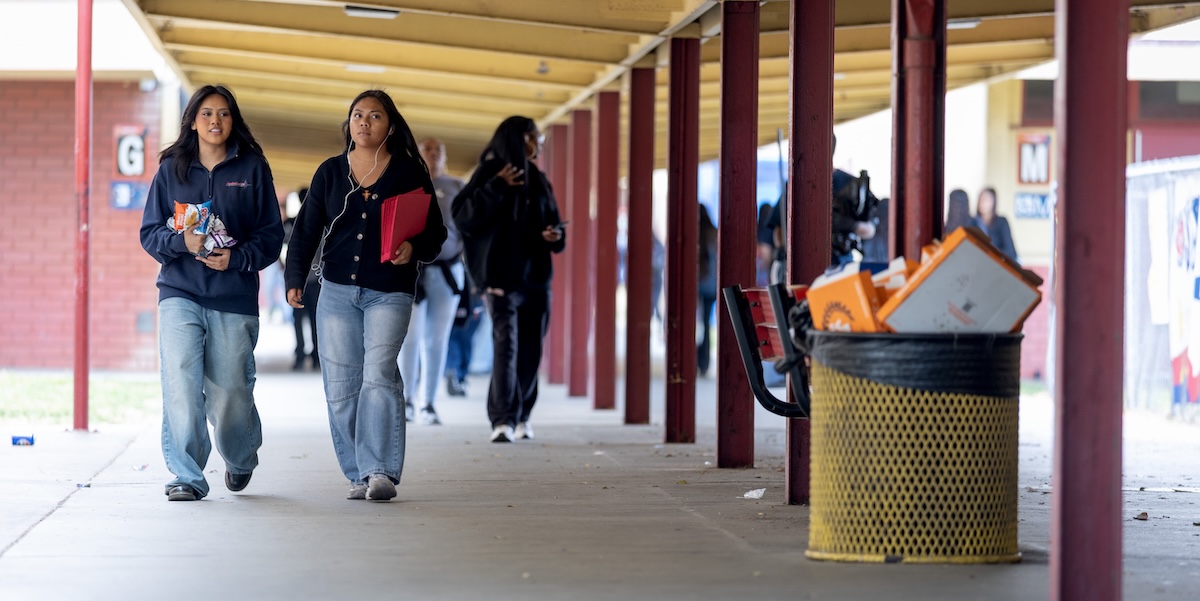
Students walk through a hallway of Dominguez High School on Wednesday, May 27, 2026 in Compton, CA. A bond measure up for a vote on Election Day would infuse millions into a rebuild of the school. (Eric Thayer / Los Angeles Times via Getty Images)