
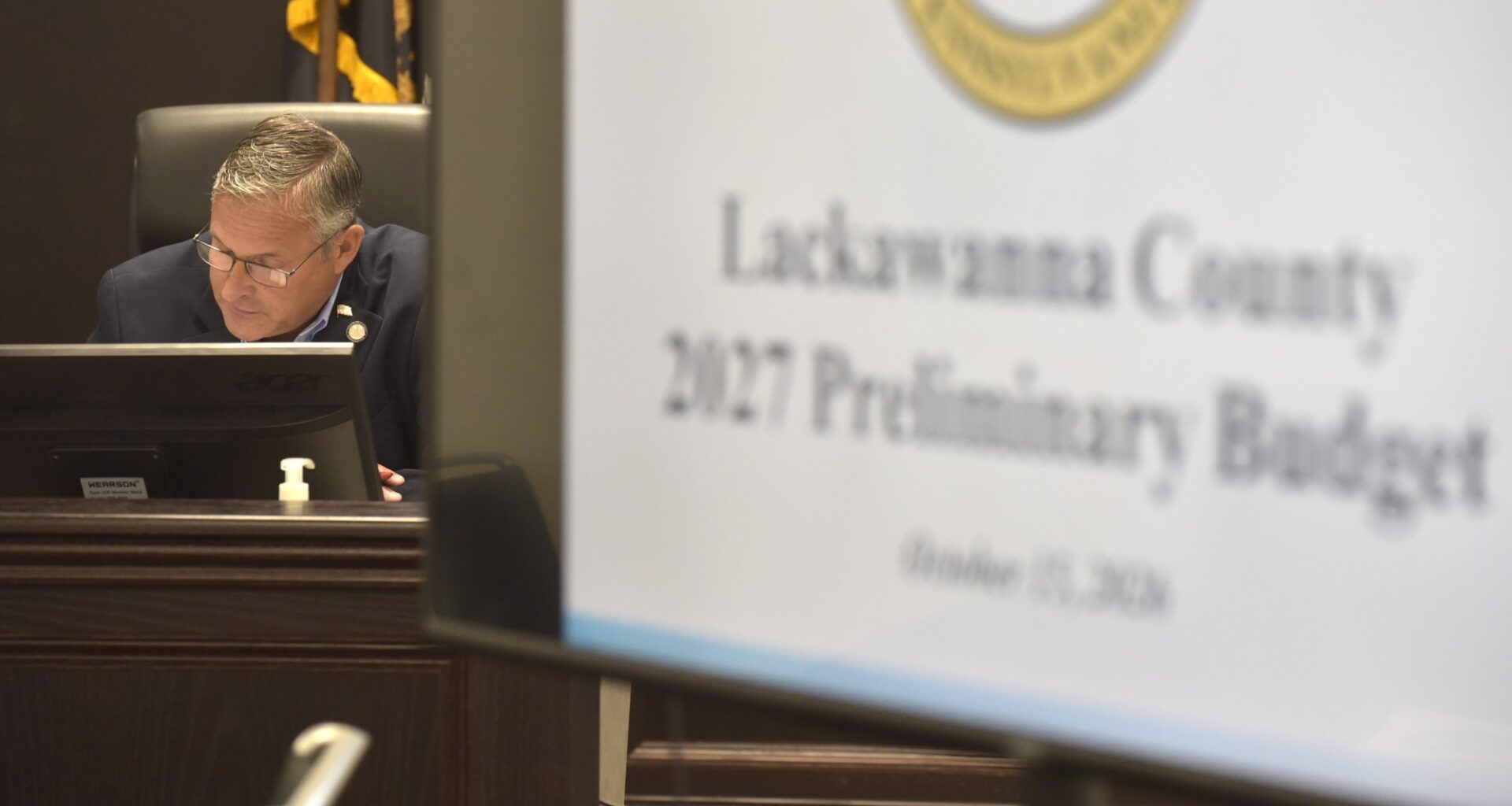
SCRANTON — Lackawanna County has a “revenue problem” and faces an almost $4 million preliminary 2027 budget deficit the county’s chief financial officer said will be hard to eliminate without raising property taxes, something two of the county’s three commissioners recently said they won’t do.
Speaking in sometimes stark terms, CFO David Bulzoni highlighted budgetary and broader financial challenges Thursday upon the release of the county’s $190 million preliminary spending plan for 2027. The draft budget remains a work in progress and already reflects considerable efforts by county officials to mitigate what was originally an almost $9 million projected shortfall, a reduction achieved through cuts and the factoring in of several nonrecurring revenue sources.
Bulzoni is confident continued work on the budget will further shrink the $4 million gap between projected revenues and expenditures, but said closing it completely without increasing property tax revenues will be a heavy lift. Drawing down the county’s accumulated fund balance, or surplus, to eliminate the deficit would also risk jeopardizing the county’s credit rating and do nothing to address structural deficit challenges likely to worsen in future years absent action to bolster revenues, he said.
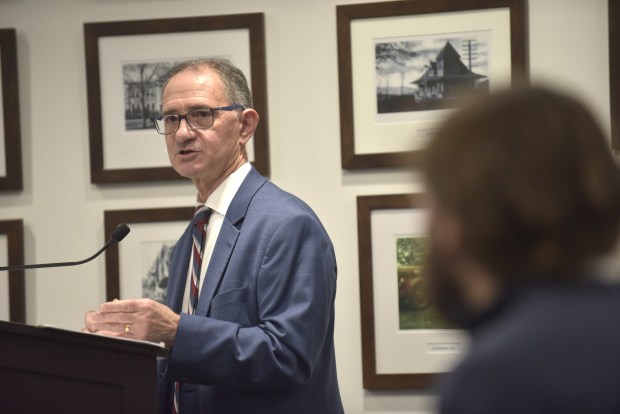 Lackawanna County Chief Financial Officer David Bulzoni talks about the 2027 preliminary budget Thursday, Oct. 15, 2026, at the Lackawanna County Government Center in Scranton. (CHAD SEBRING/STAFF PHOTO)
The ongoing 2027 budget process follows a nearly 33% tax hike in 2025 that helped ameliorate a pronounced fiscal crisis marked by a massive structural budget deficit, but that precipitous and arguably unavoidable increase was not a panacea for the county still grappling with annual expenditure growth driven by inflation, increasing healthcare and pension costs and other factors. Commissioners did not raise taxes in 2026, when the county’s first comprehensive property reassessment in nearly 60 years took effect, and aren’t currently proposing a tax increase next year.
Figures Bulzoni shared Thursday help illustrate how structural budget deficits happen and widen if unaddressed for multiple years. Budgeted expenses in the draft 2027 spending plan grew by more than $9.2 million compared to the county’s 2026 budget, an increase of 5.1%, while revenue from property taxes, the county’s largest recurring revenue source, is projected to increase by just $267,324, or 0.26%.
If officials can’t boost revenues through tax increases or other means to offset annual expenditure growth, the gap widens each year and the problem compounds, ultimately making massive tax increases like 2025’s nearly 33% hike all but inevitable. Counties required by law to administer or provide certain services are also often limited in where and to what extent they can make cuts to curtail expenses.
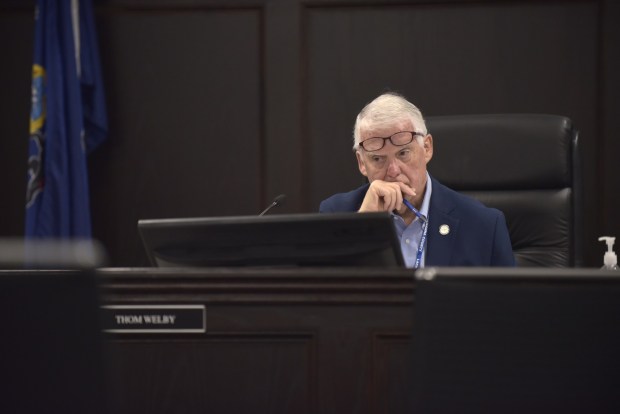 Lackawanna County Commissioner Thom Welby listens to preliminary budget details from county Chief Financial Officer David Bulzoni on Thursday, Oct. 15, 2026, at the Lackawanna County Government Center in Scranton. (CHAD SEBRING/STAFF PHOTO)
Understanding that reality, the firm behind the county’s multi-year financial management plan, PFM Group Consulting LLC, has recommended regular, incremental property tax increases to help keep pace with escalating expenses. Bulzoni echoed that recommendation Thursday.
“It doesn’t take the expertise of a strategic management planning program report to understand that adjusting revenues on a recurring basis is a necessity,” he said. “Otherwise what happens is what has happened, and not just while I was here but even prior. You have deficits of $8 million that compound to $15 million that compound to $37 million, and I don’t think we want to go back to that.”
Bulzoni’s and PFM’s recommendations notwithstanding, Commissioners Thom Welby and Chris Chermak told the newspaper this week they won’t increase the tax burden next year on property owners also grappling with inflation and cost pressures. Chermak also said Tuesday he’s “certain” commissioners won’t approve a 2028 tax hike in 2027, when the office of commissioner is on the ballot.
Commissioner Bill Gaughan also hopes to avoid a 2027 tax increase, but said Welby and Chermak have to show that’s possible without imperiling the financial progress the county made in recent years or exacerbating future fiscal challenges. He asked Bulzoni on Thursday how the county can realistically close the almost $4 million preliminary budget gap without raising taxes.
“My middle initial is M for Michael, not Merlin,” Bulzoni said. “Now we are looking at other adjustments, this has been a continuous process, and we will get that number down, I don’t have any doubt about that. But obviously, if we’re building into that process the assumption that there will be no real estate tax adjustment in 2027, then that number has to be brought to zero, and getting there is going to be a challenge.”

Lackawanna County Commissioner Bill Gaughan listens to preliminary budget details from county Chief Financial Officer David Bulzoni on Thursday, Oct. 15, 2026, at the Lackawanna County Government Center in Scranton. (CHAD SEBRING/STAFF PHOTO)

Lackawanna County Commissioner Bill Gaughan listens to preliminary budget details from county Chief Financial Officer David Bulzoni on Thursday, Oct. 15, 2026, at the Lackawanna County Government Center in Scranton. (CHAD SEBRING/STAFF PHOTO)

Lackawanna County Commissioner Bill Gaughan listens to preliminary budget details from county Chief Financial Officer David Bulzoni on Thursday, Oct. 15, 2026, at the Lackawanna County Government Center in Scranton. (CHAD SEBRING/STAFF PHOTO)
Show Caption
1 of 3
Lackawanna County Commissioner Bill Gaughan listens to preliminary budget details from county Chief Financial Officer David Bulzoni on Thursday, Oct. 15, 2026, at the Lackawanna County Government Center in Scranton. (CHAD SEBRING/STAFF PHOTO)
Gaughan also took umbrage with Chermak telling the newspaper this week that the county “should be in good shape for a long time” after the nearly 33% “whopper” of a tax increase in 2025. Pressed by Gaughan on whether that’s the case, Bulzoni said he respects Chermak’s opinion “in almost all cases, but not this one.”
“I just don’t agree with it,” Bulzoni said. “That increase took us to zero, basically, so there was no padding.”
For his part, Chermak emphasized the importance of continuing to work toward financial stability while “remaining mindful of the burden on our taxpayers” and doing everything possible to avoid adding to that burden. Economic development, he said, must be a “major part of that effort.”
“Attracting new businesses, supporting the expansion of existing businesses and encouraging private investment will help create jobs, strengthen our communities and grow our tax base,” he said. “Our goal should be to increase county revenues with economic growth and responsible financial management rather than continually relying on property tax increases.”
Welby called for more scrutiny of the preliminary budget to further curtail expenses, at one point referencing overtime line items of $2 million and $1.4 million tentatively budgeted for the county prison and sheriff’s office, respectively. He didn’t mention the prison or sheriff’s office by name during Thursday’s session, but called their preliminary overtime budgets “absolutely not acceptable.”
“And we’ll be working on that, along with other cuts that we can make, as opposed to a tax increase,” Welby said. “I believe and hope that we can achieve that for … this coming budget year.”
Work on the budget will continue ahead of final passage later this year, and the public will be able to provide input at several budget hearings the county will soon announce.
Whether Welby and Chermak can keep their commitment to holding taxes steady next year remains to be seen, but Bulzoni stressed Thursday the 2028 budget “will also arrive with a built-in deficit.”
“It’s likely going to be significant, because … when you use nonrecurring revenues there’s a compounding effect, especially when your real estate taxes are not increasing with any measurable amount but your expenses are increasing at 4,5,6%,” he said. “It has that compounding effect, so if we bypass an increase in 2027, that increase is going to revisit us in 2028.”
“Hell is going to visit us for breakfast gentlemen, in 2028, and I’m only forewarning you,” Bulzoni said.