
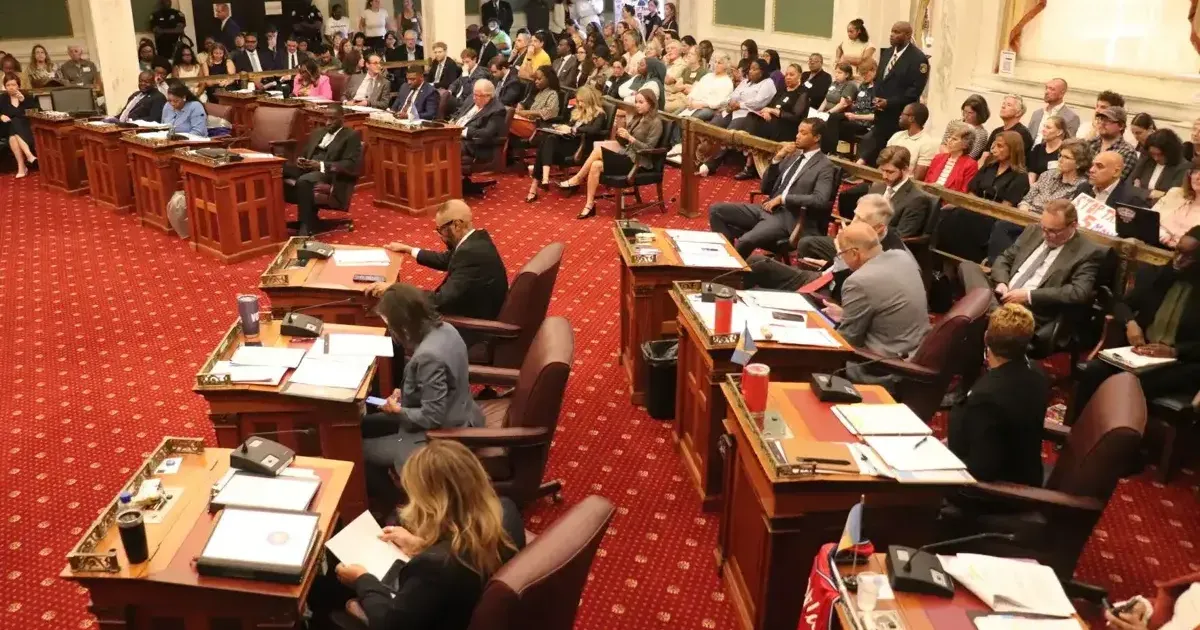
On Thursday, Philadelphia City Council voted to support a major overhaul of Pennsylvania’s healthcare system. The plan would guarantee medical coverage for every resident and could change how millions of people receive treatment, pay for prescriptions and access lifesaving care.
Council passed Resolution 260849, urging the Pennsylvania General Assembly to approve Senate Bill 1465, known as the Pennsylvania Universal Healthcare Act. The bill would establish a publicly funded, single-payer healthcare system for all Pennsylvanians, aiming to reduce reliance on private insurance and eliminate many of the costs, including premiums, deductibles and copays, that make treatment difficult to afford.
Dionne Harry, president of District 1199C, which represents more than 10,000 healthcare workers in Philadelphia, said she sees the effects of inadequate insurance coverage through untreated infections, worsening illnesses and patients arriving at emergency rooms seriously ill because they could not afford care earlier.
“As a nurse by trade, who spent over 15 years at the bedside, I saw firsthand impacts of having patients without health insurance,” Harry told Council.
She spoke about patients who waited until their conditions were critical before seeking help, including those with chronic illnesses that worsened without proper care. She said emergency rooms have become the primary place for many uninsured Philadelphians to seek medical help, straining hospital resources and increasing wait times for other patients.
“Those precious minutes and hours can be the difference between life and death for the patient waiting for a bed,” Harry said.
Harry warned that changes to federal healthcare funding could put coverage at risk for hundreds of thousands of Pennsylvanians. She cited estimates that more than 300,000 people might lose Medicaid coverage and that others could struggle to afford insurance through the federal marketplace.
The legislation supported by Council would create a Pennsylvania Office of Health Care and a healthcare board to administer a comprehensive healthcare system. Supporters envision the program being funded publicly rather than through private insurance, employer plans and out-of-pocket costs.
The proposal still requires approval from the General Assembly and the governor. Council’s resolution does not establish the system, raise taxes or change anyone’s current insurance.
Supporters argue that reducing the administrative costs associated with competing insurance companies could free up more money for patient care. However, lawmakers still need to determine the program’s true cost, how to pay for it and whether it would ultimately save money.
Doctor’s personal story
Dr. Spencer Chen, a resident physician in internal medicine and pediatrics and a union delegate, spoke about the frustration of treating patients when their insurance companies will not cover necessary medications.
“As their doctor, I spend countless hours fighting insurance companies, often to no avail,” Chen told Council. “And eventually I see these very patients in intensive care units, dying from preventable sepsis, cardiogenic shock, and respiratory failure.”
Chen shared the story of a premature baby born with a serious heart condition. The baby’s parents were nearly forced to sell their home to pay for the surgery needed to save their child’s life.
The infant was his younger brother.
His family lived in Taiwan, which established a national health insurance program in the 1990s. Chen said the system made the surgery possible without putting his family in financial trouble.
“There is a better way, and we can have that, too, in Pennsylvania,” Chen asserted.
Tax concerns draw opposition
Not everyone who testified supported the proposal.
William Small questioned whether working families and businesses could handle the additional taxes that would come with a publicly funded healthcare system.
Small pointed out that the plan includes payroll taxes of 2.5% for employees and 7.5% for employers. He argued that people in Philadelphia are already under significant financial stress.
“You’re doing this in a city where working people are already struggling under the burden of taxes,” Small told Council.
He called on elected officials to focus on lowering taxes, creating jobs and helping people build wealth through property ownership.
Christian Gay-Madison supported universal healthcare in principle but questioned whether Pennsylvania could pay for such a large program without hurting the economy or taking money away from other government needs.
“However, we must be careful in how we structure such a system to ensure that it is fiscally sustainable,” Gay-Madison said.
He questioned whether the expected revenue would be sufficient to cover medical care for Pennsylvania’s 13 million residents. He also raised concerns he heard about during a recent trip to the U.K., including treatment delays, overworked medical staff and problems with Britain’s National Health Service.
Some supporters said public funding would remove costly insurance barriers and help more people access treatment. Opponents, however, worry that taxpayers could end up paying more for a system that might face funding, staffing and patient-demand challenges.
Other states pursue universal care
Pennsylvania is among several states working on laws to replace or significantly reform the current health insurance system.
Oregon is developing a publicly funded universal healthcare plan. A nine-member board is preparing recommendations for comprehensive medical, dental, vision and mental health coverage with no premiums, deductibles or copays. The plan will be submitted Dec. 1, with possible legislative action in 2027 and a statewide vote in 2028. If approved, the plan would not take effect before 2032.
California has passed a law to begin working toward a single healthcare financing system. New York, Washington and Massachusetts have also examined universal coverage plans.
So far, no state has implemented a single-payer system for all residents.
Pennsylvania’s Senate Bill 1465 and House Bill 2763 remain in legislative committees and have not yet received a final vote. Lawmakers would need to decide how to fund the program, how hospitals and doctors would be paid and whether federal funds for Medicare and Medicaid could be used in a new state system.
Philadelphia’s resolution demonstrates the city’s support for the effort, but the final decision on universal healthcare will be made in Harrisburg.
Alexander Jenkins, another supporter who spoke Thursday, asked lawmakers to consider the real-life effects of allowing illness and financial hardship to determine who receives treatment.
Jenkins told the story of a young boy from Philadelphia who lost his father and struggled to stay in school. He wondered how many families could avoid such losses if everyone had access to comprehensive medical care.
“I can think of nothing more important in life sustaining than access to comprehensive and universal healthcare,” Jenkins told Council.
Council honors slain officer
The Council meeting began with a moment of silence for Philadelphia Police Officer Shane Seiber, a 10-year veteran of the 19th Police District who was killed in the line of duty.
Seiber was remembered as a dedicated public servant, husband and father of two young children, ages 7 and 3. Council members also prayed for his partner, who was seriously injured in the attack and remains in recovery.
“We are forever grateful for Officer Seiber’s service and sacrifice,” Council President Kenyatta Johnson said as the tribute began. “May his memory live on and may his family find strength and comfort in our city’s support.”
Following the Council meeting, Johnson called the week’s killings, including Seiber’s death, and other recent gun violence devastating for the city. He urged law enforcement officials to end their public disagreements and focus on supporting grieving families and preventing further bloodshed.
“This is a very, very dark week here in the city of Philadelphia,” Johnson remarked. “We should all be at the table talking about how we’re going to make the city safer.”
Johnson was responding to questions about tensions between District Attorney Larry Krasner and the Philadelphia Police Department following the officer’s killing. Krasner had criticized the handling of an earlier murder investigation involving the suspected gunman, prompting police officials to object to assigning blame so soon after the tragedy.
“Assigning blame for me right now is irrelevant,” Johnson asserted. “We haven’t even had a funeral for this officer.”
Johnson said Philadelphia had experienced historically low levels of gun violence and shootings, but the recent killings had shaken the city. He urged officials to put their disagreements aside while the officer’s family, fellow police officers and the city mourn.
“We should be talking about supporting the family. We should be talking about supporting the officers who lost their colleague, but also us as a city as a whole, we have to heal because I know it impacted all of us,” Johnson insisted.
Asked whether he had a specific message for Krasner, Johnson declined to single out the district attorney.
“I have a message to everyone,” he stated. “Let’s all just come together and focus on making sure we have a safer city.”
Stay informed and connected — subscribe to The Philadelphia Tribune NOW! Click Here