
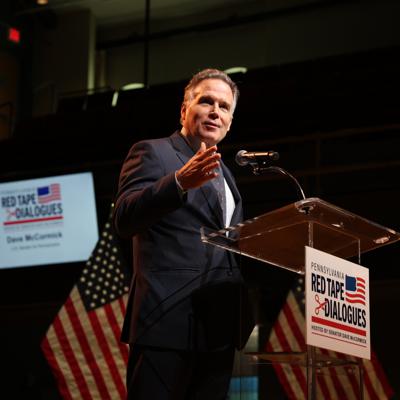
Pennsylvania, according to U.S. Sen. Dave McCormick, “is in the middle of a really unprecedented economic transformation.” On Thursday at Temple University, he convened a daylong gathering to accelerate that transformation: The Pennsylvania Red Tape Dialogues, which brought together politicians and industry stakeholders to brainstorm ways to improve Pennsylvania’s business climate.
Building on Gov. Josh Shapiro’s efforts to streamline permitting and licensing, McCormick said his goal was to find ways to limit the onerous regulations that have long stymied the commonwealth’s entrepreneurship. “Our goal is to turn the frustration that many of you feel into a practical agenda,” McCormick told an audience prior to the industry workshops.
“We have about 1.2 million small businesses in Pennsylvania, and they account for about half of our economy,” he said. “The small businesses are the economic engine for our growth – and they are disproportionately affected by the regulatory burden, by the cost of compliance … We need to deal with those frustrations in a commonsense way.”
McCormick’s office touted the event as a first-of-its-kind, nonpartisan gathering of executives, business owners, policy experts and federal and state regulators from across the commonwealth. Those invited submitted 300 initial ideas to reduce the regulations the state imposes on businesses; after hashing them out in person, 10 industry groups presented their recommendations.
“Our commonwealth has more than 166,000 regulatory restrictions. That’s 22% more, on average, than other states – and all of this comes at a cost,” McCormick told the assembly. “The greatest costs are not just in price; they’re unseen. They’re the cost of investments that are never made, the businesses that are never started, the jobs that are never created.”
Ben Kirsch, the commonwealth’s chief transformation and opportunity officer, updated the crowd on the Shapiro administration’s efforts to facilitate entrepreneurship. After his office introduced the Permit Reform System, Kirsch said, the average permit processing time dropped from six to two days.
“We’ve helped close over $43 billion of new private investment in our administration the last three years, and created over 29,000 new jobs in the commonwealth. That’s more than the last 15 years combined. So Pennsylvania is on the rise,” he said.
McCormick was also joined by former two-term Arizona Gov. Doug Ducey, the former CEO of Cold Stone Creamery. In office from 2015 to 2023, he imposed a moratorium on new state regulations and eliminated or reformed more than 3,100 rules during his tenure.
Ducey told the gathering that his experience growing Cold Stone from a franchise to a 50-state, 1,440-store operation offered a unique perspective on the role of states’ business climates.
“In a state like Arizona, we could open up our first several stores for less than $150,000… Why does it cost $450,000 to open the same store in the state of California?” he recalled wondering. As he championed reform, Ducey also cautioned that some regulation is necessary to protect public health and safety.
The Red Tape Dialogues, McCormick said, aim to target those regulations that generate paperwork without measurably affecting the public welfare. “The idea is to really cross-pollinate,” he said of the brainstorming sessions. “And within 60 days, I will publish a report outlining your proposals and the plan for how we’re going to pursue them to the benefit of all Pennsylvanians.”
Final recommendations
The day’s discussions culminated in representatives from each major industry presenting the policy recommendations agreed upon in their respective working groups.
“We need 100% oversight and accountability, and we embrace that,” said final panel emcee John Fry, the president of Temple University, of the discussions. “But we also need to see processes that are streamlined and expedited from a regulatory standpoint … That’s why today’s event is so crucial for Pennsylvania’s future business growth.”
The industry recommendations – aimed at reducing regulatory delays and improving business growth – ranged from immediate moves, such as fixing a tool or regulatory process, to wide-ranging changes, including agency rule changes and legislative reforms.
The industries represented included agriculture, farming and dairy; defense and advanced manufacturing; life sciences and biotechnology; food processing and distribution; housing and construction; higher education; retail and hospitality; transportation and logistics; independent healthcare and elder care; and early childhood education and childcare.
A common thread across several industry recommendations was the need to address worker shortages, particularly in farming and food.
Walt Moore, a fourth-generation dairy farmer from Chester County, said visa program reform – and a dairy investment tax rebate – would go a long way toward increasing dairy and milk production.
Moore mentioned yogurt giant Chobani’s announcement that it will invest $1.2 billion in the commonwealth, calling it a “game changer for us.”
“Chobani expects to need about 3 billion more pounds of milk annually, or roughly 30% of the Pennsylvania production in five years’ time,” Moore added. “While the Chobani plant is a win for Pennsylvania, for it to be a true win, we need to fill the plant with Pennsylvania milk.”
On a similar note, Astin Melhorn, president of the Paragon Poultry Management Group, said his operation was able to successfully bring in about 50 employees through the EB-3 visa program – but that they need 160 workers.
“The problem we chose to address was the shortage of workforce in agriculture and in agriculture-related businesses. Americans simply will not do these jobs,” Melhorn said. He recommended shortening the EB-3 visa approval window to 90 days to expedite the process for the agricultural industry. “The impact that would have – agriculture and agriculture-related businesses would have access to the authorized workforce needs, and also protect the American public from an inevitable food price increase and food shortage.”
Ducey, on hand for the policy discussion, said immigration reform does “overlap” with much of the discussion.
“We should have an immigration process that works … I can speak as an Arizonan: With the Southern border being secure, now is the time to address this as well.”
Other industry representatives suggested regulatory reforms ranging from modernizing the Pennsylvania Municipalities Planning Code to address the housing shortage to keeping insurance premiums down for those in trucking, logistics and even childcare.
McCormick added that he believes a politician’s role is not to create jobs, but to create an environment for economic growth, a value shared by each industry in attendance.
“We’re all on the same side of the table here. We all want prosperity for Pennsylvania, we all want good, safe regulations, we all want growth,” McCormick said in his closing remarks. “There’s a lot we agree on, and this agenda is one area where I think we can find a lot of agreement.”
McCormick’s office is expected to release a report on the attendees’ policy recommendations within the next 60 days.