
Editor’s Note: This is part three of a four-part series examining the top issues identified by our readers ahead of the Nov. 3 general election.
As voters across Northeastern Pennsylvania prepare to decide key federal contests on Nov. 3 — including high-stakes congressional races in the 8th and 9th Districts — the battle over how votes are cast and counted has emerged as a defining issue.
It’s a polarizing and highly partisan issue for voters in the toss-up 8th Congressional District race between Republican Rep. Rob Bresnahan Jr. and Democratic Scranton Mayor Paige Cognetti, as well as the 9th District contest between Republican Rep. Dan Meuser and Democrat Rachel Wallace.
The issue is so divisive that Northeastern Pennsylvania voters have their own explanations on what election integrity means and why it’s a crucial issue in the midterm elections.
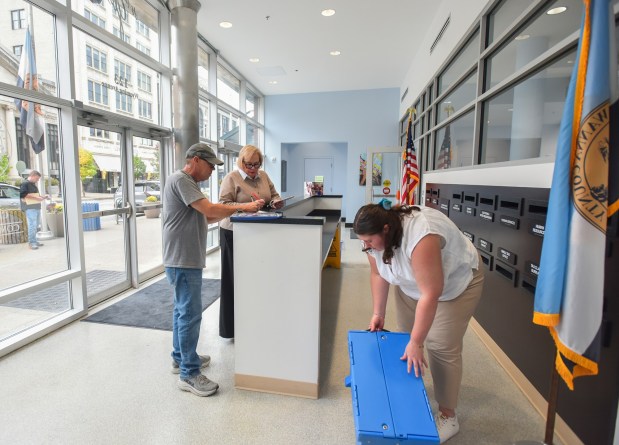 Director of Elections Beth Hopkins, with voter registration employee Darryl Bickauaskas and elections coordinator Madison Aulisio in the lobby of the Lackawanna County Government Center Wednesday, October 14, 2026. (SEAN MCKEAG / STAFF PHOTOGRAPHER)
“Why it’s important to me is those people that are invested, that have ownership in the country, they’re the only ones that should be able to vote,” said Joe Durkin, 79, a Republican from Pittston. “I mean, I do not see why anybody in this country would want to let somebody, who has no vested interest in the country, be able to get in the electoral process.”
Durkin’s concern is that noncitizen immigrants are voting in U.S. elections. It’s a claim President Donald Trump has been making for years.
Since Joe Biden unseated Trump in the 2020 election, Trump has continued to claim without presenting evidence that Biden’s victory was due to widespread voter fraud. Trump also has called mail-in ballots “inherently corrupt” and referred to the practice as “mail-in cheating.”
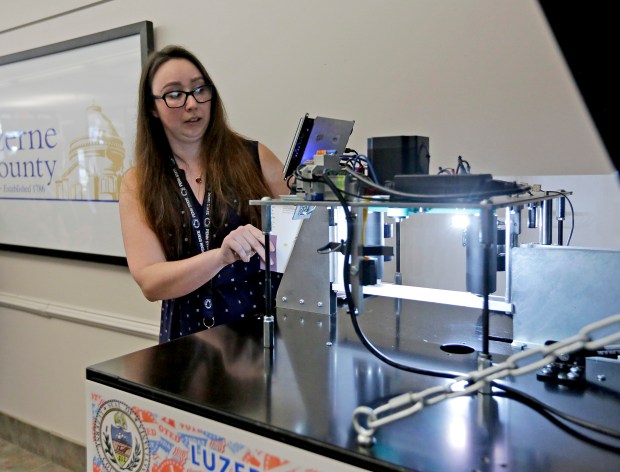 Luzerne County Election Director Emily Cook demonstrates the internal scanner and camera system of the new election ballot drop box at Penn Place in Wilkes-Barre on Thursday, April 3, 2025. BILL TARUTIS / CONTRIBUTING PHOTOGRAPHER
“He’s the one who questions the integrity of the vote. Yet he is fine when he wins or anyone in his party wins,” said Gerald Ephault, 79, a Democrat from Wilkes-Barre Twp. “So it makes no sense to me. He questions the vote, and he’s the one who’s creating this dynamic. Integrity is a key term because if you don’t have trustworthiness, that’s integrity. I trust the machines. I trust the ballots. I trust that, and the people that are defying the truth, they’re actually contrary to the truth. That’s the problem. So I have no problem with how it’s going to go in Pennsylvania, how it’s going to go here in Luzerne County.”
Overall, U.S. confidence in election honesty is 49%, while 51% of Americans are not confident, according to a Gallup poll released Oct. 7. According to the poll, 63% of Democrats expressed confidence in the honesty of U.S. elections, compared to 37% of Republicans and 35% of independents.
Mark Sopp, 70, a Republican from Kingston, explained why he views election integrity as a top issue.
“Primarily because of mail balloting and the fact that you cannot conclusively prove that the person that filled out that ballot is the person it was sent to,” Sopp said. “When we used to have regular polling, you would you exercise your right to vote, and you had to go out and vote. And if you weren’t able to, you got an absentee ballot because you were either sick or you’re going to be out of town. To me, it kept those that were engaged out voting, and they had to prove who they are. When you go in there, you’re verified. The mail balloting — you don’t know. You know the ballot’s sitting there on the counter, and your grandmother says, ‘Oh, I’m not going to fill this out,” and the grandson fills it out. There’s no way of knowing.”
Act 77, bipartisan compromise legislation signed into law by former Gov. Tom Wolf in 2019, allowed Pennsylvanians to vote by mail without an excuse. The law was employed for the first time during the contentious 2020 presidential election.
The law passed with broad bipartisan support, but later faced intense legal challenges from Republican lawmakers. The Pennsylvania Supreme Court upheld the constitutionality of the law’s mail-in voting expansion in a 5–2 ruling in 2022.
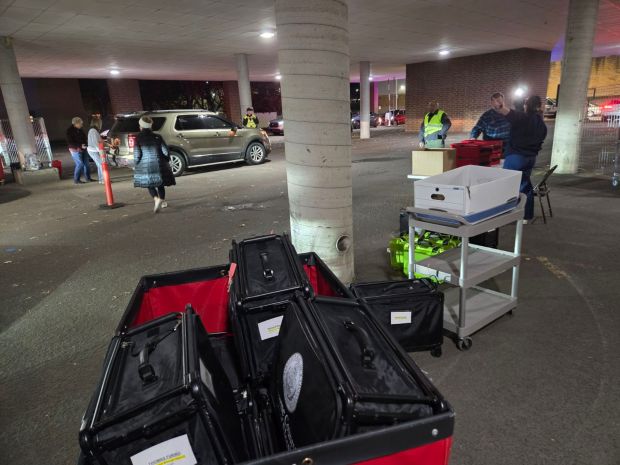 Poll workers return election results to Luzerne County’s Penn Place Building in Wilkes-Barre after the polls closed on Tuesday, Nov. 4, 2025. (Michael P. Buffer)
“I think they should ID us, but they don’t have to because we have a good enough system,” Sopp said of the Election Day voting process at Pennsylvania polls. “They put the signatures up and they look just make sure that that’s you. Mail-in though. Oh, you just don’t know. You don’t know. And some states are sending ballots out just unsolicited, not even requesting ballots. And there’s a couple of states that just mail the ballots out. I think it changes the way we elect people from people that care and consider the candidates and make a decision, go to the poll and exercise their responsibility.”
Eight states allow all elections to be conducted entirely by mail — California, Colorado, Hawaii, Nevada, Oregon, Utah, Vermont and Washington state.
“I think it’s the biggest fraud going, especially in states where they send the ballots, and then Trump was trying to get the post office not to deliver illegal ballots,” said Michael Taluto, 63, a Scranton Republican who works as a real estate agent. “If you send a ballot to someone whose address is moved, you don’t deliver it. And California is the biggest fraud going. You know they stole the Los Angeles primary away from the Republican, and they’re going to steal the governorship from Steve Hilton.”
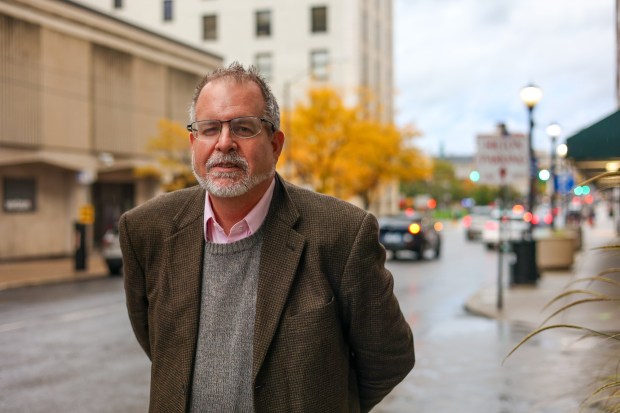 Michael Taluto of Scranton on Friday, Oct. 16, 2026. JASON ARDAN / STAFF PHOTOGRAPHER
Independent election experts and researchers maintain that widespread fraud in mail-in voting is extremely rare.
“It’s only until the last several years that under the presidency of Trump, that I was concerned with the voting, the integrity of the vote. I believe people are voting honestly,” said Ephault, a Luzerne County Democratic committeeman.
The Brookings Institute found an “average total mail voting fraud percentage across the 2016, 2018, 2020, and 2022 general elections of only 0.000043%, or about four cases of mail voting fraud out of every 10 million mail votes.”
“So that fractional number makes no difference in elections,” Ephault said. “But what’s happening now is my concern. My concern is that the integrity of the vote is being questioned, and there’s a lot of people in the United States that are questioning whether the vote is accurate or whether their vote will be counted.”
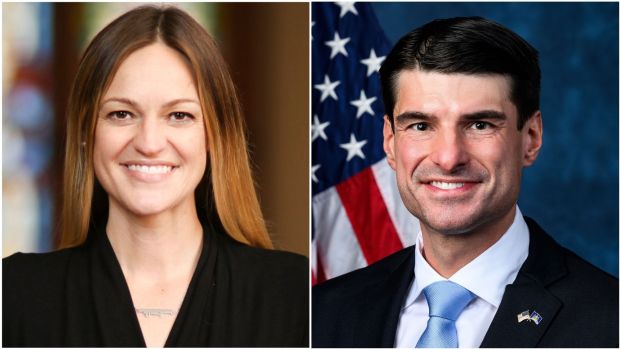 Scranton Mayor Paige Gebhardt Cognetti and U.S. Rob Bresnahan, R-8, Dallas Twp. (TIMES-TRIBUNE FILE)
Pre-canvassing
When the polls closed on election night in 2020, Trump appeared to be winning Pennsylvania. But over the next several days, officials counted mail-in ballots, and Biden won the state.
The delay was the result of an election law that forbids the opening of mail ballots until 7 a.m. on the day of the election and helped lead to a false narrative that the mail votes in 2020 were fraudulent.
Pennsylvania is one of only six states that don’t allow pre-canvassing, which involves opening and preparing mail-in or absentee ballots for counting without tabulating votes. Proponents of pre-canvassing claim it increases confidence in election results by delivering faster election night returns.
In an April 2026 report with recommendations to the state to help county election bureaus administer elections, a bipartisan Luzerne County task force proposed extending the pre-canvassing period. Additional time would provide “faster reporting of results on election night” and reduce “strain on election officials, freeing resources for polling place operations,” the task force concluded.
The Democratic majority in the state House has advanced bills that would give election workers up to seven days before Election Day to open envelopes. But Senate Republicans have insisted that any expansion of pre-canvassing must be paired with stricter voter ID requirements, a condition House Democrats have resisted.
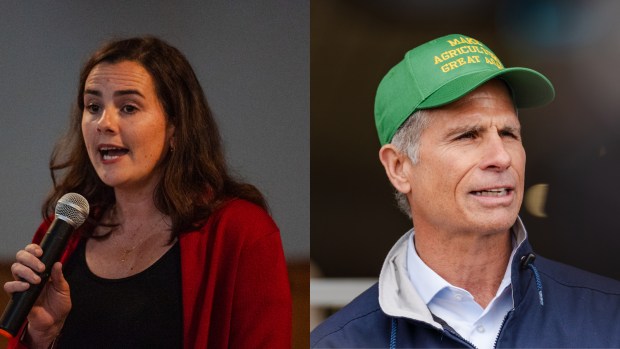 Democrat Rachel Wallace is challenging incumbent Republican Dan Meuser in the race for Pennsylvania’s 9th Congressional District. (FILE)
Federal legislation
Since returning to the White House in 2025, Trump has pushed for federal legislation to mandate national standards for mail voting and voter ID.
In February, the Republican majority in the U.S. House approved the Safeguarding American Voter Eligibility (SAVE) America Act, but the legislation has not advanced in the Senate. Bresnahan, R-8, Dallas Twp., and Meuser, R-9, Jackson Twp., voted for the act.
In July, the House approved a bill that would restrict congressional stock trading, and it included provisions from the SAVE America Act. Democrats called that legislation a voter suppression bill in disguise, and it also has not advanced in the Senate.
The SAVE America Act would prohibit states from automatically mailing ballots to all registered voters and restrict mail voting to voters with specific, verified excuses, such as illness or physical disability, military duty or travel. It also would require a mail-ballot applicant to present documentary proof of U.S. citizenship in person to an election official.
The bill would require voters to provide specific documentary proof of U.S. citizenship — such as a U.S. passport, birth certificate, or naturalization papers — in person when registering or re-registering to vote. Research by the Brennan Center for Justice estimates more than 21 million citizens do not have immediate or easy access to these documents.
Opponents claim the legislation would severely restrict online voter registration, mail-in registration and third-party voter registration drives. Critics also object that the proposed federal measure would place unfair burdens on rural residents, students, low-income citizens, young voters and married women whose legal names do not match their birth certificates.
In June, Trump touted the release of a Department of Homeland Security investigation, based on state voter rolls and public records, that claimed approximately 278,000 noncitizens registered to vote in federal elections.
The report said more than a quarter of a million noncitizens were illegally registered to vote in California, Pennsylvania, New Jersey and Nevada, based on public records, which are often erroneous or incomplete. Another 28,000 noncitizens were found on voter rolls in 25 states using the new Systematic Alien Verification for Entitlements system, an online tool managed by U.S. Citizenship and Immigration Services.
The DHS report did not assert that any of those people actually voted, which would be a crime, and the new SAVE database is purportedly plagued with errors.
In August 2025, Pennsylvania Gov. Josh Shapiro’s administration refused to turn over unredacted voter rolls to the Trump administration. Secretary of State Al Schmidt provided the standard, redacted public voter export file.
The statewide electronic voter registration list includes confidential personal information like full Social Security numbers and driver’s license numbers. The Trump administration filed a federal lawsuit to compel Pennsylvania to turn over the unredacted data from the November 2022 election through the 2024 presidential election.
“I don’t believe that we should be putting ICE officers in the voting booths. I don’t believe that we should do any kind of heavy-handed. I just think that what we should be doing is continually getting people to turn in the voter rolls,” Durkin said. “Probably my biggest thing is they just don’t provide the information, and people know that there’s a lot of hanky-panky going on.”
In June, a federal judge dismissed the Trump administration’s lawsuit, ruling that Pennsylvania was not required to share the sensitive, private information. Shapiro said the state would continue to protect “Pennsylvanians’ right to privacy — and our fundamental right to vote.”
Shapiro is seeking a second term in the Nov. 3 election. The Democrat is running against Republican Stacy Garrity, the state treasurer.
Read our previous stories in the series
Election 2026: The bipartisan politics of data center opposition
Election 2026: Local senior citizens say affordability, cost of living is hurting them