
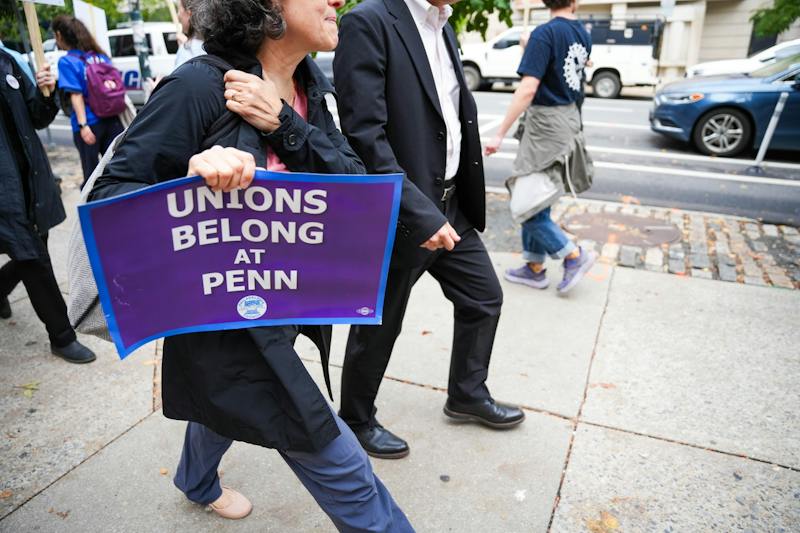
Penn’s graduate student union asked a federal court on Monday to dismiss a University filing that seeks a ruling on whether certain doctoral students are eligible for union representation.
The motion is the latest in a months-long dispute over whether first- and second-year students in Penn’s Biomedical Graduate Studies program should be considered employees under federal labor law. Graduate Employees Together — University of Pennsylvania argued on Oct. 19 that a federal court lacks the jurisdiction to answer that question.
In August, Penn filed for a declaratory judgment asking the court to decide whether those students are employees represented by the bargaining unit and whether GET-UP can pursue arbitration over the issue.
A request for comment was left with a University spokesperson.
“We filed a motion to dismiss because we believe the lawsuit filed by Penn is an attempt to circumvent our agreed-upon grievance and arbitration process,” a GET-UP spokesperson wrote in a statement.
Get the DP delivered straight to your inbox.
The union’s members were seeking to enforce their collective bargaining agreement with the University by utilizing an “agreed-upon process for resolving any disagreements,” the spokesperson added.
The agreement — ratified in February as GET-UP’s first contract — states that educational fellowship recipients who do not provide teaching or research services or who are in lab rotations and first- and second-year students in the BGS program are excluded from the union’s representation.
According to the court filing, the union filed a grievance in April that the exclusion of educational fellowship recipients violates its contract. In July, after initial negotiations fell through, a GET-UP representative sent an arbitration request to the American Arbitration Association — prompting Penn to take legal action.
A University spokesperson wrote at the time that Penn “maintains its firm position” that first- and second-year BGS students are “engaged in academic activities as they complete the foundational academic milestones of their doctoral program.”
“These are not bargaining unit activities,” the spokesperson stated. “This distinction is important because it preserves students’ right to focus on their academic progress during this critical period, as well as the University’s right to make decisions in support of that academic progress.”
Citing a “well-established federal labor policy favoring arbitration,” GET-UP argued on Monday that the court lacks “subject matter jurisdiction over this controversy” because both Penn and the union had agreed to arbitrate all disputes under the contract.
The dispute was “clearly” and “unambiguously” made over the interpretation of the agreement. As a result, GET-UP argued, it must be resolved through arbitration, not litigation.
In its August filing, Penn argued that GET-UP’s demand for arbitration was “predicated on the presumption” that first- and second-year BGS students were “employees” under the National Labor Relations Act and therefore belong in the contracted bargaining unit — an interpretation the University called inconsistent with federal labor law.
Last month, a federal appeals court found that a similar dispute — between Harvard’s graduate student union and the university, fell within the NLRB’s jurisdiction and could be decided through arbitration.
“The facts in Harvard College closely parallel the facts in this case,” GET-UP’s wrote in its motion to dismiss.
The status of educational fellowship recipients has long been a point of contention between GET-UP and the University.
Both parties attended a November 2023 NLRB hearing in hopes of settling the matter, which delayed GET-UP’s unionization election. The union argued that many educational fellowship recipients arrived with prior research experience and meaningfully contributed to research, making them eligible for the bargaining unit. Penn contended that graduate students in lab rotations are engaged solely in training.
In March 2024, the NLRB ruled that educational fellowship recipients should be excluded from voting in the unionization election. GET-UP won an appeal the following month, which allowed the recipients to vote but left their status in the union’s bargaining unit up for future consideration.
After the tentative agreement was reached in February, a University spokesperson wrote that the bargaining unit’s scope “was one of the many issues the University and GETUP-UAW resolved through negotiations.” At the time, GET-UP members said the issue remained disputed and that the union would continue advocating for the inclusion of “all workers.”
GET-UP’s contract with Penn runs through June 1, 2028. The two parties must begin renewal negotiations no later than 60 days before expiration.
Isha Chitirala is a News Editor at The Daily Pennsylvanian and can be reached at chitirala@thedp.com. At Penn, she studies economics and political science. Follow her on X @IshaChitirala.