
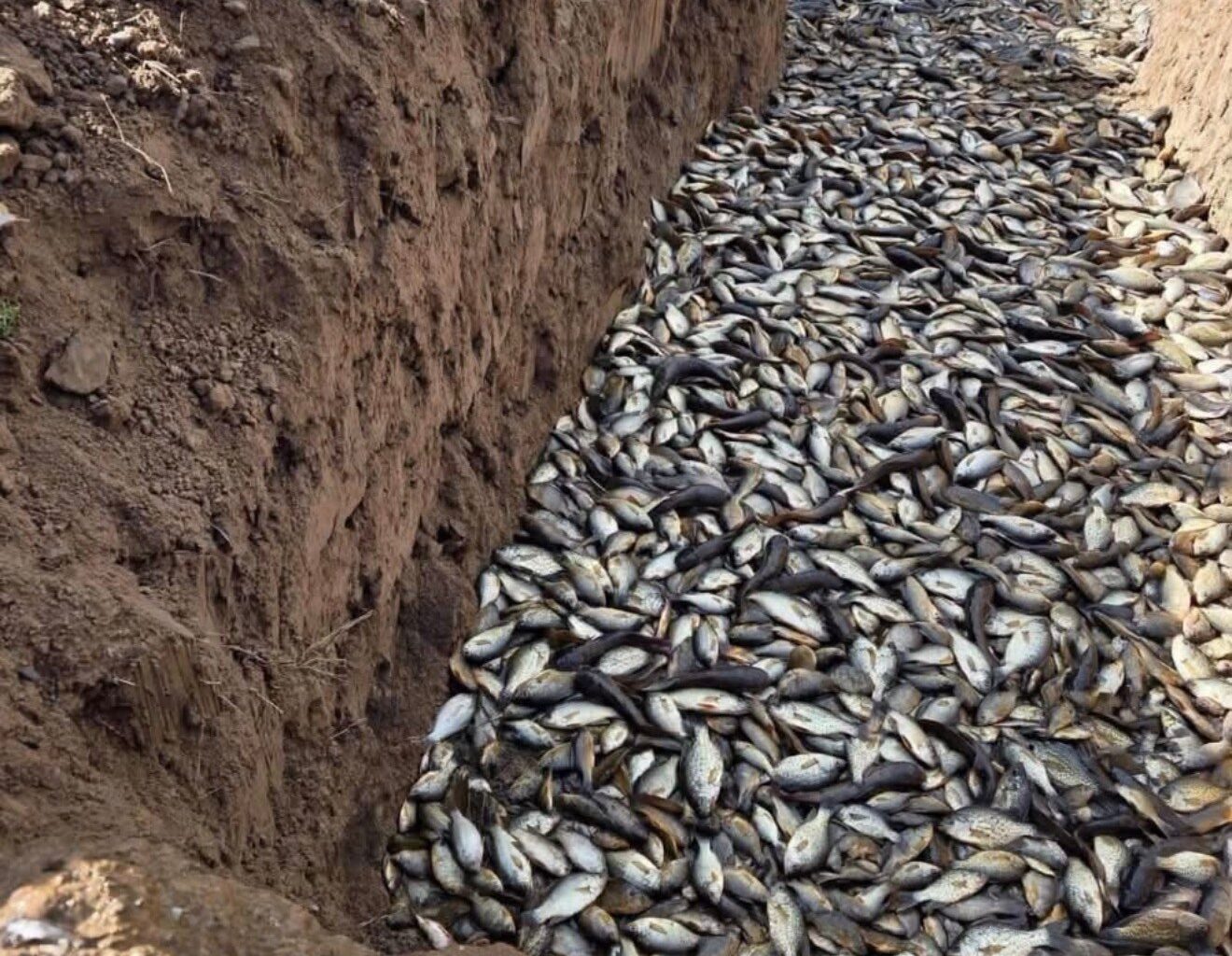
A fish salvage operation that concluded with a significant number of fish being buried in a pit at a Lackawanna County lake has generated a public outcry against the state agency responsible.
Fords Lake in Dalton is state-owned impoundment managed by the Pennsylvania Fish and Boat Commission. The 75-acre lake had been scheduled for a $3.1 million dam rehabilitation project for next spring. As part of the work, the commission began drawing down the water level in the lake earlier this month. Through the year the PFBC lifted all fishing regulations on the lake, allowing anglers to catch and keep anything regardless of size and species. The move was made to reduce the fishery prior to draining the lake. For the fish that remained, the commission planned to capture as many as possible and release them in the Susquehanna.

A fish salvage operation that concluded with a significant number of fish being buried in a pit at a Lackawanna County lake has generated a public outcry against the state Fish and Boat Commission.

Fords Lake in Dalton is state-owned impoundment managed by the Pennsylvania Fish and Boat Commission.
Show Caption
1 of 2
A fish salvage operation that concluded with a significant number of fish being buried in a pit at a Lackawanna County lake has generated a public outcry against the state Fish and Boat Commission.
On Oct. 14 and 15, the agency hauled 10 truckloads of fish — an estimated 30,000 pounds in all — according to communications director Mike Parker.
However, Parker acknowledged that fish salvage operations never collect 100% of the fish, and those that remain are typically ones that wouldn’t be able to survive being transported. And that’s what several anglers and others discovered in a pit last week dug near the lake. Estimates claim hundreds or more than 1,000 fish — many still alive — were deposited into the pit where they were to be buried.
Parker confirmed the finding, but said it’s an unfortunate, yet common, method during projects where lakes need to be drained for dam repairs.
“The last resort is to place the remaining fish that aren’t salvageable into a large hole and compost them,” Parker said. “That’s done after all other options are exhausted, and unfortunately some fish perish.”
Known as a “dead hole,” the practice is standard with many large scale fish operations, such as the one at Fords Lake. Parker said more fish were relocated than left behind at Fords Lake, and considering the large fishery the salvage operation was considered a success.
However, anglers and others who spotted the hole with fish at the bottom posted images to social media, illiciting a critical response.
Hanover Twp. resident George Bowers, who is a member of several bass fishing organizations in the area, has fished Fords Lake in the past. He said the images of the fish in an open part was a “total shame” and questioned if more could’ve been done.
“Sport fishermen practice catch-and-release and do everything we can to keep fish alive during a tournament, and then you see this where thousands of fish are left in a hole flopping around in the mud is a shame,” Bowers said.
Among the species present in the pit were largemouth bass, crappie and other panfish.
Bowers said the incident at Fords Lake sends a mixed signal as anglers strive to obey Fish and Boat Commission laws on keeping fish, and then the agency buries fish in a pit.
“I understand the need to drain the lake and replace the dam, but those fish could’ve been transported somewhere else,” he said.
Some comments on social media suggested enlisting local fishing clubs to capture the fish and release them elsewhere. Parker said that isn’t a feasible option because the muddy lakebed presents a safety issue. He added that stocking fish in other bodies of water can introduce pathogens and invasive species which can harm the existing fishery and habitat.
The Susquehanna River was deemed an acceptable repository for the 10 truckloads of fish collected from Fords Lake because the size of the river and the presence of species already found there presented little risk.
In addition to criticism from the public, the incident also generated a sharp response from several state legislators.
 Pa. Fish and Boat Commission logo (SUBMITTED)
State Rep. Jim Haddock and Sen. Marty Flynn, both serving parts of Lackawanna and Luzerne counties, issued a joint statement saying they were “sickened and appalled” by the number of fish lost at Fords Lake. They also demanded answers from the PFBC as to how many fish were lost and the decisions leading up to the outcome. The two legislators also stated they intend to bring their concerns to the PFBC Board of Commissioners.
State Rep. Dave Maloney, R-Berks County, who is the minority chair of the House Game and Fisheries Committee, called the incident “one of the most outrageous and hideous acts of cruelty and waste I have come across.”
If a member of the public did something similar, he said, they would be met with fines and potential jail time.
Parker said the agency is aware of the negativity generated by the incident at Fords Lake. He said the agency has conducted dozens of dam rehabilitation projects over the last decade, and the loss of fish is a part of the process.
“We agree we can do a better job when conducting these types of operations in the future. Unfortunately not every fish is going to make it out of the lake, and that’s part of the price we have to pay for these projects,” Parker said.
As for the future, work on the dam will being next spring and will take one and a half years to complete. While the lakebed is exposed, the Fish and Boat Commission will install fish habitat structures to improve the fishery. The lake will be refilled, Parker said, and the commission will restock it with a variety of forage and game fish similar to what was present before. It will take roughly 5 years to re-establish the fishery, he said, and anglers will be limited to catch-and-release fishing during that period.
“You will have a period where you lose the lake, but after a number of years it will be back much better than before,” Parker said.
TOM VENESKY is a freelance outdoors writer. Contact him at veneskyoutdoors.com.