
NORTH ABINGTON TWP. — A drained lake bed at Lackawanna State Park uncovered the danger of getting stuck in the mud.
Firefighters dispatched to the lake bed rescued stranded visitors twice since the dam maintenance project began in September, according to Park Manager Lee Dillon.
In the first incident on Oct. 4, a teenager was stuck in thigh-high mud for nearly an hour before emergency responders freed her. On Sunday, local fire departments were dispatched again to rescue two more people.
In both cases, park-goers were rescued without injury, Dillon said.

Footprints are visible in the mud remaining from the drained Lackawanna Lake at Lackawanna State Park in North Abington Twp. Tuesday, October 20, 2026. (SEAN MCKEAG / STAFF PHOTOGRAPHER)

A boy walks on the dried up Lackawanna Lake at Lackawanna State Park Tuesday, October 20, 2026. (SEAN MCKEAG / STAFF PHOTOGRAPHER)

People gather on the former Route 407 that has been submerged under Lackawanna Lake at Lackawanna State Park in North Abington Twp. Tuesday, October 20, 2026. (SEAN MCKEAG / STAFF PHOTOGRAPHER)

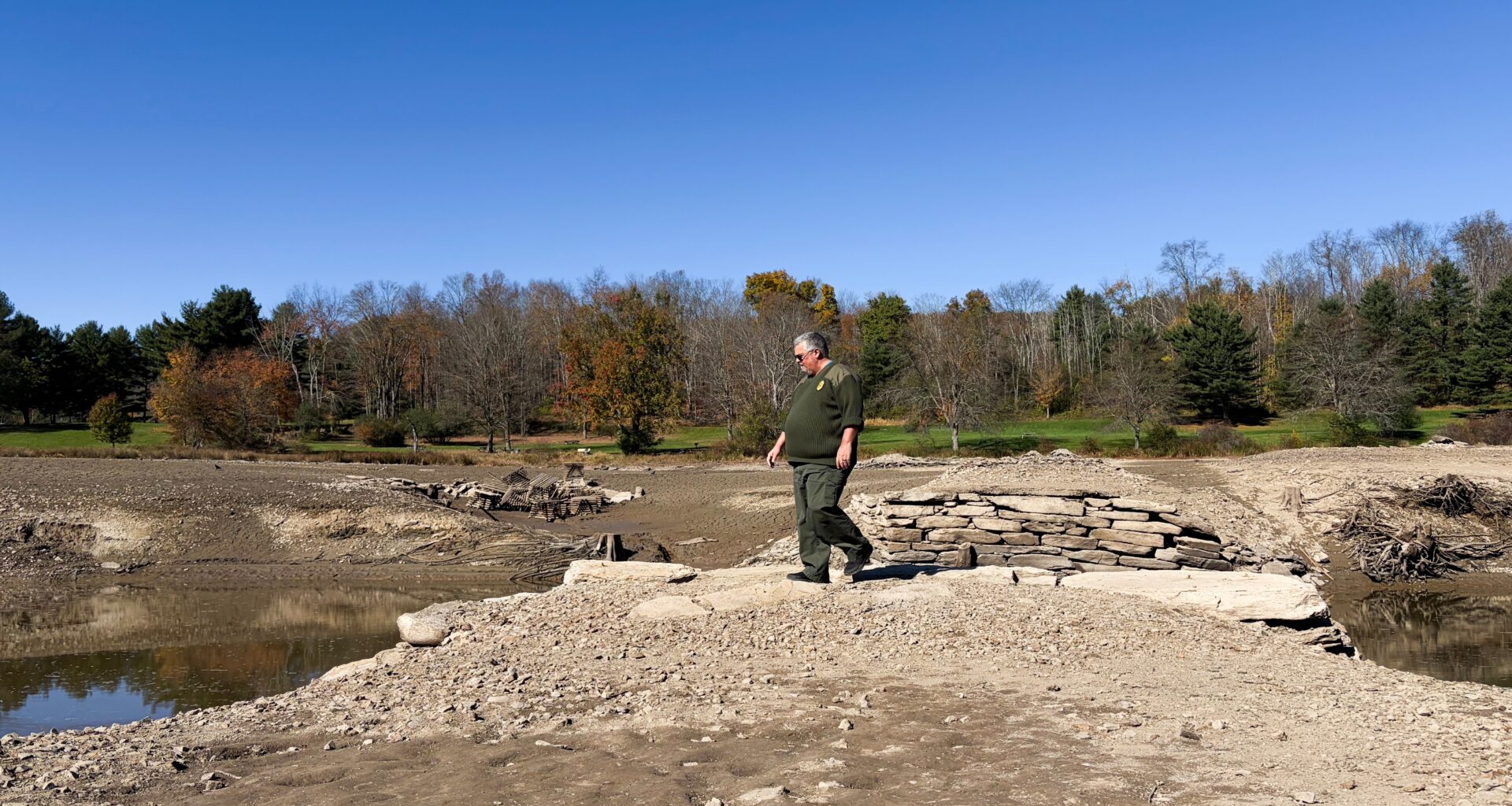
Lee Dillon, manager of Lackawanna State Park, walks onto the drained Lackawanna Lake at the park in North Abington Twp. Tuesday, October 20, 2026. (SEAN MCKEAG / STAFF PHOTOGRAPHER)
Show Caption
1 of 4
Footprints are visible in the mud remaining from the drained Lackawanna Lake at Lackawanna State Park in North Abington Twp. Tuesday, October 20, 2026. (SEAN MCKEAG / STAFF PHOTOGRAPHER)
More commonly, Dillon said, children stray from their parents and briefly get stuck before adults can pull them out.
While “cracked” ground usually indicates dry terrain, Dillon noted it isn’t a rule. He advises all visitors to avoid muddy patches entirely and stick to paved or dry pathways.
The park decided against putting up signs because staff at the site are available to provide warnings against stepping into the mud when it seems shiny or hasn’t yet dried to the degree that it appears “cracked” and to immediately respond to any incident.
“Educate, educate, educate is the key,” Dillon said.
He emphasized caution on any ground which appears wet, as it may be saturated with water still flowing beneath the surface.
He urges park-goers that at the first moment of concern, begin backtracking immediately.
Risk vs. reward
The drawdown of the lake at Lackawanna State Park has exposed a bridge that predates the park and carried the original Route 407, the main road used to access the park.
The area was filled prior to the park’s opening in 1972, Dillon said. In 1999, when the water was drained for maintenance, the bridge became visible to the public. Visitors can now also see abutments, believed to date back to the mid-1800s.
On Tuesday, about a dozen children from a local homeschool group were on field trip to the park, which they visit regularly.
Terra McAulliffe, a home school parent and leader, said the group was taking advantage of the drained waterway to learn about the bridge and the history of the area. The group visits once a month guided by a park educator.
McAulliffe said the students were working to document the uncovered bridge, something that had not been done extensively in 1999.
She said the group was staying on the paved area of the park and that group leaders had warned the children to stay away from the muddy area.
McAulliffe said she did see one person stuck in mud during the group’s visit to the park, but that the person quickly freed themselves and were on their way.
Dillon said the project, which began in September with the draining of the lake, is scheduled to conclude in January, when the lake would again be refilled “according to Mother Nature’s timing.”
In the meantime, he hopes visitors to the park will gain understanding of the history of the area and be able to visualize the area as it was in time past.