
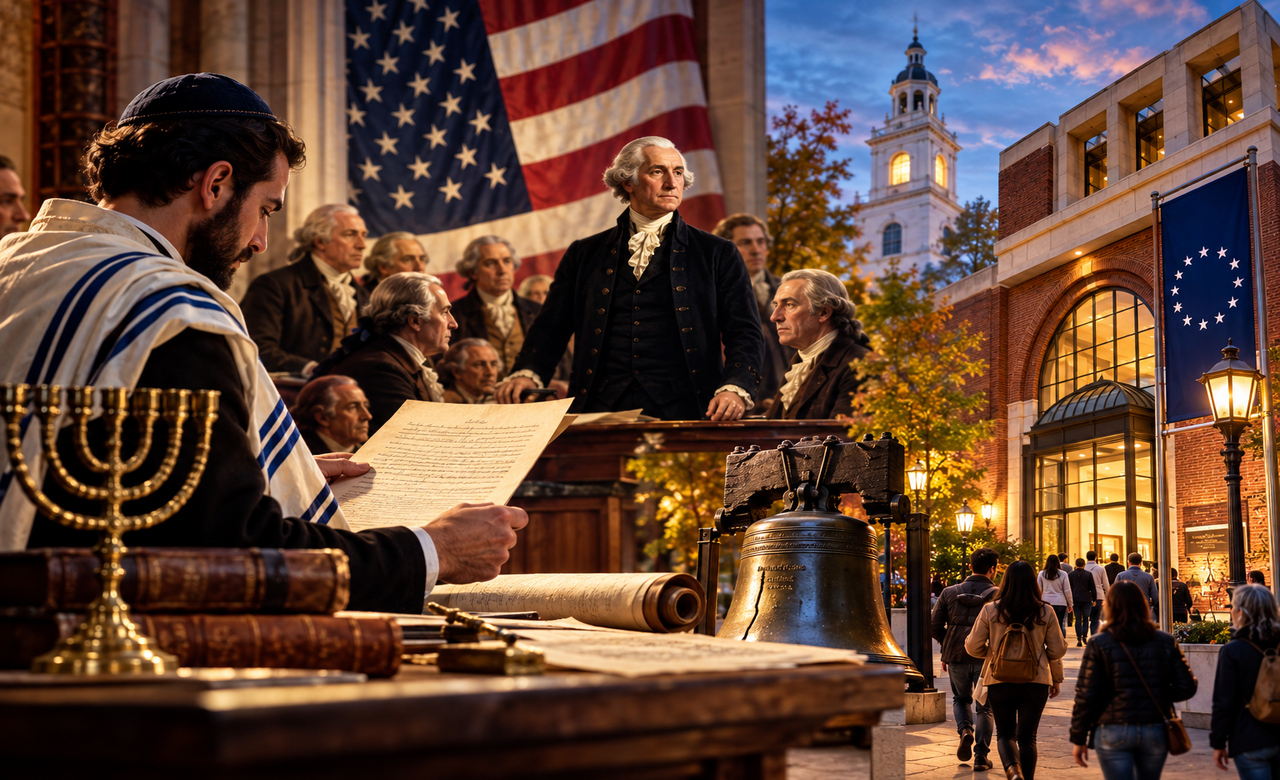
The independence of the United States is often remembered through its great leaders, the battles against the British Crown, and the documents that gave rise to the nation. Yet behind that history lies a fundamental question: Who was entitled to enjoy the freedoms proclaimed by the Founding Fathers? On Tuesday, October 20, the Museum of the American Revolution in Philadelphia will address this question by launching its 2026–2027 Read the Revolution speaker series, exploring the contributions of Jewish patriots to the development of religious freedom in the United States.
The event will feature historian Dr. Adam Jortner of Acadia University and will take place from 6:30 to 7:30 p.m. at the museum, located at 101 South Third Street in Philadelphia. The session will combine a lecture with a discussion and audience Q&A, and virtual participation will also be available via Zoom.
The event takes on particular significance in 2026, as the United States commemorates the 250th anniversary of the Declaration of Independence. The anniversary offers an opportunity to revisit not only the ideals proclaimed in 1776 but also the contradictions of a society that championed freedom while maintaining restrictions and inequalities affecting different groups.
A Freedom That Minorities Also Had to Demand
Jortner is the author of A Promised Land: Jewish Patriots, the American Revolution, and the Birth of Religious Freedom, published by Oxford University Press in 2024. His research examines how Jewish patriots participated in the American Revolution and argued that religious affiliation should not determine civil rights or citizenship.
During the colonial period, religious differences could limit political participation and social recognition. Independence created an opportunity to challenge those barriers, but it did not automatically eliminate existing restrictions. For Jewish communities, the challenge was to demonstrate that they could contribute to building the new republic without abandoning their beliefs.
Their experience illustrates that religious freedom was not simply a concession granted by those in power. It was a principle that had to be defended through debate, political decisions, and demands for equality.
From Revolution to Constitutional Protection
Ratified in 1791, the First Amendment established two essential guarantees: Congress may neither establish an official religion nor prohibit the free exercise of religion. These provisions form the constitutional foundation of the relationship between government and religious belief in the United States.
A significant historical precedent occurred in 1790, when George Washington responded to a letter from the Jewish congregation in Newport, Rhode Island. In his message, Washington defended the principle that the government should not endorse religious persecution, establishing a lasting reference point in the recognition of minority rights.
History, however, was not a straightforward march toward equality. The nation’s founding ideals coexisted with exclusions that affected different communities. Recognizing the contributions of Jewish patriots does not mean attributing the origins of religious freedom exclusively to them, but rather understanding how their experiences helped test the promises of the new nation.
Two hundred and fifty years after independence, the conference raises a question that extends beyond the past: A democracy is measured not only by the principles it proclaims but also by its ability to protect minority communities. In Philadelphia, a city closely connected to the birth of the United States, revisiting these stories helps demonstrate that religious freedom was a historic achievement that remains essential to ongoing debates about citizenship, pluralism, and equality.
WHEN: Tuesday, October 20, 2026, from 6:30 to 7:30 p.m.
WHERE: Museum of the American Revolution
101 S. Third Street, Philadelphia, PA 19106.