
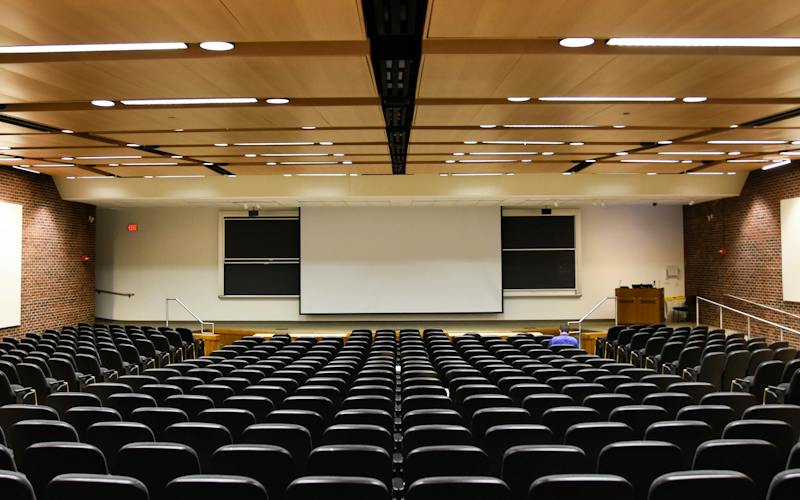
In most lecture halls across Penn’s campus, education follows a mundane script. Syllabi are designed to be rigid contracts, and lectures proceed down predictable tracks. We are conditioned to equate academic success with how accurately we anticipate exam prompts and execute assignments without deviating from the outline. At an elite institution like Penn, dominated by preprofessional anxiety and grade obsession, classes lose their spontaneity and get reduced to mindless repetition.
We have built an academic culture that confuses mechanical efficiency for intellectualism. The assumption dominating many of our courses is that distraction is an enemy to be eliminated and that the shortest path between a prompt and an answer key is the only one worth taking. We learn to perceive classes as commodities, hours invested in exchange for a predictable grade, as opposed to open environments for collective thought. My own perspective on this dynamic shifted radically during my first few weeks in professor Al Filreis’ “Modern and Contemporary U.S. Poetry” course. Although ModPo demands a heavy workload, it is by far the most engaging course on my schedule.
Such engagement flourishes because the course opposes this rigidity that encompasses so much of academic life here. Professor Filreis often reminds us of a simple, seemingly counterintuitive, truth: the poems on the syllabus are just an excuse. They are secondary to the collaborative intellectual stimulation that occurs when a group of people gathers in a room to think and engage with one another. Rather than forcing a rigid path onto every lesson, he instead leans into the distractions. When a student’s interpretation digresses or brings an unexpected personal or cultural perspective into the discussion, the class follows the distraction and allows the discussion to be derailed.
This strengthens engagement since no one knows who will be called on next. In ModPo, discussion becomes a game rather than a mundane lecture, ditching traditional cold-calling. The students are also allowed the freedom to vote for whichever poem they feel is most significant to talk about each week. In this representative and “gamified” manner, participating students are regarded as equal intellectuals in discussion as opposed to anxiously waiting to recite just the answers their professors want to hear.
Nevertheless, this open-ended, unscripted pedagogy may seem to be a luxury exclusive to the humanities. In literature, meaning is innately pluralistic, allowing for multiple valid interpretations. In STEM fields, however, there is generally only one correct answer; everything operates according to precise and inarguable physical, chemical, or biological laws. From this perspective, a linear and highly structured lecture seems not only appropriate, but also necessary to communicate foundational data. Yet this objection confuses the nature of the material with the method of instruction.
Get the DP delivered straight to your inbox.
Reducing STEM to passive note-taking hurts mastery of a subject far more than it helps. Educational science consistently disproves the idea that robotic lecturing, like reading from a set of Google Slides, is optimal for scientific training; a recent study found that nearly 80% of undergraduate students report significant improvement in academic performance, retaining information, and engagement when courses begin to incorporate interactive learning as opposed to conventionally passive lecturing. Even in disciplines governed by objective facts, full comprehension requires an environment in which students are able to address ambiguity and test hypotheses without fear of making mistakes.
ModPo is by no means hard in the traditional sense. There are no trick questions or curved grading distributions designed to weed students out. Its rigor stems from the requirement of sustained engagement. There isn’t any opportunity to get locked out of a conversation or remain a spectator. Positioning the material as an open and democratic arena enables the class to articulate their own knowledge and opinions whereas before they may have just been reproducing exactly what had been told to them.
To encourage independent thought across all disciplines, Penn’s academic departments must begin to prioritize open-ended dialogue in their courses. Academic programs have to promote deeper thought through spontaneous discussion rather than the mechanical completion of a textbook syllabus. Encouraging faculty to embrace classroom digressions as well as interactive, democratic participation allows students to view intellectual tension as an essential component of scholarship. Penn’s primary initiative must center on developing minds equipped for ambiguity and debate, so they can truly receive the prestigious and career-readying education they signed up for.
AUBREY POMRINK is a College first year studying English and neuroscience from Willow Grove, Pa. Her email is apomrink@sas.upenn.edu.