
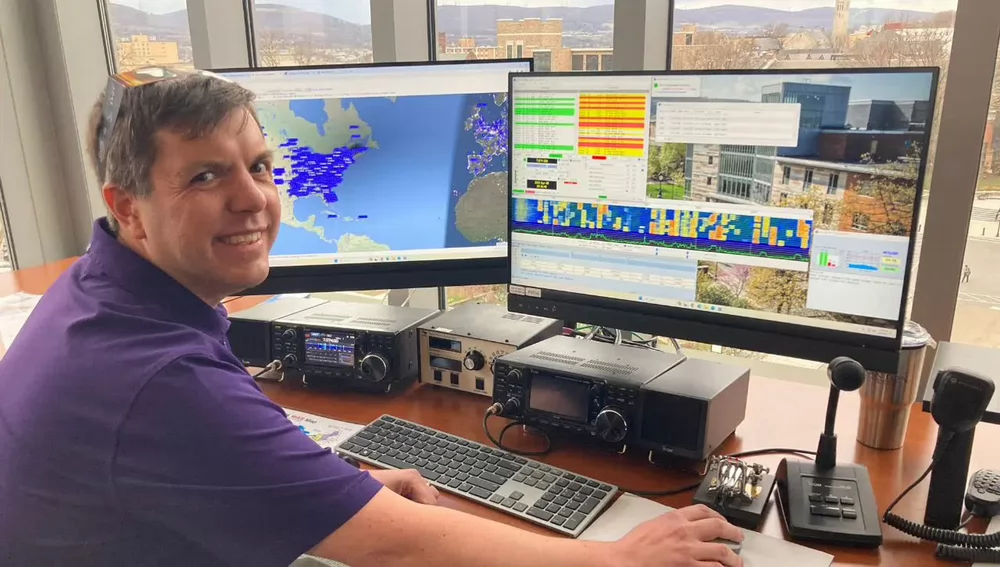
The University’s leadership in this area is closely tied to Dr. Frissell’s work as founder of the Ham Radio Science Citizen Investigation (HamSCI) community, which, for years, has already connected amateur radio operators around the world to create a network of citizen scientists.
The project’s centerpiece is the creation of “Discovery Stations,” which will be located at public venues and will allow visitors to see real-time space weather data. Individuals will be able to learn how solar activity affects communications.
Additionally, the grant will fund the deployment of approximately 85 Citizen Science Space Weather Monitors throughout the country. These stations will collect data on radio signals and ionospheric conditions, contributing observations to a national research network while also serving as education tools for the public.
Also, the ARRL Teachers Institute will provide educators with curriculum materials that will connect classroom lessons to live NASA data.
Beyond the programs and technology being developed, the initiative is designed to support a self-sustaining network of teachers, amateur radio operators, citizen scientists and community partners who will have access to NASA science long after the initial funding period ends.
For Dr. Frissell, one of the most important aspects of the award is the opportunity to collaborate with other organizations. Together, they will make NASA science more accessible to the public, developing new ideas and approaches that extend far beyond what any one institution could accomplish on its own.
“We will be innovating and collaborating with teams across the SciAct portfolio,” he said. “I can only imagine the great things that will come of this.”