
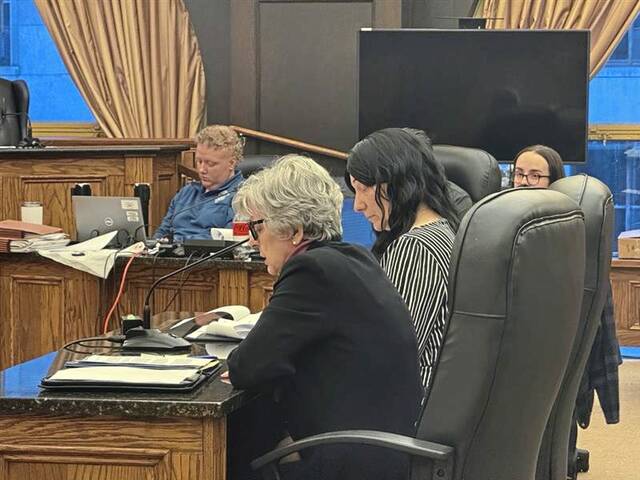
The Allegheny County District Attorney’s Office has lost 18 attorneys this year, a staffing challenge First Assistant District Attorney Rebecca Spangler said will be exacerbated by a nearly $2 million gap between the office’s 2027 budget request and the county executive’s proposal.
At Allegheny County Council’s first hearing on County Executive Sara Innamorato’s preliminary 2027 budget, Spangler said staffing shortages and salary pressures have worsened over the past four to five years, making it difficult to retain employees.
“When attorney caseloads exceed manageable levels, this could result in individual cases not receiving optimal attention, and key dates could be missed,” Spangler said.
The office reported total staff departures of 12.85% and attorney departures of 13.84% within the last year.
Spangler said the office’s 126 trial attorneys carry between 40 to 130 pending cases each, receive roughly 20 to 30 new cases per pretrial conference twice monthly, and often work 50 to 60 hours per week.
But County Manager John Fournier said the district attorney’s office is not alone in facing financial pressures.
He pointed to stagnant or declining property tax revenue, which he attributed in part to falling commercial real estate values, as a challenge for the county in balancing its budget while meeting departments’ funding needs.
“Every row office, every department could be up here telling you, ‘I can do more if you give me a little more.’” Fournier said. “The county is underfunded everywhere, and so why are we in this position?
“Why are we constantly trying to find efficiency? It is simple. Our real estate tax (revenue): it’s just not growing,” Fournier said.
On Oct. 6, Allegheny County Executive Sara Innamorato proposed a roughly $1.25 billion operating budget representing a 4.7% increase in spending from this year that would avoid a tax increase and employee layoffs.
Much of the operating budget’s increase is driven by a one-time payment on a bond issued in 2010, and $21 million on child and family related programs, much of which will later be reimbursed by the state. Without those expenses, spending under the preliminary budget would rise about 2%.
Costs and savings
Fournier said most county departments aren’t getting an increase or face cuts under the proposed budget, with increases largely reserved for specific investments or shifts in how expenses are accounted for.
Among the departments receiving additional funding is the Public Defender’s Office, where Fournier said increased federal immigration enforcement has created additional demands on attorneys and support staff. He said the office has added staff to help manage cases involving clients detained by ICE.
Fournier said the administration has sought to offset rising costs by eliminating 150 vacant positions, consolidating administrative functions and renegotiating contracts. He said those efforts have produced an estimated $20 million to $22 million in operating budget savings.
“We have worked diligently over the last year to try to manage cost increases as much as possible, and try to increase performance with what we have as much as possible,” Fournier said.
However, Acting Allegheny County Controller Amy Weise Clements raised questions about the administration’s staffing assumptions. She said her office currently has 13 vacant positions.
“I think the administration is a little more optimistic, and some of those being left vacant for the majority of the year,” Weise Clements said.
In June, Weise Clements warned that the county faced “considerable fiscal concerns” despite the 36% property tax increase approved for 2025, which generated an additional $132 million in revenue.
This year’s budget for the controller’s office is $8.8 million; the office requested $8.9 million for next year, while the administration proposed just under $8.6 million.
“We would hope for another $140,000, but we can live with the budget as presented by the administration,” Weise Clements said on Wednesday.
Fournier and Tim Cox, the director of the county’s budget office, estimated if real estate tax revenue had grown at the average rate under the previous administration, the county would have about $30 million more in its budget.
“Without real estate tax growing, we are really relying on getting creative to keep the budget balanced,” Fournier said.
The county administration is also exploring “tasteful sponsorships” for county events and facilities to help defer some costs across the organization.
“If I can get enough revenue in here to defray the cost of five police officers, I’m doing that, right? That just makes all the sense in the world. So we’re looking at a number of different options here to help keep the budget afloat through fiscal year ‘27 and into fiscal year ‘28,” Fournier said.
During the hearing Councilwoman Kathleen Madonna-Emmerling, D-Moon Township, asked Fournier what the county’s plan is to tackle its countywide first reassessment in over two decades — which was ordered by the court in August — while raising an additional $100 million a year for the county pension fund that has a deficit of more than $1.4 billion.
“We obviously have a lot of external pressures that we have to respond to,” Madonna-Emmerling said. “Assuming nothing changes policy or financially wise at the state and federal level, and you can’t ‘efficiency’ forever — at some point, you’re cutting.”
The county set aside $3 million in its capital budget for next year to help fund a court-ordered full property reassessment.
Fournier said the county plans to use bond funds to pay for the rest of the court ordered reassessment. He said that conducting reassessments more frequently would make the process less costly and easier to incorporate into the county’s regular budget.
He added that the county has not yet developed a definitive plan to address its pension funding shortfall.
“I can’t articulate a plan for you at this moment that’s set in stone about how we are going to tackle the need that we have for the pension, but I can tell you we are intent on tackling it,” Fournier said.
The Allegheny County Council’s next budget hearing is scheduled for Wednesday, Oct. 29.