
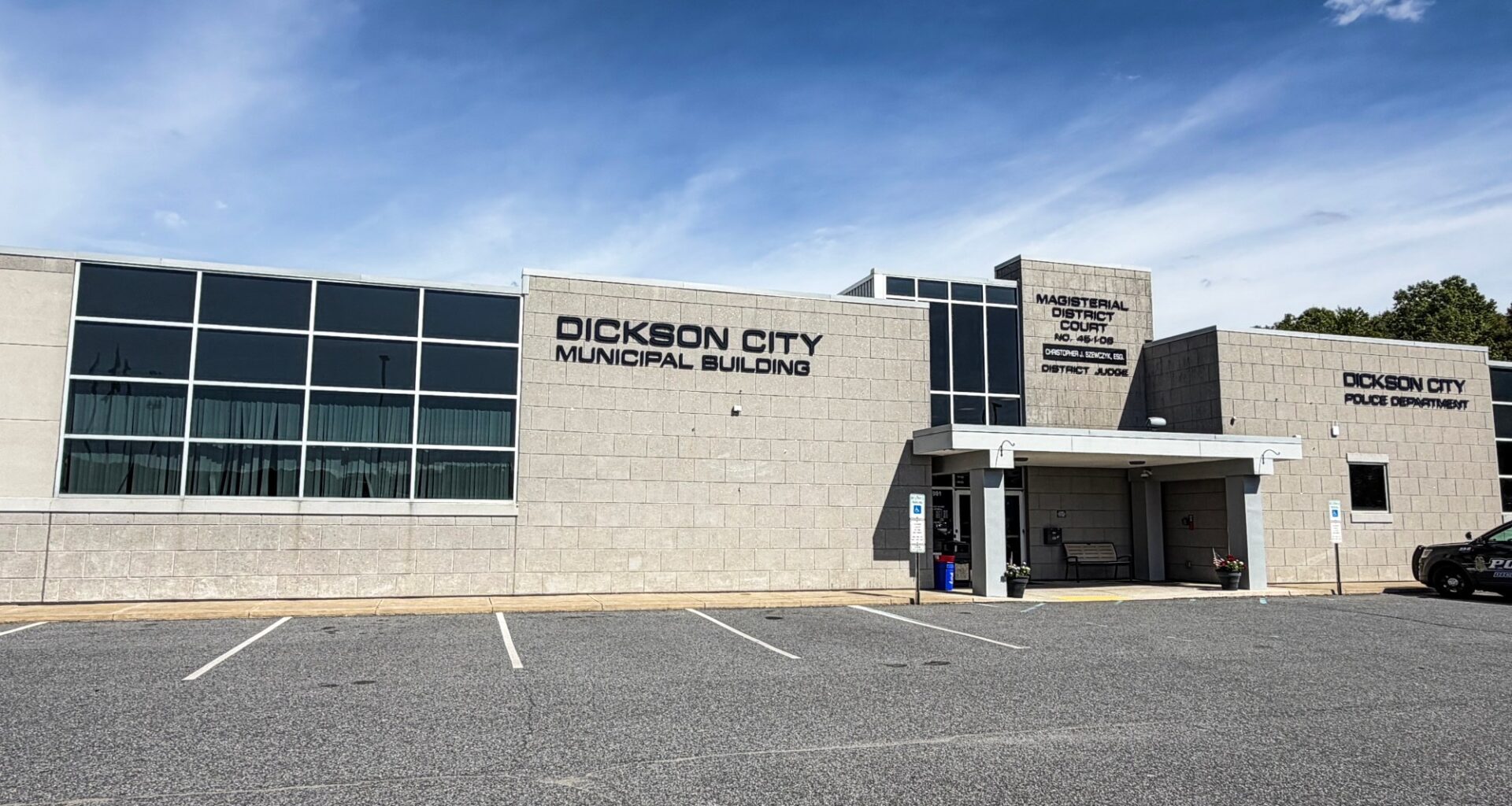
The Dickson City Police Department is dealing with an ongoing mold problem that is complicating daily operations and raising safety concerns for officers and staff.
In spite of a borough official’s assurance that the facility is safe and the situation is under control, officers continue to fear for their health and say the environment compromises their ability to do their jobs.
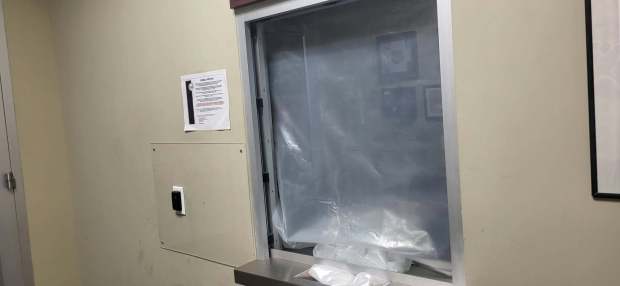 The reception area window at the Dickson City police department shown covered in heavy plastic shown on Oct. 22, 2026. Officers say mold and other ongoing issues are interfering with their ability to do their job. (GERI GIBBONS/STAFF PHOTO)
Borough Manager Frank Marcin, who has held the position for less than a month, said the borough proactively responded when officials became aware of a mold and water infiltration at the police station on Aug. 28, hiring a service to clean the space and remove moisture from the air.
Now, Marcin believes the problem is largely resolved pending an engineer’s report and is waiting to hear back from the borough’s insurance company to restore the department’s workspace.
But, because the remediation required the removal of Sheetrock and drywall, department officers continue to work in a chaotic environment with their desks moved away from the walls into the center of the room, leaving the chief without access to his own office.
In addition, officers are not convinced that the borough has fully resolved the problem and continue to have health concerns, police Chief William Bilinski said.
‘Water was coming out of electrical outlets’
Officers first brought mold found near electrical sockets to the borough’s attention in late August, and officials hired Servpro to remedy the problem.
When the borough failed to provide a timeline for repairs, Christopher Tully, president of the Dickson City Police Officers Association, submitted a complaint to the Pennsylvania Department of Labor and Industry.
In that Sept. 10 complaint, Tully alleged water was coming out of electrical outlets, cited multiple instances of mold in the police station and noted dehumidifiers were pulling 55 gallons of water from the building every three to four days.
Tully, said he spoke with Servpro representatives about air quality testing, but it had not been completed. He noted Servpro representatives said the building was safe and testing was unnecessary.
Most concerning was the need for Chief Bilinski to relocate out of his office into another room, Tully said.
Bilinski said working from the temporary spot — which is sealed with thick plastic sheeting — has made basic tasks difficult, such as moving around headquarters to make copies.
Even more concerning, he said, is that the department’s secretary, who previously interacted with visitors from behind a reception window, now has to step into an open area to assist the public.
While that is usually not an issue, Bilinski noted that irate residents occasionally come to the office, making her uncomfortable. During those times, Bilinski or another officer must step to the front for safety reasons.
The longer the situation continues unresolved, the lower police morale drops, he said.
While Bilinski concedes officers spend much of their time in patrol vehicles, they still need a functional space when returning to the station for arrests or interviews, he said.
He pointed out that Servpro removed sections of wall to locate the source of the mold and moisture, forcing desks into the center of rooms and restricting workspace.
Adding to their concern is that the borough has not provided a clear timeline for resolving the issue, he said.
Bilinski emphasized that the department is not trying to create trouble for the borough, but simply wants a safe, orderly workplace. The department is working with Marcin to address the issue as soon as possible.
He added that temperatures will soon fall below freezing, making options like removing windows or insulation a significant problem for officers.
Continuing efforts
Tully continued to follow up with the Department of Labor and Industry, which, to his knowledge, has not sent a representative to inspect the building or headquarters.
On Sept. 16, the state agency confirmed receipt of the complaint and referred it to a supervisor.
On Sept. 29, Tully reached back out to request the name and contact information of the local investigator assigned to the case.
“My complaint of unsafe work conditions was filed 19 days ago, and to the best of my knowledge no one has visited the police station to investigate,” he wrote. “Yesterday, work crews were spraying chemicals in an occupied office, which caused numerous employees to experience burning eyes.”
On Sept. 30, an L&I official responded to Tully’s email: “We are unfortunately an extremely understaffed department at this time. Please be patient as I have quite a few General Safety Law issues on my log currently.”
Borough response
Marcin, who was appointed borough manager on Oct. 1, said officers discovered a wet spot behind a bulletin board on Aug. 28. He said the borough immediately contacted Servpro, which brought in dehumidifiers, air scrubbers and filters, and conducted air-quality testing.
The borough initially developed a plan to relocate officers, though it was ultimately deemed unnecessary, Marcin said. He said the borough is waiting on insurance claim approval and the results of an engineering report.
“It’s not a severe situation … at all,” Marcin said. “There was a moisture problem that developed, so some drywall and insulation were removed.”
When people hear the word “mold,” they automatically assume “black mold,” he added. “That is not the case.”
On Oct. 16, engineers and a construction crew spent the day on site, removing a window to check for water infiltration and address potential issues.
The borough is now awaiting next steps from the insurance company “so we can get everything put back together, make sure everything is sealed appropriately, and ensure there’s no water infiltration going forward,” Marcin said.
Bilinski said he’s looking forward to getting safely back to normal.