
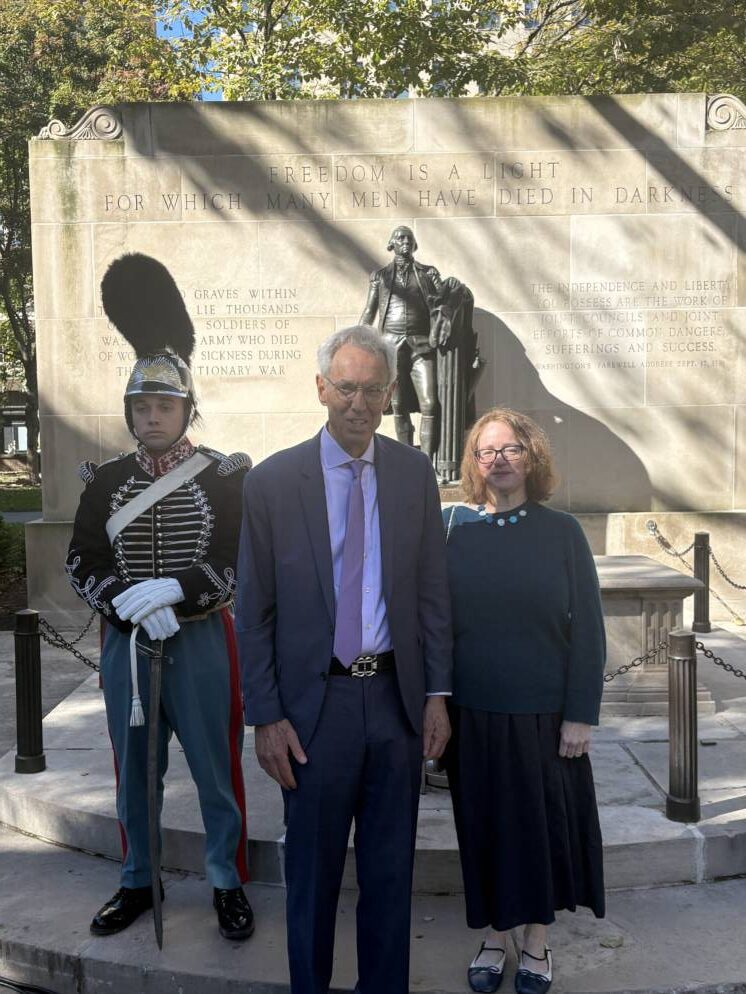
 Malcolm Lazin, Haym Solomon 250th Commemoration chair and Laura Leibman, Princeton Professor of American Jewish Studies, in front of Washington statue and wall. (Photo credit: Jon Marks)
By Jon Marks
Of all the tributes bestowed on Haym Saloman, relatively unknown outside the Jewish world for his financial and other contributions that helped defeat the British during the Revolution, there’s one few know that remains a part of our daily lives.
“If you look at the dollar bill, there’s a Jewish star on it,” said Jeffrey Lasday, senior chief of external affairs at Jewish Federation, moments before the ceremonies honoring Saloman got underway Oct. 19 in Washington Square. “If you look above the eagle there’s a cluster of stars. They’re in the formation of a Jewish star in tribute to Haym Saloman.
“In today’s crazy world it’s very important for the American people to recognize contributions the American Jewish community have made to America. Today symbolizes one of those contributions he made to the founding of America.”
The ceremony continued to bring that out, telling the story of Saloman, a Sephardic Jew born in Poland in 1740 who decided to emigrate to the colonies in his early 30s, starting out in New York. Malcolm Lazin, who moderated the ceremonies attended by 100 or so people as well as a number of military men, picks up the story here.
“When he arrived in New York, he became very prosperous doing international trade transaction with the Dutch, French, and the Germans,” said Lazin, Haym Saloman 250th Commemoration chair and a former federal prosecutor. “But he did what was the unlikely thing when he joined the Sons of Liberty, which would be the equivalent of the Haganah.
“It was viewed as a terrorist organization. He gets imprisoned twice. The second time he is literally sentenced to death but fortunately is able to escape and ends up in Philadelphia.
“There he quickly comes to the attention of Robert Morris and becomes the co-financier of the Revolution.”
In that capacity, Saloman opened his personal account to help fund the cause, paying disgruntled soldiers, buying food and needed munitions. He also gave money to luminaries John Madison, Thomas Jefferson and Alexander Hamilton.
According to Lazin, the $20,000 Saloman handed out is the equivalent of $500,000 today. More important, it emboldened the colonists to better take on the Redcoats, who for long stretches of the Revolution seemed to have the upper hand.
Everything culminated at the battle of Yorktown, Virginia, which took place Oct. 19, 1781, exactly 245 years to the day of the ceremony. With Cornwallis’ surrender, it turned out to be the final land battle of the Revolution.
And it might not have happened if not for the man who died penniless at 44, likely from tuberculosis he contracted while in British prison. “Haym Saloman is the Jewish Founding Father of this nation,” said Lazin, standing to the side of a statue of George Washington in the square. Behind Washington is a wall filled with inscriptions headed by “Freedom is a light for which many men have died in darkness.” In front of him is a flame commemorating the Tomb of the Unknown Revolutionary War Soldier.
“He was the quintessential patriot,” continued Lazin. “Someone who put the country first and put his life at risk as a freedom fighter.”
Those efforts, recognized by Washington and the Founding Fathers back then, still resonate. “Haym Saloman financed the Battle of Yorktown for General Washington, the last land battle of the Revolutionary War, said Brig. Gen. Frank McGovern of the Pennsylvania Army National Guard. “Without his support, Washington could not have achieved what he did.”
“He made a great sacrifice and we’re thankful for what he did. Without it we don’t know what the future holds. There’s an unbreakable link between those who served with General Washington and those serving today.”
“So we’re honored to be part of this.”
Yet there’s nothing in writing to verify Saloman’s role and you won’t find his John Hancock anywhere. “You won’t find his name on any of the documents,” said Lazin, presiding over a ceremony that included a rendition of Irving Berlin’s “God Bless America” by Congregation Rodeph Sholom Cantor Bradley Hyman. “because at that moment in time Jews were not allowed to vote and could only hold public office by swearing on the Christian or Protestant Bible, which he was unwilling to do.”
While living in the city Saloman became a member of Congregation Mikveh Israel, while at the same time associating with those at nearby Rodeph Sholom. Recognizing his efforts and aware that Saloman and other Jews weren’t being treated fairly, President George Washington decreed that would change.
“The Revolution is really groundbreaking because it happens to be a moment when Jews hope they have the opportunity to have a lot of the rights that we take for granted be possible,” said Laura Leibman, Princeton professor in American Jewish Studies and a leading historian of early American Jewish life, “One of the things that we see is that immediately the leaders of different Jewish communities and all of the major population centers write letters to George Washington.”
“They’re asking ‘Are we going to have protections against anti-Jewish violence? Are we going to have rights like everybody else?’”
“Those letters are so important. They’re the moment where the new leader of this nation is saying ‘Yes, the government is going to have your back. You can expect that you will be treated like any other citizen.’ That was his response.”
So, nearly 250 years later, what would Saloman, whose wife Rachel bore him four children, think of the way Jews are treated today? “I think he would be probably totally amazed by how far we’ve come,” conjectured Lazin, noting not only did Saloman and his family face antisemitism but several Jewish New Yorkers had their homes and their synagogue set on fire. “While all things are not perfect, in the aftermath of World War II, it started to make it a little bit socially unacceptable to be overtly antisemitic.”
Yet Leibman says there should be more. “This is part of what the Founding Fathers were agitating for,” she explained. “They wanted to make sure that everybody in the country was going to be safe regardless of their religion.
“That was part of the promise the Founding Fathers gave to Jewish American communities. They were going to be protected and it wasn’t going to be a place where prejudice against Jews was tolerated.
“For Jews the Revolution is really important, laying the groundwork for what is going to be Jewish rights. We think in our current climate, it’s a promise that’s been partially fulfilled, but something we still desire and look forward to being completely fulfilled.
“The Revolution and people like Haym Saloman were so crucial making it clear the Jews deserved certain rights at the time. We’ve worked for those rights and ideally someday they will be fulfilled.”
Jon Marks is a freelance writer.