
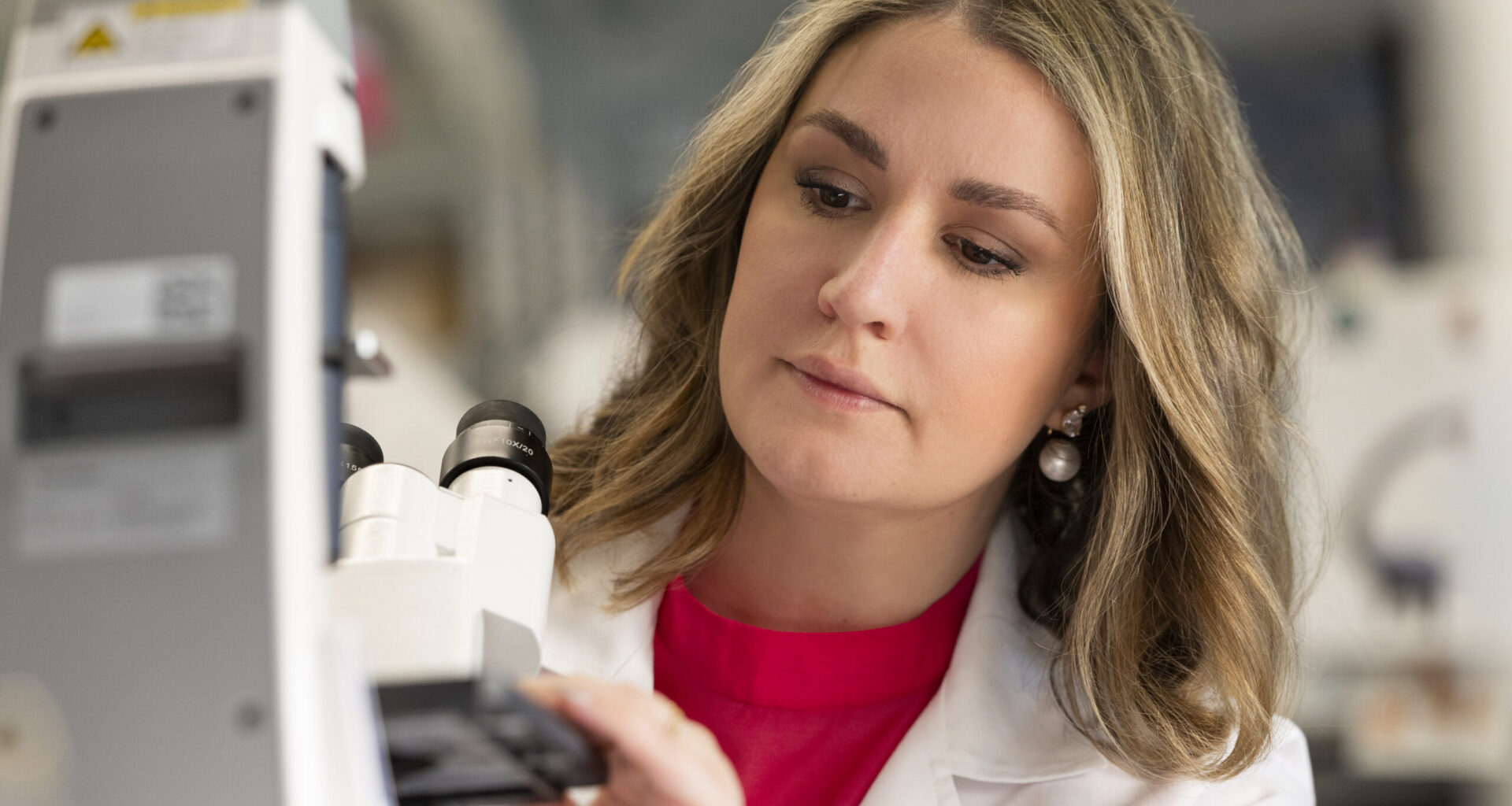
By Shannon Turgeon
Photography by Joshua Franzos
Abigail Overacre’s interest in science dates back to her childhood.
Her father, who was a physician, would often discuss his cases over the dinner table, and she enjoyed making “experiments” with kitchen ingredients.
“I love understanding how things work, but I think in part due to my dad’s influence and talking with him, I was very driven to do something that I felt like could help people directly,” said Overacre, who is an assistant professor of immunology in the School of Medicine, University of Pittsburgh.
That led her to pursue graduate training in cancer immunology.
“Cancer is very complex, and every cancer is unique. It becomes a really challenging problem, but one that we can make a lot of headway in.”
On Friday, Nov. 13, Overacre will present “A Delicate Balance: Microbiome Control of Cancer Immunotherapy and Toxicity” as part of the 2026 Senior Vice Chancellor’s Research Seminar Series. (Join the lecture here.)
Overacre’s research now focuses on how to maximize immunotherapy response through modification of the gut microbiome and diet.
Her goal is to do this without increasing or causing immune-related adverse events (the side effects that occur during immunotherapy that can range from minor—such as a rash—to severe, like colitis and myocarditis.)
Overacre and her team use several tools for their research, including human-to-mouse avatar studies. This approach allows them to move beyond simply observing a connection between microbiome patterns and patient outcomes to actually testing how specific gut bacteria provide benefits.
They also use TCR-transgenic T cells (cells that are engineered to target a specific gut microbe) and recently developed a novel mouse model of immune-related adverse events.
“Before, there was not a good mouse model for that, which made it almost impossible to understand any sort of mechanism underlying why some people get adverse events and other people don’t, and try to uncover new treatments,” Overacre said.
Overacre’s research demonstrated that the consumption of sucralose (a common artificial sweetener) is detrimental to immunotherapy response rates in both mouse models and humans with melanoma and non-small cell lung cancer.
They also discovered that the consumption of what is known as a “western diet” (higher fat and carbs with low fiber) affected the gut microbiome in a way that rendered mice susceptible to immune-related adverse events. By analyzing the dietary data of patients, they found evidence that this is applicable to humans as well.
“Ultimately, the mechanism that was driving adverse events was the changes to the gut microbiome and metabolites. It dysregulated immunosuppressive T cells, which prevent you from getting autoimmune disease or any sort of aberrant inflammation,” Overacre explained.
“What we learned is that these animals, and patients with severe adverse events, had dysfunctional or unstable regulatory T cells as a result of these dietary microbiome changes.”
Moving forward, she plans to continue her research to better understand how the gut microbiome impacts the immune response during cancer. She is also collaborating with clinicians to work toward identifying specific interventions—such as dietary recommendations—to improve outcomes for patients receiving immunotherapy.
In the meantime, Overacre remains fulfilled by the potential to help people with cancer and other serious conditions.
“The possibility of discovering or targeting something that can help people who are fighting for their lives… It doesn’t get any better than that,” she said.