
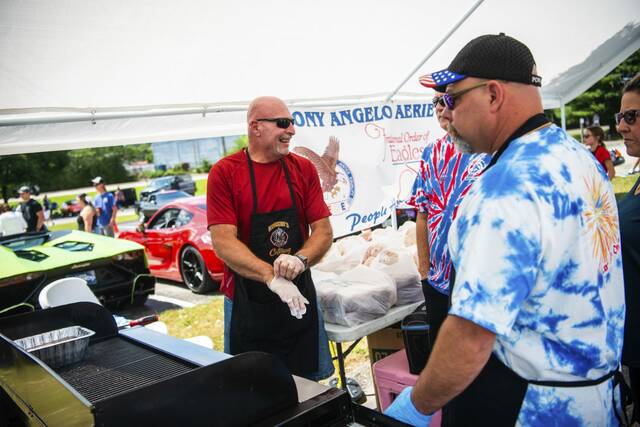
Ed Butina, secretary of the Latrobe Fraternal Order of Eagles Aerie #01188, said that the fraternal organization is hemorrhaging members despite its many activities and charitable efforts.
“We still have about 700 members yet,” Butina, 59, of Latrobe, said. “When I first came on as secretary in 2018, we had roughly 900 members. We can lose 50 members a year.”
Fraternal organizations like the Eagles, the Moose, the Elks, the Slovenska Narodna Podporna Jednota (SNPJ) and others are social organizations where men and women gather to host events, raise funds for charitable causes and aim to improve their communities. Many of them began in the late 19th and early 20th centuries and reached peak popularity in the mid-to-late 20th century.
The Fraternal Order of Eagles, for example, began in Seattle in 1898. The Latrobe Aerie was established in 1905, and recently celebrated the centennial of its current building.
“There’s a lot of history here,” Butina said. “We have four floors and the roof. The basement used to have a bowling alley.”
Over the years, the Aerie has hosted meetings, special events in its ballroom, bingo games and sporting events.
“The third floor used to be a big ballroom with chandeliers. … They used to have weddings in there in the ‘50s and ’60s,” Butina said. “Now it’s a batting cage for the Latrobe Little League. It’s one of our charities.”
The Fraternal Order of Eagles mission statement says the organization is “an international nonprofit organization uniting fraternally in the spirit of liberty, truth, justice and equality, to make human life more desirable by lessening its ills and promoting peace, prosperity, gladness and hope.”
Butina joined the Eagles nine years ago to become a part of its golf league.
“We still have a golf league. We still have a bowling league. We have a machine bowling league, too,” he said.
But still, the organization is having trouble recruiting younger men to join, and that means membership is continually dwindling.
“What we do to try to attract members — open mic nights, we have bands in — we brought a lot of stuff we used to do back,” Butina said.
He also said that the organization will have special events, such as free food for Steelers games.
“You let them know what the organization is about,” he said. “It’s not just the bar.”
He said that the charity work raises a lot of money for local causes. “Between last year and this year, we made over $50,000,” Butina said.
At SNPJ Lodge 223 in Greensburg, bar manager Andrea Parfitti, 53, said that while popularity has never fully bounced back after the covid-19 pandemic, they still see a large amount of members and customers.
SNPJ was founded in 1904 to provide life insurance and disability coverage to Slovenian immigrants, and the words translate to Slovene National Benefit Society in English.
“We’re a non-profit. We’ve had bike runs before, for breast cancer, MS, different things like that … and we have a golf outing for veterans every year,” Parfitti said.
On Wednesday nights, the lodge offers food specials, from tacos to Reubens to shrimp and gyros. The SNPJ lodge has a pool league, bocce, holiday parties and many events to attract members and participants.
She has been involved at the lodge for more than 15 years, so she’s seen the ebb and flow of people.
“We do have some younger people,” she said. “Most of it’s probably 40s to mid-60s.”
Many longtime members and regulars are older, and while aging might be an issue, the SNPJ has also formed a tight-knit family atmosphere.
“As long as I’ve been here, I’ve pretty much had the same clientele coming in,” she said. “Some new faces, but we have our regulars.”
While these organizations aren’t as ubiquitous as they once were, many younger people are still looking to them for community and camaraderie. Elliott Stone, 34, of Lawrenceville, joined Allegheny Elks Lodge #339 four years ago.
“I wasn’t that familiar with the BPOE, which the is the Benevolent and Protective Order of Elks,” he said. “My coworker frequently talked about it and was like, ‘Hey, I could sponsor you if you’re interested in joining.’”
The attraction for Stone was the ability to find somewhere social to hang out, attend events and do good for the community.
He said that the membership process wasn’t complicated.
“You need to have a current member in good standing to speak on your behalf. You go through the paperwork and then the actual ceremony of becoming an Elk is very secretive.”
Stone said the lodge maintains the mystique of its initiation ritual, holding ceremonies when enough new members have joined.
The BPOE was established in 1868 in New York. Allegheny Elks Lodge #339 was established in 1896 with 103 charter members. The lodge participates in and spearheads a number of charity drives, including a drug awareness poster contest, generous scholarship programs for high school seniors, free home nursing services for people with a variety of developmental disabilities and much more.
“A lot of it is harm reduction, donating to homeless shelters and food banks,” Stone said.
As far as the community activities he enjoys at the lodge, Stone raved about their weekly Pittsburgh Banjo Club night on Wednesdays.
“You’ll get every demographic in there because it’s just fun. It’s a good time to go out, get some food, have a drink, hang out, and all that money is going to a good cause.”
The weekly banjo nights are open to the public.
Stone said that his young age doesn’t make him as much of an anomaly as you’d think at the Elks; he’s hopeful about the continuing future of the organization.
“They’re really trying and succeeding to get a lot of young people involved,” he said. “When I got initiated, 90, 95% of the people were my age or younger.”