

The Moravian diary keepers of 18th century Bethlehem were very careful when it came to recording about was happening in their community. And the American Revolution gave them plenty to write about. But almost certainly the high point came on July 25, 1782, when, “unexpectedly” as their account recorded, General George Washington and two aides-de-camp came riding into town late that afternoon.

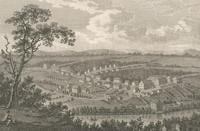
The Moravian settlement of Bethlehem, 1778
Washington was on his way north from Philadelphia where he had consulted with his French ally to Newburgh, New York where he had stationed his troops. The Moravians went all out to impress him, complete with a performance of the trombone choir. And Washington had good reason to be pleased with Bethlehem for providing as best as possible (by the standards of the day) military hospital facilities.
Many members of his army were buried on its grounds. But in all the stories about Washington’s visit little has been mentioned about the two young officers who traveled with him as aides-de-camp: Lieutenant Col. Benjamin Walker and Major Hodijah Baylies.
The roots of the concept of an aide-de-camp go far into the past. Alexander the Great and Julius Cesar must have had something like it within their own armies. But it was the French King Louis XIV (1638-1715), the so-called Sun King, who fought enemies foreign and domestic. At least in part that explains why the term “camp assistant” is in French.
Louis’ military machine needed organization as much as a ball at Versailles needed a dancing master to lead the quadrille. “French military officers began appointing trusted junior officers as aides-de-camp to assist with various duties such as carrying orders, handling correspondence and providing personal assistance… serving as indispensable assistants to senior officers and generals,” notes one source.
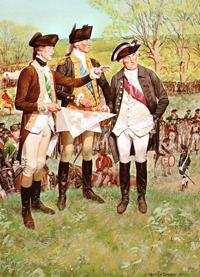
The American Soldier, 1775; George Washington (center) pictured with an aide-de-camp on the left, and Major General Artemas Ward on the right.
It was not long before British officers began to carry out the same concept. By the time of the American Revolution, Washington, who was familiar with the British army’s structure, knew their importance. Throughout the Revolution he had 32 different aides-de-camp. The best known was Alexander Hamilton. Many historians believe it was Hamilton’s knowledge of French that made him invaluable to Washington after the French alliance in 1778. Another was Tench Tilghman who was a close friend of Allentown’s James Allen.
How or why Washington had Walker and Baylies as his aides-de-camp is not easily discoverable. With the surrender of Lord Cornwallis at Yorktown the previous October it was understood that a peace agreement was on the horizon.
What some sources suggest is that Washington had been talking to the French commander Rochambeau in Philadelphia about getting some money together to pay his troops in Newburgh, New York where they were waiting. Or so, that is believed. “France,” as historian Margret MacMillan noted recently, “was probably bankrupt, in large part because of the enormous amounts it had borrowed to help defeat the British.”
As the Moravian diary keeper noted, the arrival of the Washington party had been “unexpected.” Several sources suggest that French military guests had already praised the Sun Inn as a very good place to stay both for the food and cleanliness. Of course, the germ theory of disease was far in the future, but one source claimed it was the equal to the best English inns.
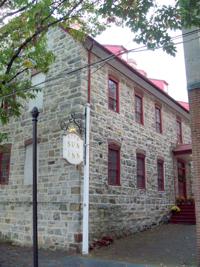
The Sun Inn in Bethlehem
It would have been great if Walker or Baylies had given us an account because it was they who were the ones that probably dealt with the Sun Inn’s keeper. The Moravian leadership were almost certainly made aware of Washington’s arrival right away and perhaps informed the trombone musicians to set up the impromptu concert.
Did the cook in the kitchen make something special? Did a special wine come up from the cellar? Who was at the Sun Inn’s stables taking care of the horses? How did the bold Miss Anne Kliest get the inspiration to clip a bit of the great man’s locks? Did the aide-de camps express understandable concern when she did so, clippers in hand? All these unanswered questions hang in the historical air.
The “Washington party” were certainly up at the crack of dawn to get an early start and were on the road. We know of course that they eventually got there safely, and without incident. We all know what happened to Washington of course. But what happened to Walker and Baylies in the aftermath when peace finally came with the Peace of Paris of 1783?
A long and interesting article that ran in a Massachusetts newspaper at his death in 1843 gives Baylies’ story. He was a native of that state and his distinctive first name comes from a figure in the Old Testament in the book of Nehemiah, as one of the Levities who helped the Jews returning from their captivity in Babylon understand the Law. Borrowing names from the Bible was not an uncommon practice in Puritan New England. He was the youngest of six brothers.
He graduated from Harvard in 1777. “His transition from the college to the camp was immediate,” the article notes. Baylies joined as a lieutenant.
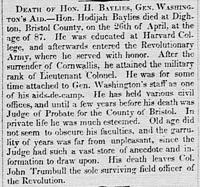
Obituary notice for Hodijah Baylies
After serving briefly on the Hudson, he joined General Benjamin Lincoln’s command in the South as one of his aides-de-camp. With General Lincoln’s defeat at Charleston, he became a prisoner of war and after he was exchanged immediately rejoined the army and was selected by Washington as an aide-de-camp.
After the surrender of Cornwallis in 1781, “Baylies remained in the Washington military family” and spent some time living at Mount Vernon before, in 1784, returning to New England where he married a daughter of General Lincoln. From there he returned to Taunton, Massachusetts, and took over the iron works and operated it for many years. In 1810 he was appointed by the governor to be a Judge of the Probate Court.
In 1834 Baylies retired from that position at age 78. “The vigor of his mind never failed,” noted his obituary. “His perceptions were clear and acute; his conversation, marked with a strong sense, abounding with anecdotes, and interesting reminiscences of the revolution, exhibited almost to the last days of his life, the liveliness of youth, without any of the garrulity of age, — always tasteful, animated, and correct.”
When he died on April 26, 1843, Baylies, except for a Colonel John Trumbull, “was believed to be the only surviving field officer of the revolutionary army.”
Baylies’ colleague that hot July day, Lt. Col. Benjamin Walker (1753-1818), was from a different world. Born in England his education was in a charity school sometimes called a Blue Coat School and received “not a brilliant but a solid education.” As a young man he spent some time in France. Here he became fluent in French which served him well. One French scholar described him as “a master of the French language.”
Hired by a respected London broker, Walker was sent to the New York branch of the firm. Apparently, he was soon caught up in the revolutionary ferment of the time and was appointed captain of the Second New York Regiment. In April of 1778 he came to the attention of Baron Fredrich Wilhelm von Steuban, the retired German soldier who is famous for training Washington’s army at Valley Forge.
Walker was instrumental in translating Von Stuben’s writings. “Superintending his correspondence,” notes his Wikipedia entry, “Walker was a special help in translating Steuben’s words.” Using his knowledge of French, Walker would transcribe them from that language into English. Almost all the drafts of Steuben’s plans for Washington’s army are in Walker’s handwriting.
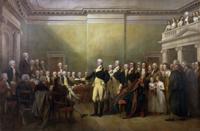
General George Washington Resigning His Commission by John Trumbull. Benjamin Walker stands directly behind Washington.
Walker was appointed Washington’s aide-de-camp in 1782. On December 23, 1783, he was with him when Washington resigned his commission as commander-in chief to Congress. Many years later when artist John Turnbull painted a picture of the scene it shows Walker right behind Washington. In 1784 he married a Quaker woman named Mary Robinsion and together they raised their daughter Eliza and Mary, his wife’s niece.
By September 1789 Walker was the New York customs naval officer. From March 21, 1791, until February 20, 1798, Walker served as a captain and the naval officer of customs. He later worked as the First Secretary to the Governor and a broker for the New York estate of the Earl of Bath. In 1801 Walker was elected as a Federalist to Congress and served one term.

Walker Street in Tribeca
Google maps
In 1797 Walker and his family moved to Utica, New York where he built a large home on 15 acres of property. Walker Street, located in the part of lower Manhattan now known as Tribeca was named to honor him. He died on January 13, 1818. His home in Utica was destroyed in 1932.
Copyright 2026 Maranatha Broadcasting Co., Inc.. All Rights Reserved.