
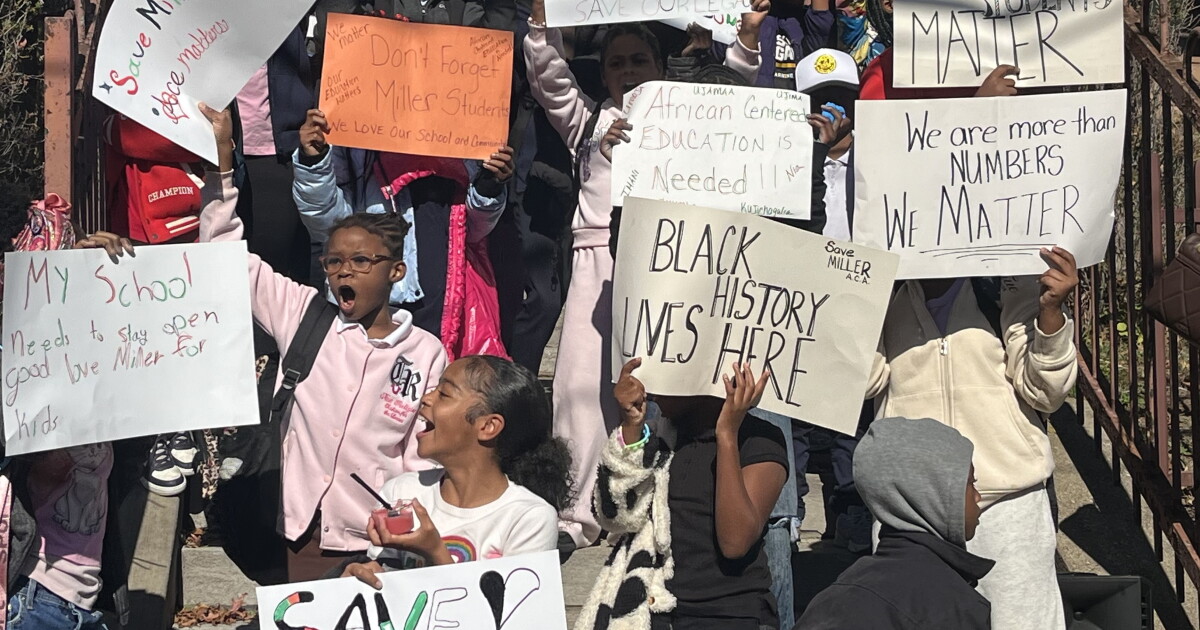
After school was dismissed early Friday, Miller African-Centered Academy students came down the school’s front steps holding signs calling on Pittsburgh Public Schools to reverse its decision to close the school.
The students were joined by parents and community members who held a rally in front of the school to emphasize the importance of having a school in the Hill District that provides an African-centered education.
“We bring our children here because this is where we live,” said Naomi Chambers, a parent of two Miller students. “If our children cannot learn in the community in which they grow, in which we feed them, that is wrong. That is not okay.”
In May, school board members voted 6-2 to move forward with a facilities plan that will close nine school buildings and restructure several more over the next few years. Officials maintain the plan is meant to address declining enrollment and more equitably distribute resources across the district.
Under the plan, students who currently attend Miller will be reassigned to either Weil Elementary in the Hill District or Liberty Elementary in Shadyside next school year.
Miller is the district’s only elementary school with a focus on Black culture and African heritage where students are taught about things like Nguzo Saba — the seven principles in the celebration of Kwanzaa.
Deanna Marie, whose children previously attended Miller, said the African-centered approach teaches students to value themselves, their education and their community.
“This is a school we’re going to fight for, and we’re going to fight till the last nail is chopped, banged and unscrewed and screwed again because this school represents the core values of African American culture,” she said. “It represents what we have been fighting for, for the last decades and millennia in this city.”
Closing the school would mean there would be no more African-centered models in the district, said Justin Laing, a former Miller parent. Culturally responsive pedagogy, which the district has said it plans to integrate into individualized instruction and supports, is not the same, he said.
PPS public relations director Ebony Pugh said the district recognizes the deep cultural and educational significance Miller has for the Hill District community and understands that change can be difficult.
Feedback from Hill District residents directly influenced changes to the recommendations, she said, and the district recognizes that culturally responsive teaching and an African-centered educational model are not interchangeable.
“We respect the importance of Miller’s educational identity and the value that families place on its approach to teaching and learning,” she said. “As we prepare for the transition, the district is committed to working with school communities to identify opportunities to preserve and honor the history, culture and traditions that have shaped their students’ educational experiences.”
Speakers also called on school board director Erikka Grayson, who represents much of the Hill District and Oakland, to add an item to the board’s agenda to reverse the decision to close Miller. Grayson abstained from the May board vote due to conflict of interest from her role as Senior Clubhouse Director at the Boys and Girls Clubs’ Lawrenceville campus.
As a result, Hill District families had no representation during the vote, Laing said.
Grayson did not immediately respond to a request for comment.