
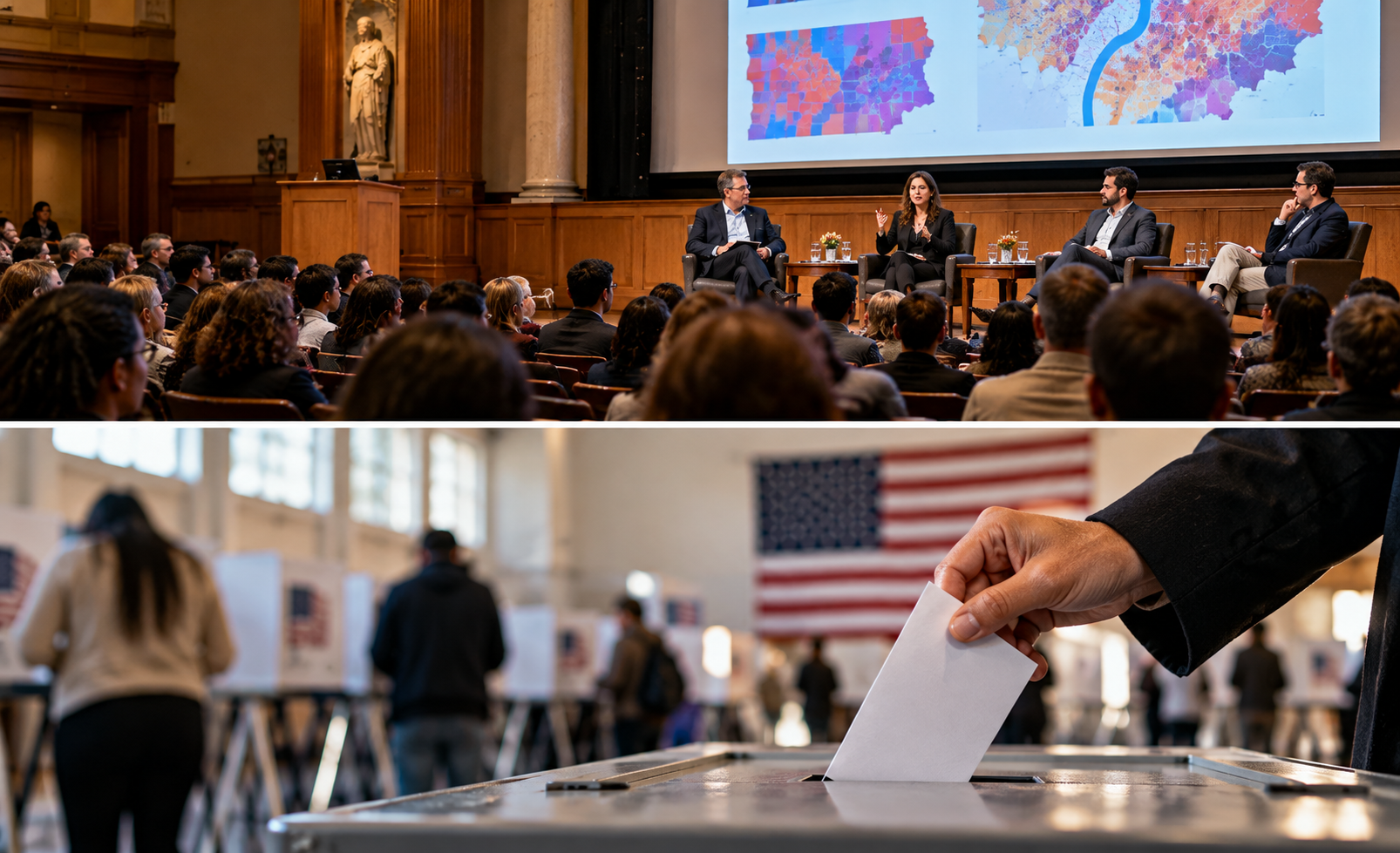
An election begins long before a voter marks a box on a ballot. Before a vote is cast, someone has defined the districts, established the rules for counting ballots, and designed a system that turns millions of individual decisions into collective outcomes. These processes, which often remain outside the public eye, have direct consequences for who gains political representation and how power is distributed.
The relationship between numbers and democracy will take center stage at The Mathematics of Elections and Voting, an academic forum hosted by the University of Pennsylvania this Friday, October 23, at the Rainey Auditorium at the Penn Museum in Philadelphia. The event will bring together experts in philosophy, political science, computer science, and mathematics to examine the mathematical foundations of elections, from drawing district boundaries to the methods used to translate votes into political decisions.
The forum comes just days before Pennsylvania’s general election, scheduled for November 3. Its significance lies not in predicting outcomes or endorsing candidates, but in raising a fundamental question for any democracy: How can the rules governing an election influence the way the public’s will is expressed?
When Maps Also Distribute Power
Drawing electoral district boundaries may seem like a technical task, but its consequences are deeply political. Geographic boundaries determine which communities vote together, which groups can elect representatives who share their interests, and how representation is distributed across territories.
The distribution of voters does not always align with district boundaries. A community may account for a considerable share of the population and still face difficulties translating that presence into political representation. For this reason, the criteria used to draw electoral maps are the subject of ongoing debates over fairness, competition, and democratic participation.
One of the issues studied in this field is gerrymandering, a term that describes the manipulation of electoral district boundaries to benefit partisan interests. Mathematical and computational tools make it possible to analyze district shapes, compare voter distributions, and identify patterns that might go unnoticed in a superficial review.
Mathematics, however, cannot resolve every controversy on its own. Findings depend on the data, the criteria used for comparison, and the methodological choices involved. Its contribution lies in providing tools to examine claims, identify patterns, and bring greater transparency to a debate that affects public representation.
Votes and the Rules That Determine the Outcome
The second major issue is how votes are counted. Different electoral systems establish different rules for turning individual preferences into collective outcomes. In some elections, the winner is the candidate who receives more votes than any other candidate. In others, a specific majority is required, or additional mechanisms are used to allocate seats.
These differences matter because different systems can produce different outcomes from similar voter preferences. The mathematical study of voting makes it possible to analyze how these rules operate, what incentives they create, and what limitations they face when attempting to represent a population’s preferences.
Academic discussions also help distinguish between the integrity of the vote count and the design of the electoral system. Ensuring that votes are properly recorded and counted is essential, but it does not eliminate questions about how districts are organized or how winners are determined.
A University Connecting Knowledge and Citizenship
The event is part of the SAS Commons initiative, affiliated with Penn Arts & Sciences. Its Democracy and Knowledge program seeks to explore how the humanities, social sciences, and scientific disciplines can contribute to understanding and strengthening democratic practices. The university plans to hold this series of forums throughout the 2026–2027 and 2027–2028 academic years.
Participants include Daniel Wodak of Philosophy and Dan Hopkins of Political Science, both from Penn; Bailey Flanigan, a specialist in computer science and political science at MIT; and Ismar Volić, a mathematician at Wellesley College and director of the Institute for Mathematics and Democracy.
The combination of disciplines reflects an important premise: Democracy is not merely a legal system or a competition among candidates. It is also a structure of decision-making that can be studied through quantitative tools, philosophical arguments, and analyses of political behavior.
For citizens, understanding these mechanisms makes it easier to evaluate the rules governing elections and ask informed questions about representation. This understanding is particularly relevant for communities whose demographic weight does not always translate into proportional political influence.
Participation Begins with Information
In Pennsylvania, the general election will take place on Tuesday, November 3. According to the Pennsylvania Department of State, polling places will be open from 7 a.m. to 8 p.m. The deadline to apply for a mail-in ballot is October 27 at 5 p.m.
Penn’s forum does not replace official election information or electoral participation. Its contribution lies in examining the rules that make the democratic process possible and demonstrating that behind every outcome are institutional decisions that deserve closer scrutiny.
Ultimately, voting is an individual decision, but representation emerges from a shared system. Understanding how that system works is a fundamental part of informed citizenship.