
West Scranton resident Lori Geiger is disabled, suffered a stroke last year, was hospitalized in January with a severe case of influenza and lives with a number of health challenges, including pronounced gastrointestinal issues and congestive heart failure.
She’s enrolled in a Geisinger Gold Medicare Advantage insurance plan and relies on Social Security Disability Insurance for her modest monthly income, but accrued close to $3,000 in medical debt this year alone as copays and out-of-pocket costs accumulated. That debt and the prospect of it growing with future doctor visits, potential hospitalizations and possible ambulance trips is a real source of anxiety for Geiger, a progressive Democrat grappling with high gas prices, inflation and broader affordability challenges she attributes to “deliberate policy choices” by Republicans.
“Every time you go to the doctor’s office and it comes up on the computer — ‘well would you like to make a payment?’ — it’s like, yes, but I’d also like to have a roof over my head, so I really can’t right now,” the 60-year-old woman said in a recent interview. “It’s stressful. … Unfortunately some people have to delay care because they know they can’t afford it, even with coverage, and then problems get worse and more expensive down the road.”
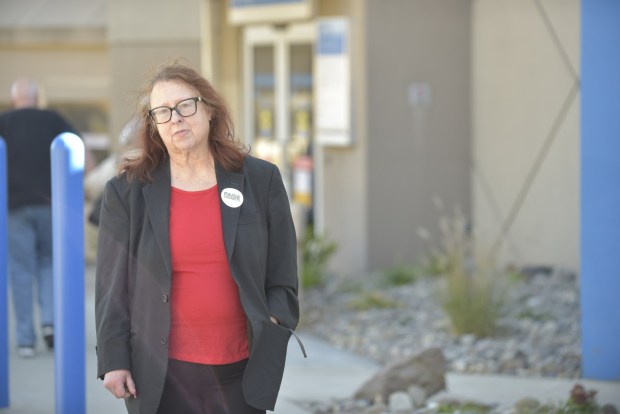 West Scranton resident Lori Geiger says she is concerned about the rising cost of healthcare. (CHAD SEBRING/STAFF PHOTO)
Geiger is aligned with a local coalition of residents, progressive activists, union healthcare workers and others focused on healthcare and health insurance affordability, key concerns for many voters this midterm election cycle. And while she and other Affordable Healthcare for NEPA coalition members and allies interviewed for this report are Democrats, polling shows bipartisan anxiety over high healthcare costs.
A professional poll the coalition commissioned earlier this year found 71% of Northeast Pennsylvania voters were at least somewhat worried about being able to afford health insurance, a summary of the poll conducted by Upswing Research and Strategy shows. The survey of 500 registered voters included, among others, voters in the 8th Congressional District, where Democratic Scranton Mayor Paige Cognetti is vying to unseat incumbent Republican U.S. Rep. Rob Bresnahan, and the GOP-heavy 9th Congressional District, where Schuylkill County Democrat Rachel Wallace is challenging incumbent Republican U.S. Rep. Dan Meuser.
The same poll found 83% of voters, including 84% of Democrats and 84% of Republicans, “agree that health insurance companies should commit or be required to freeze out-of-pocket costs to halt the growing increase in costs,” per the summary.
Democratic edge
A more recent KFF Health Tracking Poll released earlier this month found a large enthusiasm gap between Democrats and Republicans heading into the midterms, and that the Democratic Party has “a clear edge” over the GOP on who voters trust to handle the cost of healthcare, the cost of living and other important election issues. It also identified health costs as a top affordability anxiety for voters, six in 10 of whom are worried about being able to afford their healthcare expenses, per the poll.
“Of all the cost-of-living worries hitting voters now, a big health care bill is the least predictable, and that’s a big reason why health care costs are right up there with gas prices and the costs of food and housing on voters’ minds,” KFF President and CEO Dr. Drew Altman said in a news release about the poll.
It notes Democrats “hold nearly a two-to-one advantage over Republicans on whom voters trust more on the issue of health care costs,” with 42% of voters saying they trust Democrats to do a better job handling the cost of healthcare compared to just 22% that said they trust Republicans more in that respect. It’s a gap that’s widened since April, when 37% of voters said they trusted Democrats and 26% said they trusted Republicans to do a better job addressing those costs.
The population of local voters who trust Democrats considerably more than Republicans on the healthcare front includes nursing home employee Dorsey Rebillard, 26, and retiree Donna Gerhardt, 64, both of whom are voting blue.
Rebillard, a coalition member and SEIU Healthcare PA union worker at Oak Ridge Rehabilitation and Healthcare Center in Taylor, where she earns about $16.30 an hour as an activities aide, lives in Taylor with her 72-year-old retired father. Between her share of her employer-sponsored health insurance, the cost of his Medicare supplement insurance and prescription drug coverage and their combined out-of-pocket expenses, healthcare is a major burden for the household.
“His Social Security and my paycheck barely make ends meet,” Rebillard said. “If it wasn’t for us two being together — I live in a shoebox — I couldn’t imagine being by myself with a $16.30-an-hour job. … And my dad, being an elder in the community, he feels it worse because he’s saying, ‘Well, I’m on a fixed income, how much more can I stretch? I can’t afford gas. I can’t afford my out-of-pocket prescription prices, because they went up again too.’”
A member political organizer for her union who’s been canvasing for Cognetti, Rebillard also said higher grocery prices, utility bills and the general cost of living becoming more expensive have exacerbated her financial anxieties.
“It’s almost life or death,” she said. “I feel that if we don’t pay our bills we lose everything we have, but if we can’t afford to keep going it could kill us. You can’t pay for your health insurance and pay for your groceries and try to work as many hours as you possibly can, you just get burnt out, and it’s going to burn people out to the point where they can’t handle it anymore.”
Premium pressure
Dorsey and other Democrats were quick to criticize Bresnahan over his vote for the 2025 Republican megabill that included major cuts and changes to Medicaid, with some describing it as a betrayal. Meuser and almost every other House Republican also voted for the “One Big Beautiful Bill Act” — fellow Pennsylvania Congressman Brian Fitzpatrick was one of two who didn’t — that remains the GOP’s signature legislative accomplishment of the second Trump administration.
But Bresnahan was in much rarer Republican company when he bucked House GOP leadership in an ultimately unsuccessful effort to extend enhanced pandemic-era subsidies that made health insurance purchased through Affordable Care Act marketplaces more affordable for millions of Americans, including Gerhardt. Her monthly premium for insurance coverage purchased through Pennie, Pennsylvania’s ACA marketplace, essentially tripled after Congress failed to extend those subsidies that expired at the end of 2025.
Bresnahan helped force a House vote in early January on legislation extending the expired subsidies, but the legislation stalled in the Senate after clearing the lower chamber.
Gerhardt, a longtime human resources professional who retired in 2023 and moved from New Jersey to Monroe County with her husband, saw the monthly premium cost of her Ambetter Health plan jump from about $575 last year to nearly $1,500 this year. And she’s prepared to soon pay more than $2,000 a month after the Pennsylvania Insurance Department recently approved a 35.1% average rate hike for Ambetter individual plans for the 2027 plan year.
Premium costs alone, not counting deductibles and other healthcare expenses, will eat up about half of Gerhardt’s annual retirement income from Social Security and a small pension. It’s the cost of “just having insurance, not actually using it,” she said.
Gerhardt won’t become Medicare eligible until the fourth quarter of 2027, and said health insurance cost increases have already forced her to make sacrifices. Among other examples, she said she curtailed charitable contributions, went without dental insurance this year, cut back on planned travel and opted to forgo replacing her 11-year-old car.
The Middle Smithfield Twp. resident acknowledged that Bresnahan was “sensible enough” to push for extending the ACA subsidies, but sharply criticized him for selling Medicaid-related stock before voting for the Trump megabill, which she called the “big ugly bill.” Bresnahan has been dogged this cycle by a broader stock trading controversy, used as a cudgel by Cognetti and Democrats, despite his repeated insistence that he doesn’t sell his own stocks and had no involvement in the hundreds of trades he disclosed last year.
Stock trading notwithstanding, Gerhardt said her objections to GOP politics and policies are numerous and stem from far more than just healthcare costs.
“I am willing to say that I will vote for anyone other than a Republican,” she said.
‘Feelings of anxiety’
Harold Cameron, 70, a longtime consumer advocate and government liaison, was a Republican and voted twice for Donald Trump, but denounced the “catastrophic” and “heartbreaking” impact of Trump’s megabill on social safety net programs like Medicaid and the Supplemental Nutrition Assistance Program, or SNAP.
Cameron, who calls himself “the people’s advocate,” spends his time advocating for people who need help in various areas, including with Social Security disability claims and appeals. He often encounters people struggling with healthcare costs and other affordability challenges.
“I am fortunate, I get awesome, excellent healthcare, but it makes me sad to know there are so many others that don’t get it and should be getting it and need it,” he said. “It is probably one of the worst feelings of anxiety that someone can experience. They have serious, major health needs and cannot receive the quality of healthcare that they need because they’re not insured or underinsured.”
Cameron, now a Democrat, said he changed his party affiliation “because I care about social programs” and to “emphasize my complete and utter concern with what was happening” during the second Trump administration.
A Jermyn resident, he’s still undecided in the 8th District race and emphasized that there are things about both parties, and both candidates, that he likes. But he’s “not at all” surprised that Democrats look to have an advantage on the issue of healthcare costs this cycle, and understands why it would galvanize voters.
Also undecided in the congressional contest is Paupack Twp. resident Steve Prall, 62, a Wayne County Republican retiree frustrated with the direction of the party and the country under Trump’s leadership in recent years.
Prall, whose wife is from England, is among the many Americans who feel the current healthcare system in the United States needs significant improvements.
“People go into bankruptcy over healthcare, and to me, we’re a first-world country, it seems like we shouldn’t be operating like a third-world country where people are struggling,” he said.
Prall described the publicly funded National Health Service in England, where the couple has a home and frequently visits, as preferable in that respect, even if it falls short in others. And he’d potentially support the creation of some type of similar national healthcare program here, possibly funded by a national sales tax or similar levy, describing that as a favorable alternative to the status quo if it could be done without significantly adding to the country’s more than $40 trillion national debt.
The recent KFF poll found bipartisan agreement among adults that the U.S. healthcare system needs major changes.
“About half of adults across partisanship say, ‘There are some good things about our health care system, but major changes are needed,’ and an additional third (36%) feel even more strongly, saying, ‘There is so much wrong with our health care system that it needs to be completely overhauled,’” per the poll findings.
It also found 32% of adults strongly favor and another 34% somewhat favor “having a national health plan, sometimes called Medicare-for-all, in which all Americans would get their insurance from a single government plan.” Support for a single-payer system is “susceptible to change,” however, “as people hear about potential effects of such a plan commonly cited by proponents and critics.”
“The latest poll finds public opposition to Medicare-for-all increases significantly when people hear that such a plan could mean potential delays in medical tests and treatments (76% oppose), an increase in taxes (64%), or threats to the current Medicare program (61%),” it notes. “On the other hand, larger majorities say they would favor such a plan if it guaranteed health insurance as a right (76%) or eliminated premiums and cost-sharing (75%), demonstrating the wide appeal of universal coverage and lowering health care costs for individuals.”
‘Sad state of affairs’
Critical care nurse James Taylor IV, 29, an SEIU Healthcare PA officer who works in the intensive care unit at Geisinger Wyoming Valley Medical Center in Plains Twp., is well acquainted with the realities of the country’s current healthcare system.
“I see it every single day,” the registered nurse, Nanticoke resident, Democrat and Cognetti supporter said. “Patients, they’re not just worried about their healthcare, like how their health is in the moment, they’re worried about how they’re going to afford it.”
Taylor and other coalition members recently celebrated Geisinger freezing healthcare premiums and deductibles next year for its employees, with members vowing to continue the fight for affordable care and cost freezes more broadly to mitigate the intense financial pressure many people feel.
“I had a surreal moment the other week where a patient was very critical, on life support, we ended up being able to stabilize them, we got the breathing tube out and one of the first things they said to me was, ‘Oh my God, I don’t know how I’m going to afford this,’” Taylor recalled. “It makes your head spin, like that’s the last thing someone laying in the ICU should be thinking about. It’s really a sad state of affairs.”