
This installment is one in a series of reports on the travails of Philadelphia’s Kensington community.
Near McPherson Square in Philadelphia’s Kensington community, where children should be climbing on playground equipment, chasing friends and enjoying the simple pleasures of childhood, Ta’Nika Thornton-Trice’s two young children routinely encounter discarded needles, people slumped over in an almost comatose state, and adults overdosing near their home, she said.
The young mother, a longtime Kensington resident and block captain, who is expecting another child, knows her children are growing up surrounded by sights they are too young to fully understand yet old enough to fear.
“They’ve actually seen people overdose,” Thornton-Trice told the Tribune during a recent visit.

Ta’Nika Thornton-Trice is a Kensington resident and block captain. —TRIBUNE PHOTO/KAYLA BROWN
Kayla Brown
TRIBUNE PHOTOGRAPHER
Beneath the rumbling trains of the Market-Frankford Line, people struggling with addiction stand bent over along litter-strewn sidewalks, while others lie sprawled on the pavement. Piles of garbage accumulate outside vacant storefronts and abandoned buildings, walls covered with colorful murals that stand in stark contrast to the suffering on the streets.
Kensington has the greatest concentration of drug related crimes and overdose deaths in Philadelphia and 1/3 of all homeless people, according to a 2024 report issued by kensingtonplan.org, a group which focuses on a resident-driven framework for change. The report also states that 1 in 8 unintentional overdose deaths citywide occurred in Kensington from 2018 to 2022.
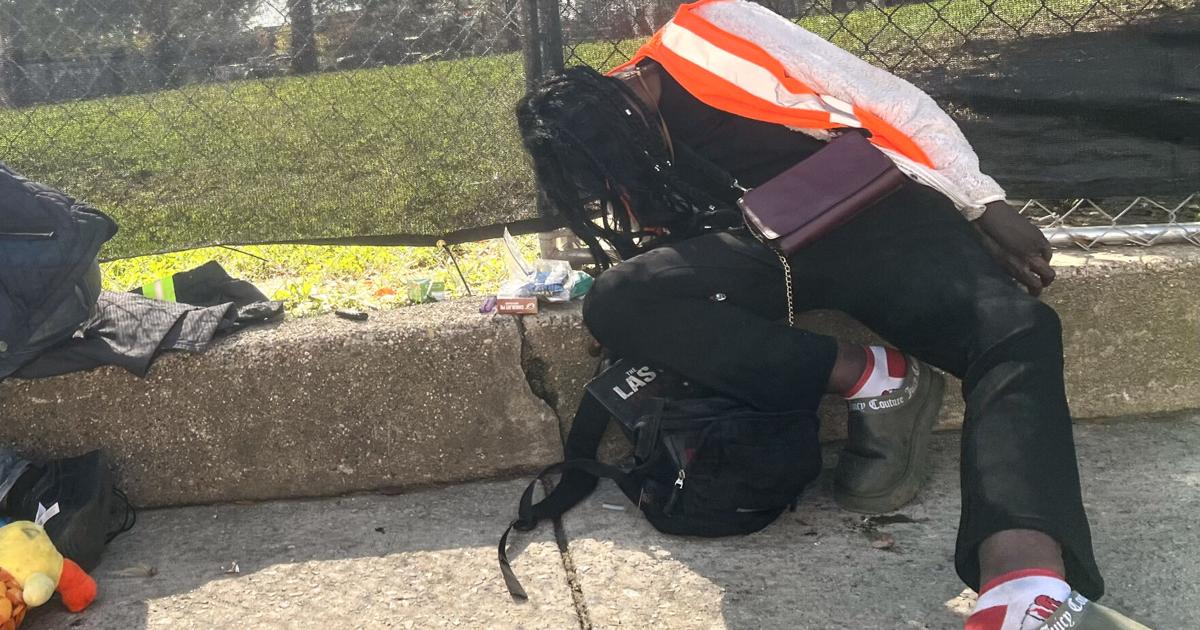
Parents there teach children to recognize and avoid dangers from an early age. On the way to school or the store, children encounter urine, feces, empty naloxone boxes and addicts slumped in the familiar posture known as the “Kensington lean.”
Over several days on Kensington Avenue, The Philadelphia Tribune witnessed firsthand the toll the drug crisis has taken. Where reporters visited, no children played, no grandparents walked and no parents pushed strollers.
Still, inside Kensington’s rowhouses, families go about their daily lives raising children, preparing meals, getting ready for school, and trying to hold on to their neighborhood.
For these families, Kensington is not merely the location of Philadelphia’s most visible drug market. It is home.
On Sept. 28, Mayor Cherelle Parker arrived at McPherson Square Library and Park to celebrate her 1,000th day in office and to break ground on a $21.7 million renovation of the historic Carnegie library and its six-acre surrounding park.
Blue-and-gold signs marked the mayor’s milestone. Architectural renderings depicted a restored library, landscaped grounds and a playground. Seven ceremonial shovels stood at the ready as elected officials, city administrators and invited guests gathered beneath the aging building’s towering columns. Police vehicles and officers were stationed at the park and library entrances.
A map of the Kensington, Fishtown and Port Richmond neighborhoods. — kensingtonplan.org
“People very much want a functional library,” said Dr. Bill McKinney, executive director of the New Kensington Community Development Corp. (NKCDC), a nonprofit that promotes social equity and economic empowerment in the Kensington, Fishtown and Port Richmond neighborhoods, “but they also want to be able to stay in their homes, right? They want to have food to eat. They want to be healthy.”
Parker is looking to accomplish what those before her in the mayor’s office could not: a Kensington on par with some of the city’s most vibrant and wholesome neighborhoods. Mayor Ed Rendell launched Operation Sunrise in 1998. Mayor John Street launched Operation Safe Streets in 2002. Mayor Michael Nutter launched a Block-by-Block Approach in beginning in 2008. Parker has launched One Philly Kensington Blitz.
Yet, some residents inside the community say they see little change.
Asked if City Hall listens to residents, Thornton-Trice answered with an immediate, “No.” Adding, “We get a lot of attention for various reasons. But I don’t think it’s focused attention. Like, it’s scattered.”
Just outside Parker’s celebration and groundbreaking in Kensington late last month, people affected by drugs remained on the sidewalks. “The Kensington that I’m standing in today — this is not the Kensington that I walked in January of 2024. Quality of life is improving here,” Parker declared.
The McPherson Library in Kensington is currently undergoing renovations. —TRIBUNE PHOTO/KAYLA BROWN
Kayla Brown
TRIBUNE PHOTOGRAPHER
City officials say the investment will help return McPherson Square to families who have spent years navigating drug activity near one of the neighborhood’s most important public spaces.
McKinney questions the public ceremonies held by elected officials touting have much better things are in Kensington. “Are things better or have things just changed?” he asked. “Because the core issues haven’t been addressed.”
“The real issues here aren’t just cleanliness and crime,” he added. “The problems are jobs and education. That’s what’s at the root”
He compared the city’s efforts to the way he tidies up his office before guests arrive. “I straightened up a little bit before you all came,” he said to a group of journalists. “All my trash is under my desk right now. It’s still here.”
No one should trust the ceremonies that promise a better Kensington, McKinney said, because he’s in the community before officials show up and after the cameras are gone. “Come see it for yourself,” he said.
Mayor Cherelle Parker celebrates the renovations being done at McPherson Square Library and Park in Kensington. —TRIBUNE PHOTO/KAYLA BROWN
Kayla Brown
TRIBUNE PHOTOGRAPHER
So we took him up on his offer.
The Tribune walked Kensington’s streets with McKinney and interviewed residents whose experiences illustrate the economic hardship accompanying the neighborhood’s drug crisis.
McKinney, who has lived in Kensington for about 25 years, believes the neighborhood cannot recover without addressing the poverty and unemployment that helped the illegal drug economy take root.
“The core issues are poverty, workforce development, education,” he said.
Dr. Bill McKinney, NKCDC executive director, on Tusculum Street in Kensington. —TRIBUNE PHOTO/KAYLA BROWN
Kayla Brown
TRIBUNE PHOTOGRAPHER
The mayor says the general well-being in the area has improved. But has it really?
This article begins a series of online and print reports over the next several weeks detailing what residents say about life inside Kensington; what city officials say they are doing to improve the quality of life in the area; how one non-profit organization and citizens have put together their own framework for change and a myriad of other issues confronting the area.
What residents say
Anthony “Tony” Russo, 62, a longtime Kensington homeowner and retired machinist, welcomes the city’s investment because “Kensington has been treated like the city’s dumping ground … better lighting and a nice park path are great deterrents for crime,” he said before adding, “let’s be honest: addiction, poverty, and homelessness are human problems, not architectural ones.
“If the city spends millions to beautify the grass but doesn’t radically scale up long-term housing, mental health treatment, and economic pipelines for our people, they are just pushing the addiction crisis a few blocks over into someone else’s front yard,” he said.
Samira Allen, 45, born and raised in Kensington, wants to know what happens when the library is closed during the two years of construction.
“That’s two full years where the community loses its anchor, and the immediate block loses its eyes and ears,” she said. “I worry that without active daily programming to keep the space activated during the construction phase, the drug trade will just consume the perimeter. We need structural, daily enforcement and public health interventions to run parallel to this construction, otherwise we’re just putting a Band-Aid on a broken bone.”
Elena Rosario, 68, a retired seamstress, said she’s watched the neighborhood change for three decades. “You may not always see people my age after dark, but don’t think we aren’t here. We are the eyes of these blocks. We watch out for each other. We share groceries, and we keep our front areas clean and as safe as possible. We stay here because this is our home, and our roots are deep, and we can’t lose that.”
City Hall’s Kensington Blitz
First Deputy Managing Director Crystal Yates-Gale, who oversees Philadelphia’s health and human services departments, said the Parker administration is working to improve conditions through an intensive, coordinated effort across city agencies.
The effort, known as the One Philly Kensington Blitz, began on Sept. 5 under Managing Director Carlton Williams.
The city divided Kensington into three geographic zones and concentrated services in one zone each week. Workers clean and power-wash streets, remove trash and abandoned vehicles, address dangerous properties, collect discarded syringes, and connect people experiencing homelessness or substance use disorders to treatment and shelter.
The operations involve the Police and Fire Departments, Emergency Medical Services, the Department of Behavioral Health and Intellectual Disability Services, the Office of Homeless Services, the Health Department, Streets and Sanitation, Parks and Recreation, Licenses and Inspections, the Water Department, and the Philadelphia Parking Authority, said Yates-Gale.
“What we’re trying to do from the managing director’s perspective is more coordination and collaboration across many city departments,” Yates-Gale told the Tribune.
Yates-Gale said Philadelphia has established 785 of the 1,000 additional shelter beds sought through Parker’s expansion initiative, and those beds are operating at approximately 95% capacity.
Yates-Gale also cited reductions in shootings, homicides, and fatal overdoses as evidence of progress, though she could not provide the specific figures during the interview. “I think that evidence comes from the police district’s reporting,” she said when asked whether measurable improvements show Kensington is becoming safer.
People doze along a sidewalk in Philadelphia’s Kensington neighborhood. —TRIBUNE PHOTO/KAYLA BROWN
Kayla Brown
TRIBUNE PHOTOGRAPHER
The city has also found that new people continue arriving in Kensington seeking drugs or experiencing homelessness. “And we have to figure out how to do things upstream,” Gates offered.
McKinney and other neighborhood advocates believe that organizations already working with residents should play a greater role in shaping the city’s response.
Yates-Gale acknowledged that the government cannot achieve its goals alone.
“We know that the residents can’t solve it alone. And we know the nonprofit organizations can’t solve it alone. We have to all do it together,” she said.
Parker isn’t the only elected official with a focus on the community.
Council representation
Councilmember Quetcy Lozada, who has represented the district since 2022, said she has taken “concrete steps” to address challenges in the community including the establishment of the Kensington Caucus and the Special Committee on Kensington “to bring greater focus and coordination to issues affecting residents.
She also points to securing $750,000 for mental health support in Kensington schools for children directly or indirectly affected by witnessing substance use disorder, “which I will continue to prioritize,” she said.
“Every child deserves to feel safe in their neighborhood, and every family deserves clean streets, safe parks, and access to the services they need,” she said. “No single program or investment can solve a crisis of this magnitude, but each of these efforts is part of the sustained work needed to make Kensington safer and stronger.”
A person dozes along a sidewalk in Philadelphia’s Kensington neighborhood. —TRIBUNE PHOTO/KAYLA BROWN
Kayla Brown
TRIBUNE PHOTOGRAPHER
Lozado added, “residents need relief. Children need safer blocks. People struggling with addiction need real pathways to care. Service providers need clear guidelines. Coordination, collaboration, and care continue to be our guiding lights. Our work is far from finished, but we’re making steady gains.”
When Kensington had jobs
Long before people traveled to Kensington to buy fentanyl, thousands came to work in Kensington.
Textile mills, machine shops, metal manufacturers, and other industrial businesses filled the neighborhood with jobs. Factory wages covered mortgages, supported corner stores, and sustained families, many of whose children stayed in Kensington as adults.
Workers could walk to their jobs, and the streets filled with people starting shifts, leaving factories, and shopping at businesses that relied on their paychecks.
Beginning in the 1960s, industrial employers closed plants or relocated operations. Jobs disappeared, commercial corridors weakened, and families with the means to leave sought opportunities elsewhere.
Illegal drug trafficking expanded as legitimate employment declined. Methamphetamine operations emerged in the 1970s, crack cocaine spread in the 1980s, and high-purity heroin attracted customers from across the region in the 1990s.
Kensington’s transportation connections brought buyers directly into the neighborhood. Empty industrial buildings and abandoned properties provided the trade with space to operate.
By 1992, the illegal drug economy was reportedly valued at $250 million, according to law enforcement.
Police launched raids, made arrests and conducted major enforcement campaigns, including Operation Sunrise in the early 2000s. Dealers adapted, customers continued to arrive, and increasingly dangerous drugs entered the market.
McKinney sees a familiar approach across successive administrations. “Policing and sanitation,” he said.
He acknowledges that some streets are cleaner, violence has declined, and fewer people are dying from overdoses. But he questions whether these changes have improved Kensington families’ financial circumstances.
“Kensington is still just as poor as it was.”
‘Keep hope’
For Thornton-Trice, the problems facing Kensington families become especially painful at McPherson Square.
She remembers visiting the playground with her children and discovering that the equipment and surrounding grounds were being used for purposes far removed from recreation.
“Somebody’s sleeping under the slide. There are belongings, lighters, needles on the slides, on the steps, on the benches, and human feces,” she recalled.
She has also encountered what appeared to be blood on the playground equipment.
These are the things she has to explain to her children.
“I tell them the truth,” Thornton-Trice said, explaining that she warns them about the physical dangers of drugs and discarded needles. “I have to be transparent and real. And tell them exactly what it is. Otherwise, they might run into something and not understand how to deal with it.”
Yates-Gale was asked directly about parents, such as Thornton-Trice, whose children have witnessed overdoses before being old enough to attend elementary school.
“I say, ‘keep hope.’ Remain hopeful because I also am hopeful,” she remarked, acknowledging the potential psychological consequences for children exposed to drug use and medical emergencies.
“Seeing these types of things can be traumatic,” Yates-Gale noted.
Neighbors fight for their blocks
Thornton-Trice grew up in Kensington, moved away as a child, and returned in 2019.
She became a block captain after recognizing that neighbors needed help organizing cleanups and addressing drug activity near their homes. As a result, residents have begun telling people they can’t use drugs on their block, and neighbors have worked together to remove trash and improve conditions.
Thornton-Trice credits the Kensington-based IMPACT program, which provides employment assistance, job training, housing support and neighborhood services, with helping keep the streets cleaner.
She said sanitation crews now visit more frequently.
“It used to be a lot worse,” she insisted.
Thornton-Trice remembers 2020, when encampments filled parts of McPherson Square and mattresses, couches, clothing, and other belongings accumulated throughout the park, remembers McPherson Square before the playground became a place where she worried about needles and overdoses. “This park is beautiful. I used to play in the park all the time,” she reminisced.
She hopes her children can make their own memories there rather than merely hearing stories about the park she once knew. But what she heard from them recently troubled her.
“Mom, tell them to stop doing bad stuff. Tell them to stop doing drugs in the park,” they told her.
Stay informed and connected — subscribe to The Philadelphia Tribune NOW! Click Here