
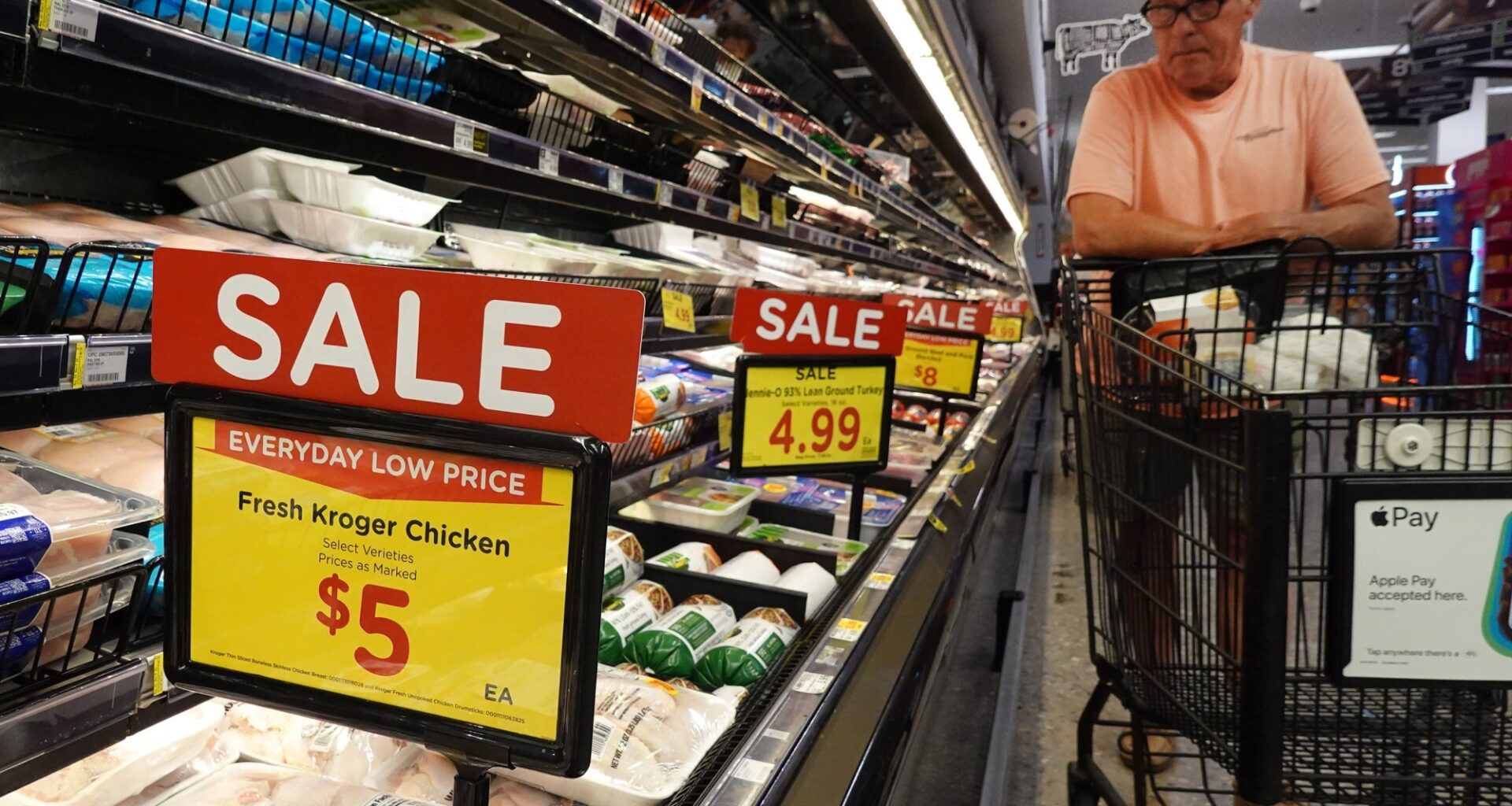
In a trend that echoes that of two years ago, inflation and economic concerns have taken center stage during the 2026 midterm election, as persistent high prices have created a widespread sense of dissatisfaction with the political status quo.
That trend is apparent in the Lehigh Valley, one of the nation’s most purple political areas and home to the most expensive congressional race in Pennsylvania.
Democrats see voters’ widespread disapproval as an opportunity to win over swing overs, while Republicans are largely on defense about Donald Trump-backed policies like tariffs and the Iran war that have led to higher prices, and are instead attempting to highlight more popular moves from the administration, like tax cuts.
The persistent dissatisfaction from voters has led to widespread disillusionment with politics in general, low approval rating of both political parties, and an apparent “cycle of backlash” that could see incumbent politicians punished — Democrats are heavily favored to take back control of the House in 2026, and the Lehigh Valley’s 7th Congressional District race between Democrat Bob Brooks and Republican Rep. Ryan Mackenzie is a top target.
According to the Bureau of Labor Statistics, the consumer price index rose 0.6% in September and 3.7% year-over-year. The rise in the index largely came from a major spike in gasoline costs, 9.1%. Experts attribute the rising cost of fuel to the ongoing Iran war, which has stymied the flow of oil into the United States.
According to a recent Harris poll, over 60% of voters believe that the U.S. economy is in a recession, including 72% of Democrats, 61% of independents and 50% of Republicans. Voters ranked gas prices, grocery prices, living expenses and healthcare costs as their top concerns heading into the midterms.
Voters in the Lehigh Valley are feeling pain at the pump and the cash register. How will that affect how the district votes in November?
Economic struggles
Grocery store shoppers in Upper and Lower Macungie townships, near the heart of one of the swingiest districts in Pennsylvania, said they are upset and sometimes angry that food, gas and other everyday necessities are increasingly unaffordable.
Brenda Nieves of Allentown said she is a full-time caretaker for her fiance, who is on dialysis. She drives him to multiple dialysis appointments a week in Fogelsville — a 40-minute drive — so the rising cost of gas has only made her financial situation more difficult.
“I really can’t afford too much. I constantly keep my gas tank at half a tank. So at least if I have half a tank in there, I’m OK. But as soon as I reach that point, I go put gas in,” Nieves said. “I normally, before all of this madness, I was able to fill up — with $40, I was able to fill up my gas tank. Now I can’t.”
It’s not just the cost of gas; Nieves has seen the price of a load of laundry at her local laundromat increase from $6 to $10, her electricity bill go from $120 to nearly $250 a month and the cost of repairs to her vehicle double, from $900 to nearly $1,800.
Nieves, a lifelong Democrat, blames Trump and Republicans in Congress for those financial troubles, citing the war in Iran and cuts to social programs like SNAP and Medicaid.
She said she plans to vote “straight blue” in November. Brooks, who has drawn on his blue-collar background to make his appeal to voters, has made the case that he understands better than most politicians what it means to financially struggle.
“I feel that [Brooks] knows what it is to live day-by-day. I don’t know if he earns his paycheck day-by-day, if he works like me, unfortunately, I work from paycheck to paycheck,” Nieves said. “It’s hard for me to save because of the situation. I’m sure he’s gone down that road before.”
Daniel Jasuilewicz lives in a senior housing complex in Easton, meaning that his housing costs are relatively low but, still, he has little left over to pay for nonessentials — like corn to feed the deer that live nearby — after paying his monthly bills.
“If I wasn’t in senior housing, I don’t know what I would do,” Jasuilewicz said.
“There’s money left over, but the only reason it works out that way is because I’m careful about what I do,” he added.
The Easton resident said he is frustrated by what he sees as broken promises from Republicans, and plans to vote for Democrats in the midterm elections.
“I would vote Democratic because, for a simple reason: that every time Republicans get in, they say they’re going to do things, but they give wealthy people a tax break, and everybody else ends up paying for it,” Jasuilewicz said.
Jasuilewicz said he hopes Brooks will try to bring down prices and hold Trump accountable on the status of peace negotiations between the United States and Iran.
Jared Labarba, a Bethlehem small-business owner, said he considers himself an independent who has voted for both Republicans and Democrats in the past, including Barack Obama and Donald Trump. In an interview, he did not specify whom he would vote for in November, but added that he does not know much about Brooks, and believes that Mackenzie has “not done a bad job.”
However, he said he doesn’t think “the people’s best interests are always in mind of any politician,” Republican or Democrat.
“I think it unfortunately comes down to … reelecting and then who can say the right things at the right times. I mean, I think when things are going great, everybody takes credit; when things are going bad, everybody pushes it off,” Labarba said.
His attitude reflects a widespread national mood of disillusionment with both political parties and the status quo in general. According to a compilation of polls from Real Clear Polling, just 37% of voters have a favorable opinion of the Republican Party and 40% approve of the Democratic Party.
The widespread political disillusionment has led to election cycles that have not been kind to incumbents, Lehigh University political science professor Chris Borick said.
“If you look at the political environment in the United States, right now, it is an era of searching for some answers that don’t seem to arrive,” Borick said. “And thus we do see the vacillation, we are now vacillating with the last three presidential elections we moved from Democrat to Republican, Republican to Democrat, Democrat to Republican, we have seen control flip back quickly between legislative bodies. There seems to be this nagging desire for something better that’s not produced.”
The case for Republicans or Democrats
Democrats arguably have an easier case to make than their counterparts: As the minority party for the last two years, they have vowed to reverse Trump-backed policies they claim have harmed the U.S. economy, like tariffs, the war in Iran and cuts to social programs like Medicaid and SNAP. Some Democrats, including Brooks, are also running on an anti-corruption agenda, and have vowed to raise taxes on the wealthiest Americans, ban stock trading, implement term limits and repeal Citizens United, the Supreme Court ruling that removed limits on political spending.
“Regular people are getting tired of getting kicked in the teeth,” Brooks said at a campaign event this year. “What’s happening in Washington right now is not working for us. It’s time to send them a message.”
Still, amid the economic strife, Republicans are pointing to some positive gains they have made on economic issues that they hope will persuade voters to give them another two years in control of the House.
On the campaign trail, Mackenzie has highlighted tax cuts supported by Republicans, tens of millions in federal grants and his constituent services efforts to persuade voters to give him a second term.
Rick Reppert, owner of construction company RL Reppert and a supporter of Mackenzie’s campaign, said good things take time, and he trusts that Republicans will deliver on their promises to lower prices if they are granted House and Senate control next year.
“The gas prices, they were high under Democrats, too. This isn’t the first time it’s been high,” Reppert said. “In construction, things have to get worse before they get better when you’re trying to fix something — on a project of ours, costs will skyrocket before coming down and getting better.”
Mackenzie has also aimed to deflect attention away from economic concerns by waging attacks on his opponent, Brooks. He has labelled his Democratic opponent a “crook,” “nutjob” and “criminal” based on a now-settled lawsuit with his former in-laws and reports from conservative news outlets about Brooks’ lawn care business and tenure as Pennsylvania Fire Fighters’ Association president.
Brooks has denied any wrongdoing and called on Mackenzie to focus on his legislative record instead of personal attacks.
Personal and character-based attacks are common in the most competitive races across the country, including in Pennsylvania’s 1st Congressional District in Bucks County, the Ohio gubernatorial race and Michigan Senate race, among others.
“You see that in a lot of races right now, that you make your opponent to be unfit for office, which is time-honored, right? That’s not new, but you double down on that, because you might not have the same opportunities on an issue like economic matters,” Borick said.
Still, Democrats are betting big on dissatisfaction with the economy as the crux of their pitch to voters. By and large, they expect it to pay off: Democrats are heavily favored to take back control of the House in 2027, and their path to doing so may run through the Lehigh Valley.
The Cook Political Report this month changed its forecast of the 7th District race from a “toss-up” to “lean Democrat,” indicating good news for Brooks.
“Inflation is, of all things, all economic things, perhaps the most potent politically, because it’s a constant reminder of the limitations of what you can now do with the same amount of resources, and it hits people hard, right? It’s like, ‘OK, I’ve just filled up my tank and it cost me $20 more, and I filled up my grocery bags and it cost me $40 more there, and now that that money is gone, and I have no ability to do what I used to do with it,’ ” Borick said. “And that’s just that’s frustrating to people and they want answers. And in this election cycle, it’s turned on the party in power like it was two years ago, except it’s a different party in power.”
Reporter Lindsay Weber can be reached at Liweber@mcall.com.