
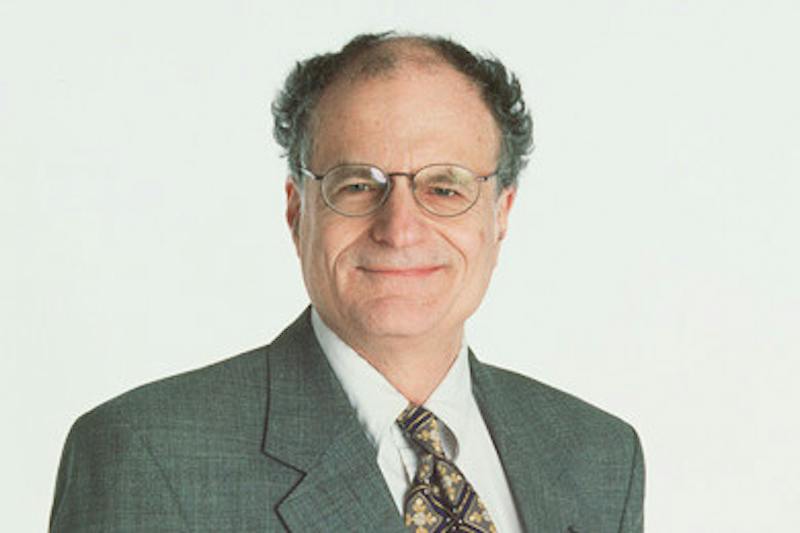
One of the Wharton School’s newest professors is a Nobel Prize-winning economist.
Thomas Sargent has returned to Penn over five decades after serving as an economics professor in 1970 — a post he held for a year and a half. In 2011, he received the Sveriges Riksbank Nobel Prize in Economic Sciences for empirical research on cause and effect in the macroeconomy.
In a press release, Sargent — the newly appointed Rowan Distinguished Professor of Finance — credited collaborations with fellow Penn professors in the 1970s with shaping the research path that eventually earned him the Nobel Prize.
He added that he views himself as a “symbol of all the economists who put in the work leading up to the recognition.” In 2011, he was recognized alongside fellow economist Christopher Sims.
The pair carried out their research independently, but produced complementary findings that has led to global policy adoption. They both developed new methods to study how economic policy affects macroeconomic variables such as gross domestic product, inflation, employment, and investments.
Get the DP delivered straight to your inbox.
Sargent’s own research focused on how households and firms respond to economic policy and how their individual expectations influence the economy.
This year, he is among nine new faculty members joining Wharton. Sargent’s return marks another Nobel laureate affiliated with the University.
Since the Nobel Foundation was created in 1901, Penn has employed 30 Nobel laureates — including eight for economics.
Sargent’s new title stems from a $50 million dollar gift from Marc and Carolyn Rowan in 2018 — which was contributed to help Wharton to attract and recruit faculty who are global leaders in their fields.
At the time of the donation, it marked the largest single contribution in the school’s history.
At Wharton, Sargent will continue his research while teaching FNCE 9350: Foundations of Statistics and Information — a capstone course for PhD and master’s students.
He has also joined the Finance Department’s Macro Lunch Group, which brings together researchers from the Finance Department, Penn Economics Department, and the Research Department of the Federal Reserve Bank of Philadelphia.
In the past, Sargent has held teaching and research positions at the University of Chicago, Stanford University, Harvard University, Seoul National University, and New York University — which is where he was stationed when he received the Nobel Prize.
He has also held roles with the Federal Reserve Bank of Minneapolis and the National Bureau of Economics Research.