
Roxanne Nelson-Moore knows the difference a few hours can make.
Every six weeks, the 65-year-old East Norriton resident spends about two hours at Jefferson Health’s Center City campus undergoing a blood exchange to treat sickle cell disease. Her blood is removed through a double port in her chest and replaced with donor blood, a treatment she said has improved her hemoglobin levels and helped with other health conditions.
“Once I have my exchange, I feel alive,” Nelson-Moore said.
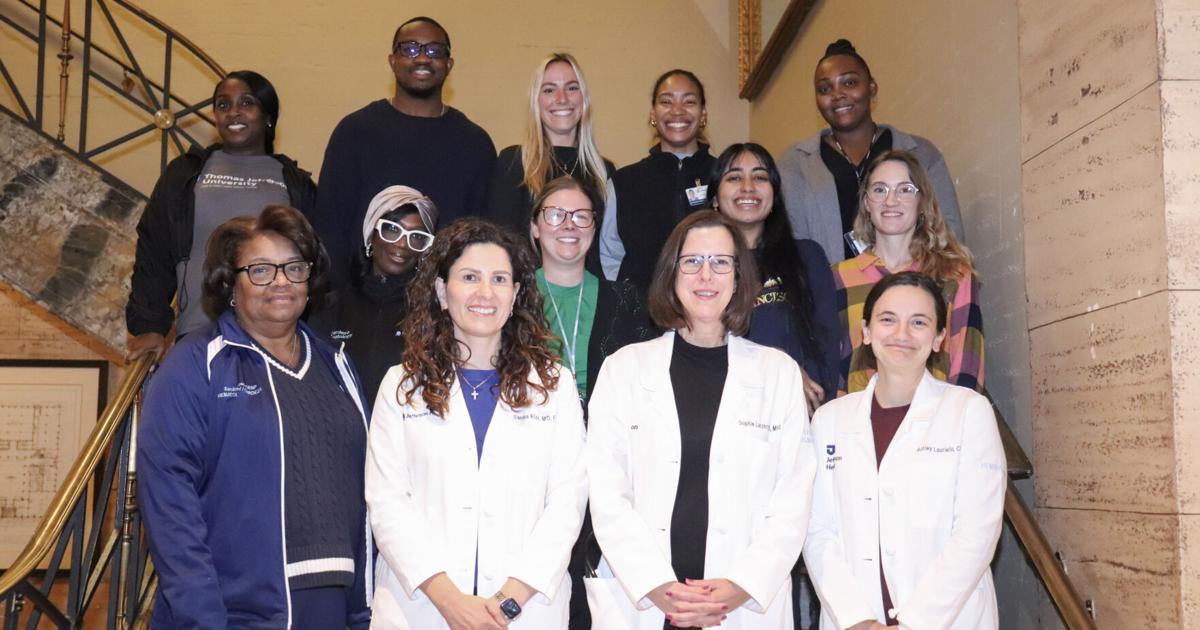
Nelson-Moore is among about 400 sickle cell patients treated by specialists at Thomas Jefferson University, which received the U.S. Department of Health and Human Services’ 2026 Sickle Cell Disease Regional Care Excellence, or SoRCE, Award.

Roxanne Nelson-Moore
The recognition comes with $950,000 in annual funding over the next four years and is intended to improve access to specialized care for people living with the inherited blood disorder.
For Nelson-Moore, the need for that care stretches back decades.
She grew up suspecting she had sickle cell disease, but the genetic disorder did not begin causing significant problems until she joined the military in her 20s.
Nelson-Moore began experiencing joint pain that was treated with morphine. Her symptoms eventually became so severe that she was discharged from the military early.
“I was still able to function, but some things were a little hard, like physical training,” Nelson-Moore told The Philadelphia Tribune. “When you overexert yourself, then it really aggravates the sickle cell, as far as the oxygen and everything in the blood cells.”
Treatment for the disease
Sickle cell disease is an inherited blood disorder in which red blood cells become crescent- or sickle-shaped instead of round. The cells can break down more quickly than healthy red blood cells and become stuck in small blood vessels, resulting in anemia, reduced oxygen flow and episodes of severe pain.
The disease disproportionately affects Black Americans. More than 90% of people with the disease in the U.S. are non-Hispanic Black or African American, according to the Centers for Disease Control and Prevention. About 1 in every 365 Black babies is born with sickle cell disease, while about 1 in 13 is born with sickle cell trait, meaning the child inherited a sickle cell gene from one parent.
Treatment for the disease has evolved beyond managing chronic pain episodes and can include medications, blood transfusions, gene therapies and bone marrow transplants.
At Jefferson, patients dealing with some of the most debilitating effects of sickle cell disease, as well as those receiving chronic opioid or disease-modifying therapies, are seen at least every three months. Patients with milder symptoms are generally seen every six months.
Patients also receive screenings every three to 12 months to identify possible organ damage that may occur without obvious symptoms.
Dr. Sophie Lanzkron of Thomas Jefferson University Hospital cares for patients with sickle cell disease. —TRIBUNE PHOTO/KAYLA BROWN
Kayla Brown
TRIBUNE PHOTOGRAPHER
Nelson-Moore followed Dr. Sophie Lanzkron from Johns Hopkins University in Baltimore, MD to Jefferson. Nelson-Moore more had been commuting by car from East Norriton to Baltimore. Lanzkron, who has served as a principal investigator on previous federal awards and led Jefferson’s application for the most recent award, said her department treats about 400 patients with sickle cell disease.
“The purpose of this grant is to try to improve high-quality care for people with sickle cell disease,” Lanzkron told The Tribune on Thursday.
She said one of the biggest challenges is ensuring that patients can receive care from medical professionals with specific expertise in the disease.
“The reason that I do this is because I think one of the most important things is to make sure that people living with sickle cell disease know that they need care at a high-quality sickle cell center with people with sickle cell expertise,” Lanzkron said.
“This isn’t usually your community hematologist, who’s a lovely human being, I’m sure, but really doesn’t have the level of expertise that’s needed. Everybody needs to see a sickle cell expert, but there aren’t many of us.”
Jefferson Health lists sickle cell care among its clinical specialties, offering diagnostic services and individualized treatment.
The federal award recognizes Jefferson as one of seven centers across the country providing services close to communities in need.
“People living with sickle cell disease deserve access to high-quality care and support close to home,” Health Resources and Services Administration Administrator Tom Engels said in the announcement.
“Through the SoRCE Program, HRSA is strengthening regional networks that connect clinical expertise with trusted community partners so more individuals and families can get the care and services they need.”
The need is particularly significant in Philadelphia. The Sickle Cell Disease Association of America, Philadelphia/Delaware Valley Chapter, told The Tribune that about 2,000 city residents are living with sickle cell disease.
Zemoria Brandon, a social worker with the chapter who lost her husband to sickle cell disease, said Jefferson’s approach extends beyond medical treatment.
“They have a comprehensive program, which includes a social worker, behavioral specialist, nurse practitioners,” Brandon said. “They have an infusion unit in the [emergency department], meaning that when people come to the emergency room that have sickle cell disease, they will have access to this unit so they don’t have to sit around, waiting for hours to be seen. They also have an adult support group that meets monthly, which we co-facilitate.”
Lanzkron said partnerships with organizations such as the Sickle Cell Disease Association are critical because they allow health care providers to connect with people outside the walls of hospitals and medical offices.
“They’re essential,” she said. “They’re an essential sort of ability for us to sort of stretch out the care that’s needed. Many of the community-based organizations in our region provide community health workers. These are people who are boots on the ground, who can identify people who are not necessarily in care but need to be in high-quality care.”
Lanzkron said the federal funding will also allow Jefferson to expand collaboration and “telementoring” with other physicians.
Improving treatment, she said, also requires confronting the longstanding difficulties patients have faced when seeking medical care for severe pain.
Previous approaches to the disease contributed to a lack of trust among some patients, Lanzkron said, particularly when they described debilitating pain episodes that could not be verified through conventional medical testing.
Despite decades of advances, she said, researchers and physicians still do not know enough about the disease to consistently provide effective treatment outside specialty centers.
“The problem in sickle cell disease is that the evidence, for a lot of what we do, just isn’t here,” Lanzkron said. “There hasn’t been enough research done to know.”
The lack of extensive research also affects the clinical resources that health professionals rely on when deciding how to treat patients, she said.
“When you go to the resources that physicians and clinicians use to figure out how to do things, you actually have to have evidence for those systems to work and to tell you what to do,” Lanzkron said. “They’re just not good enough because we don’t have reams and reams of data for how to take care of patients.”
Bunting Macauley understands how dramatically the right treatment can affect daily life.
Macauley spent much of his life dealing with severe pain from sickle cell disease. His episodes worsened during periods of extreme heat or cold, and the condition led to frequent hospital stays.
About 20 years ago, doctors at Children’s Hospital of Philadelphia performed what Macauley described as a “chimera” bone marrow transplant, replacing half of his bone marrow with his brother’s. But the procedure did not resolve his condition.
After moving from Central Jersey to Philadelphia for work, Macauley began seeing specialists at Jefferson. When Lanzkron arrived at Jefferson, Macauley said he immediately noticed something different about her approach.
“She spent her time honestly just asking me questions,” the East Falls resident told The Tribune on Thursday. “She just wanted to get to know me as a patient, my history. I just automatically told her my entire history. Once I mentioned my particular situation, she was like, ‘Oh shoot, let’s find out.’”
Lanzkron ultimately recommended that Macauley undergo a second bone marrow transplant, this time a full transplant.
After undergoing the procedure in June 2025, Macauley said he no longer experiences the pain that extreme heat or cold once triggered.
“My quality of life has greatly improved,” he said. “The change in temperature hasn’t affected me. I’m able to get up and move throughout the day without thinking about sickle cell, which is a transformative thought process for anyone who has gone through sickle cell or has sickle cell.”
Macauley said living with the disease once required him to constantly anticipate how weather, hydration and everyday activities could affect his body.
“We’ve always been concerned about carrying extra jackets [in the winter] or in the summer carrying more water than usual,” he said. “Maybe find different ways to eat or prevent a sickle cell crisis. Over the past 15 months, I’ve had none of that.”
Now, something as ordinary as the arrival of cooler weather feels different.
“Going into this fall season, I just get to enjoy fall, maybe even wearing a light jacket versus being heavily clothed,” Macauley said.
For Lanzkron, giving more patients an opportunity to experience that kind of improvement is at the heart of Jefferson’s work and the federal funding supporting it.
“We’re trying to address it from all angles to have people live the best possible life they can, and that’s part of what this grant is about,” Lanzkron said. “It’s about getting people into that care so that their outcomes can also improve.”
Stay informed and connected — subscribe to The Philadelphia Tribune NOW! Click Here