
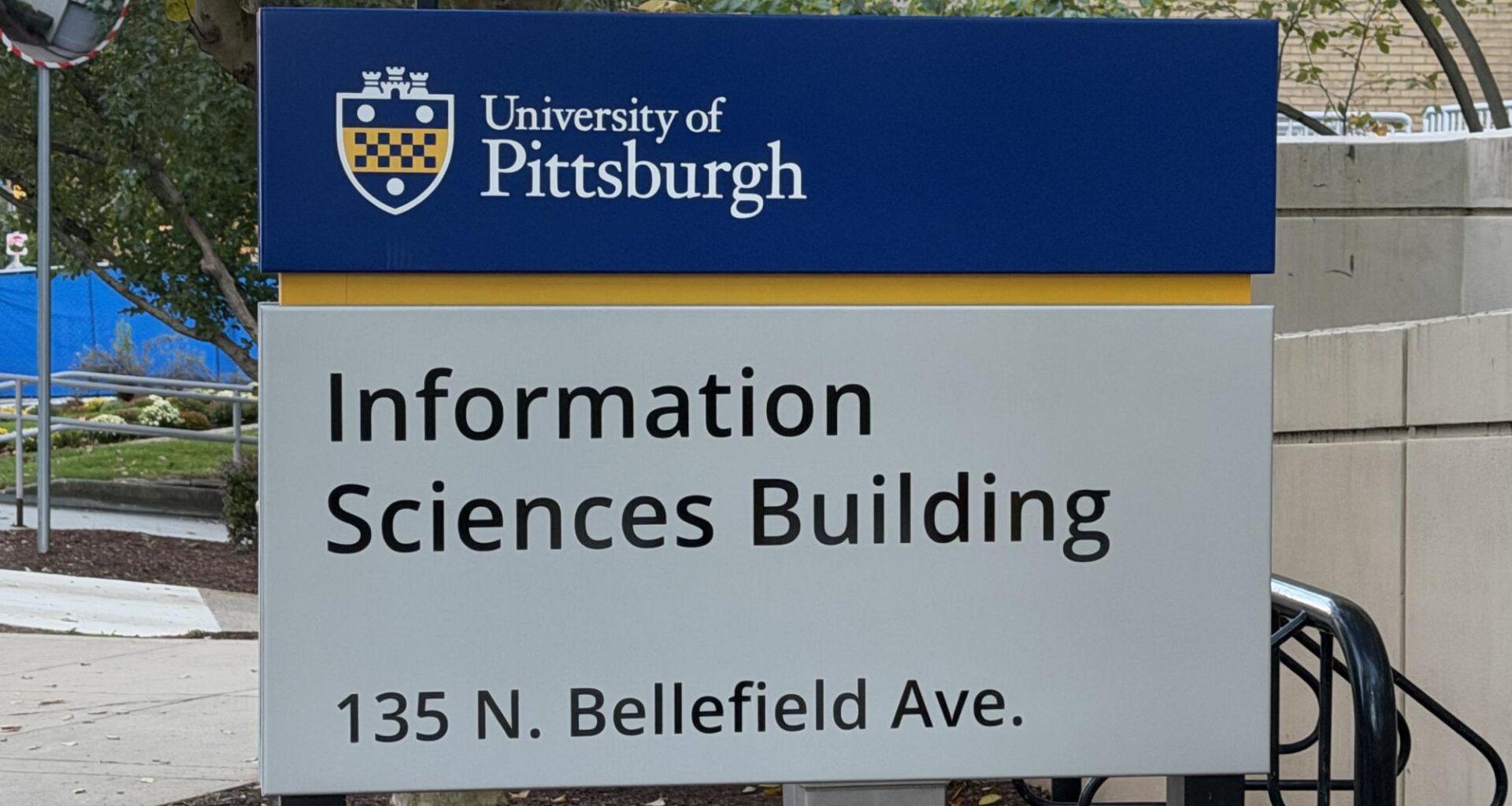
Undergraduate enrollment at Pitt’s School of Computing and Information dropped 18 percentage points within the past year, according to the annual student census released in early October.
In particular, first-year undergraduate enrollment decreased from 310 to 143 from 2025 to 2026, according to additional data provided by a University spokesperson. Faculty and students in SCI said the decreases are partly due to labor market changes caused by the rising capabilities of artificial intelligence.
Adriana Kovashka, chair of the computer science department situated within SCI and an associate professor, explained that computer science and its related areas are undergoing a labor market change for multiple reasons, including a record high employment of computing professionals from 2022 to 2023 and the “great leaps in AI” over the last couple years affecting the kind of knowledge, skills and experience that employers most need.
“These reasons have led to a job market correction,” Kovashka said. “This correction is shifting entry-level employment needs away from traditional roles that focus on routine software development to the orchestration of AI and practical experience in applying AI. This shift has affected student interest and beliefs as reflected in national enrollment trends.”
Kovashka referenced a report from the Computing Research Association showing that in fall 2025, 62% of computing academic units saw enrollment declines.
Kovashka believes the profession is “robust,” yet the bar is “higher than before,” requiring students to have more experience and specialization.
“Companies are having trouble finding enough qualified applicants, partly because applicants do not have real-world work experience and are not prepared to integrate AI in business workflows in an effective manner,” she said. “The skills and experiences that employers look for in applicants has evolved while hiring has tightened for those that do not have those skills and experiences.”
Shreyash Ranjan, a senior computer science major and former president of the computer science club, said there were 244 students in attendance for the first general meeting in 2025 and 137 students at the start of 2026.
Ranjan believes with AI continuously changing, educational institutions are having a hard time catching up to new information, techniques and skills. He said it’s already too late for schools to just be teaching the foundational aspect of AI, adding that this “isn’t necessarily the right direction to go” since researchers are so far past the foundation.
“Models are already so good, so there’s no need to necessarily go into that. What we can do is the application side of things whatever that might be, like making ChatGPT better and Claude better [in application],” Ranjan said. “You’re not going to work too much on the underground kind of stuff.”
Throughout the last 50 years, computing and information science demand has gone through multiple up and down cycles, according to Kovashka and SCI teaching professor Michael Miller Yoder. In interviews, they both referenced the 1990s dot-com bubble, which saw an unprecedented growth of technology followed by collapse in the early 2000s.
Following the COVID-19 pandemic which brought with it a rising demand for digital technology, employment of computing professionals reached a high. Yoder said technology fields follow this “pattern” of high and low demand when economic shifts such as the dot-com bubble, 2008 recession and the pandemic occur.
The Bureau of Labor Statistics predicts a faster overall growth in most computer and information technology professions from 2025 to 2035 compared to the average of all occupations. Projections include a 10% growth in software developing, 21% in information security and 22% in computer and information research science. On the other hand, the BLS predicts a 7% dwindle in computer programming jobs.
Kovashka said programming and computer support services are more at risk, which is partly driven by AI taking on routine programming and service support tasks.
Kovashka said the decrease in SCI enrollment brought a reduction in the number of sections for some core, foundational courses. However, Kovashka said, more work-relevant elective courses are popular and have not seen a significant reduction.
Yoder explained monitoring all the new information or updates on AI is a challenge, though he said he does his best to keep updating the curriculum and wants to prepare students for what employers are looking for.
“It’s hard to prioritize sometimes, with some of the old stuff that I need to get rid of versus what’s foundational and important, what of the new stuff is just a passing fad, or a hype thing that’s not going to be around in a couple of years,” Yoder said.
Ranjan explained that those studying computer science are readjusting by specializing or stepping into a majors less susceptible to disruption from AI.
“What I’m hearing from friends is that they want to go into something where it’s going to be harder to replace, so it’s going to be like electric engineering or computer engineering, where it’s more physical,” he said.
Ranjan said despite how “scary” the field of computer science may be right now, there is a lot of effort to “push the field as a whole.”
“The one really good thing about majoring in CS is it’s always changing. You shouldn’t ever get bored in this field,” Ranjan said. “There are some fields out there that don’t move nearly as fast as we do.”