
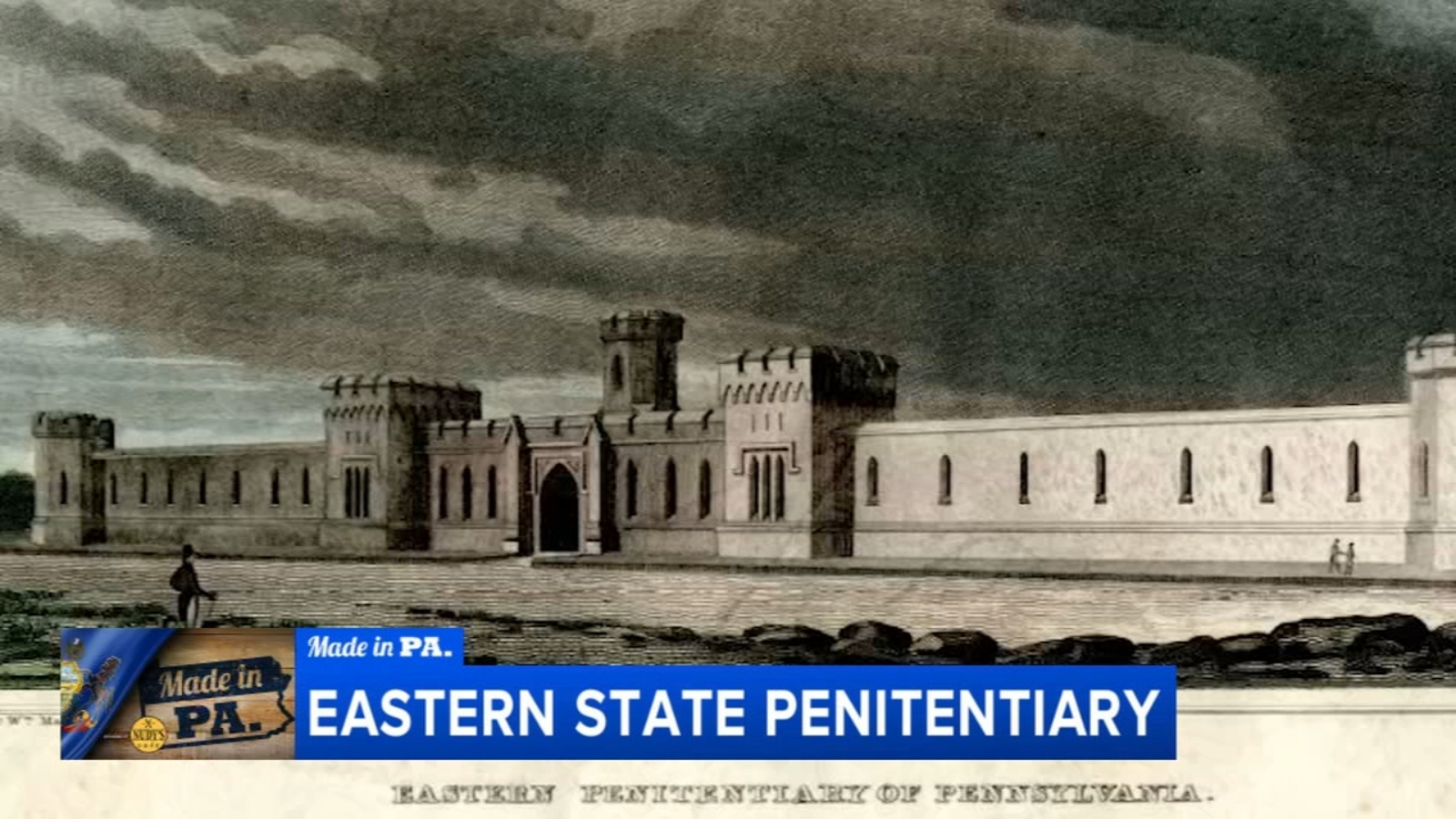
PHILADELPHIA (WPVI) — When Eastern State Penitentiary opened in Philadelphia’s Fairmount neighborhood in 1829, it introduced a radical approach to incarceration: isolating prisoners to encourage reflection, remorse and reform.
The nearly 500,000-square-foot prison was built around the idea that people could change, a concept supported by influential figures including Benjamin Franklin and Dr. Benjamin Rush. Its model would go on to influence prisons around the world.
“This is the place that started a wave in America and around the world to center human dignity in criminal justice, to say that people are inherently good and we can find a way back to that inherent good,” said Kerry Sautner, executive director of Eastern State Penitentiary. “But at the same time, they invented one of the most cruel ways to incarcerate people, long-term solitary confinement.”
Originally designed to hold 250 people, Eastern State housed as many as 1,700 prisoners at its peak in the mid-1920s, including notorious criminals such as Al Capone.
The prison’s approach combined solitary reflection with labor in an effort to inspire contrition rather than simply impose punishment. But the experiment became deeply controversial, with critics arguing that prolonged isolation was inhumane.
Eastern State closed in 1970 and was later preserved as a museum. Today, the 11-acre site explores the history of incarceration while encouraging discussions about the criminal justice system and its impact.
“There’s a lot of teachable moments in a place like this,” Sautner said.
She said she hopes visitors leave with a greater understanding of the people affected by the justice system and questions about how it can be improved.
“I hope they really walk away with two things,” Sautner said. “One, curiosity to understand the people behind the justice system. How does it work, and how do we do better?
“And then two, I hope they understand that, at the beginning and the end of the day, this place was started around the founding ideals of our country, around liberty, fairness and justice.”
Copyright © 2026 WPVI-TV. All Rights Reserved.