
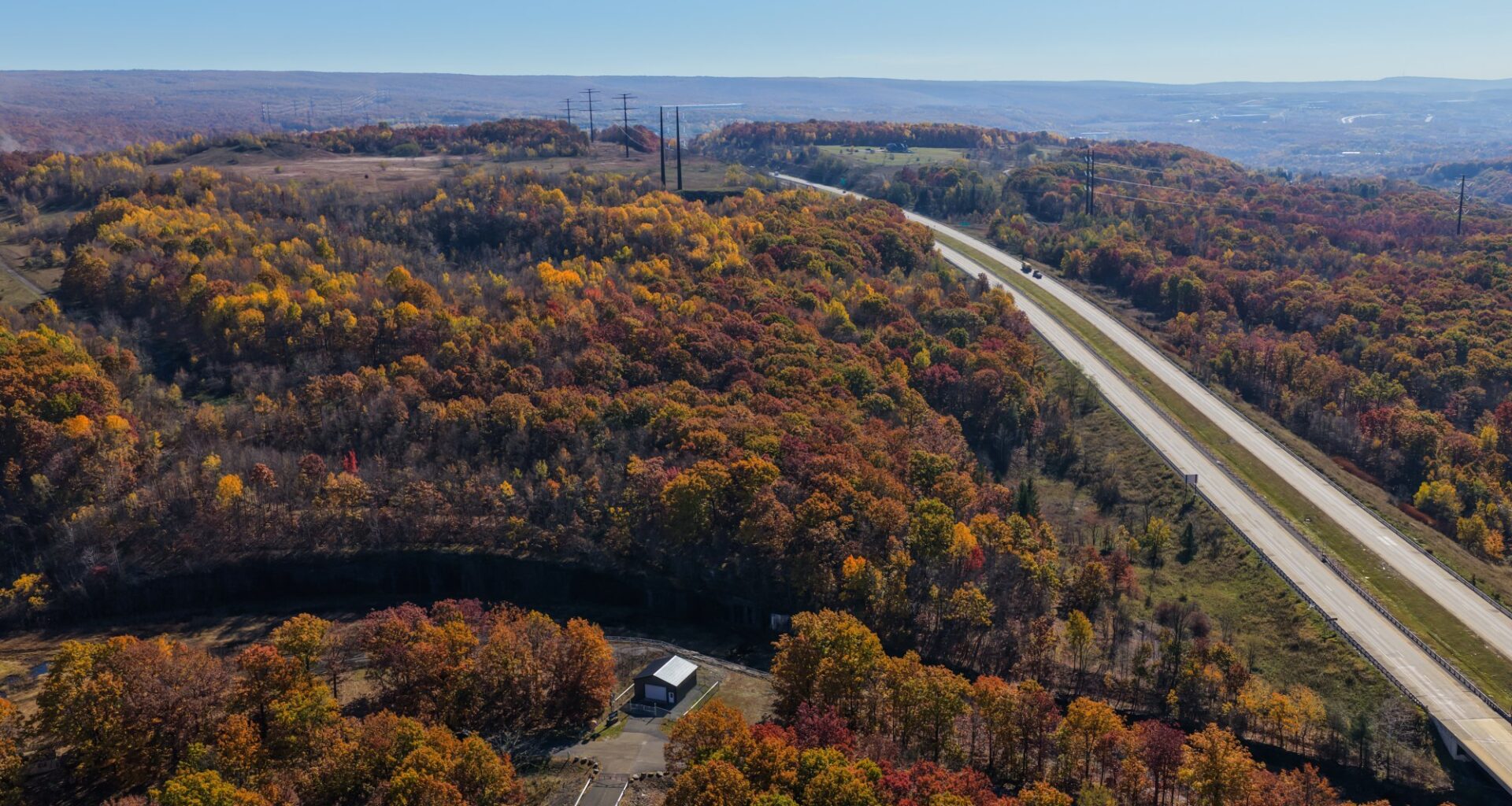
PPL Electric Utilities spent $4 million to acquire just over 230 acres in Archbald south of Aylesworth Park and extending into the borough’s Number 5 Hill neighborhood.
The Allentown-based utility purchased the land from Archbald residents Joseph W. and Nancy S. Kotcho in a deed in lieu of condemnation — an alternative to eminent domain — according to a property transaction recorded Oct. 22 by the Lackawanna County recorder of deeds. Pennsylvania’s statute on eminent domain defines condemn as, “To take, injure or destroy property by authority of law for a public purpose.”
The transaction encompasses property south of Lackawanna County’s Aylesworth Park on both the east and west sides of the Casey Highway. The property is segmented by the highway and existing PPL transmission lines.
The utility plans to upgrade the transmission lines as part of a Midvalley-based project that involves building new power lines and infrastructure spanning the sites of multiple proposed data center campuses.
The property also includes undeveloped land in the Number 5 Hill section of Archbald between Rock Street and the Lackawanna River, continuing south toward Church Street.

Rock Street is seen in Archbald Monday, October 26. 2026. (SEAN MCKEAG / STAFF PHOTOGRAPHER)

Undeveloped land is seen east of the Governor Casey Highway in Jermyn, south of Aylesworth Park Monday, October 26, 2026. (SEAN MCKEAG / STAFF PHOTOGRAPHER)
Show Caption
1 of 2
Rock Street is seen in Archbald Monday, October 26. 2026. (SEAN MCKEAG / STAFF PHOTOGRAPHER)
As part of the sale, the Kotchos retain a swath of land below Lackawanna Street and Hudson Street near the border of Archbald and Jermyn.
In a statement emailed Monday afternoon, PPL Electric spokeswoman Dana N. Burns said the property was acquired for PPL Electric’s transmission system — not for the construction of a data center or power plant.
The utility’s parent company, PPL Corporation, secured more than 11 square miles of northern Lackawanna County this year as part of a joint venture with Blackstone Infrastructure and Invitium Energy to explore building power plants for data centers. The utility’s land acquisition is separate from PPL Corporation’s joint venture, Burns wrote.
“We acquired the Archbald property through a negotiated agreement with the property owners,” Burns said in the email. “Planning and development activities are still preliminary, and we do not have additional details to share at this time regarding specific facilities that may be located on the property or potential construction timelines.”
As PPL Electric’s service territory continues to grow, the utility periodically acquires property that may support electric infrastructure needed to maintain reliable service for customers, she said.
“Our role is to help support the regional transmission grid through careful, long-term planning that strengthens reliability and meets future energy needs,” Burns said.
Attempts to reach the Kotchos were unsuccessful.
PPL’s presence
The land borders property that PPL Electric’s parent company, PPL Corp., is under agreement to purchase as part of its joint venture with Blackstone, known as Invitium Energy. PPL Corp. is distinct from PPL Electric Utilities; Pennsylvania prohibits utility companies from owning and operating their own power plants.
Although the property is in the vicinity of some of PPL Electric’s proposed new infrastructure, it does not appear to overlap with the Archbald Mountain Project.
The Archbald Mountain Project involves constructing about 12 miles of new power lines, three new switchyards and a substation, according to PPL’s project website. PPL’s maps for the infrastructure upgrades depict multiple customer facilities — coinciding with proposed data center campuses — that tie into the new switchyards, including the recently denied Wildcat Ridge Data Center Campus, Project Scott and Project Gravity.
As part of the project, PPL would extend new transmission lines from Callender Gap Switchyard on the northwest corner of Project Gravity’s property near Business Route 6, following existing power lines extending southeast across Main Street and continuing east across the Casey Highway, bifurcating PPL’s newly acquired property.
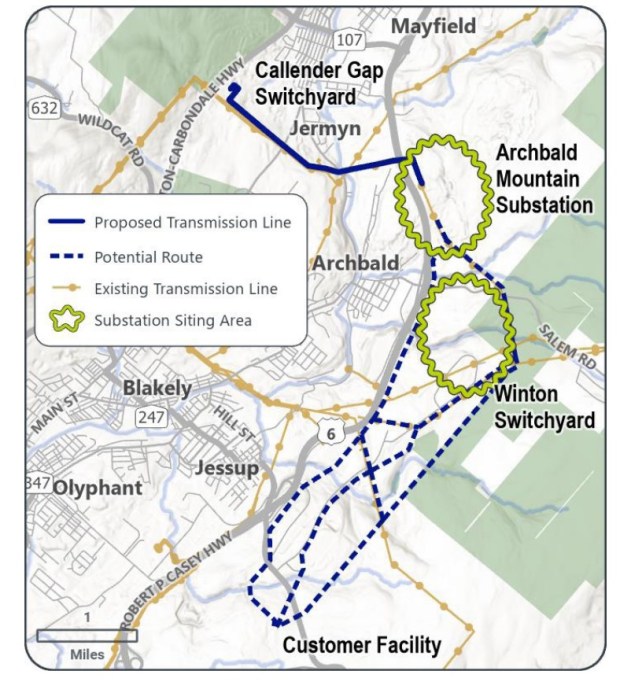 PPL Electric Utilities’ plans for its Archbald Mountain Transmission Project. (SCREENSHOT VIA pplarchbaldmountainproject.com)
An aerial map hosted as part of a virtual open house points to Archbald Mountain Substation south of PPL’s property near the proposed Project Green Mountain data center campus at the Stavola Quarry. Project Green Mountain proposes to build seven two-story data centers, each with a 138,000-square-foot footprint.
PPL’s land also borders the southeast tip of Invitium Energy’s land deal with Dunmore businessman Dominick DeNaples totaling nearly 7,200 acres. Earlier this year, a land holding company for the joint venture between PPL Corp. and Blackstone, NE Keystone Property Holdings LLC, entered into memorandums with DeNaples in April and June for a west campus that begins in Carbondale Twp. above Business Route 6, lines the city and extends north through Fell Twp.; and an east campus that includes properties spanning from near Aylesworth Park north to the Brownell Reservoir in Carbondale Twp.
The joint venture also filed interconnection requests with grid operator PJM for two natural gas power plants totaling 2.25 gigawatts: a 1,500-megawatt facility and a 750-megawatt facility. Invitium has not disclosed where it would build the power plants, though the timing of the interconnection requests corresponds with the west campus memorandum. Representatives with the joint venture attended a Fell Twp. planning commission meeting in September to discuss developing power plants to fuel potential co-located data centers, though Invitium would only build the power plants without owning, operating or constructing the data centers.
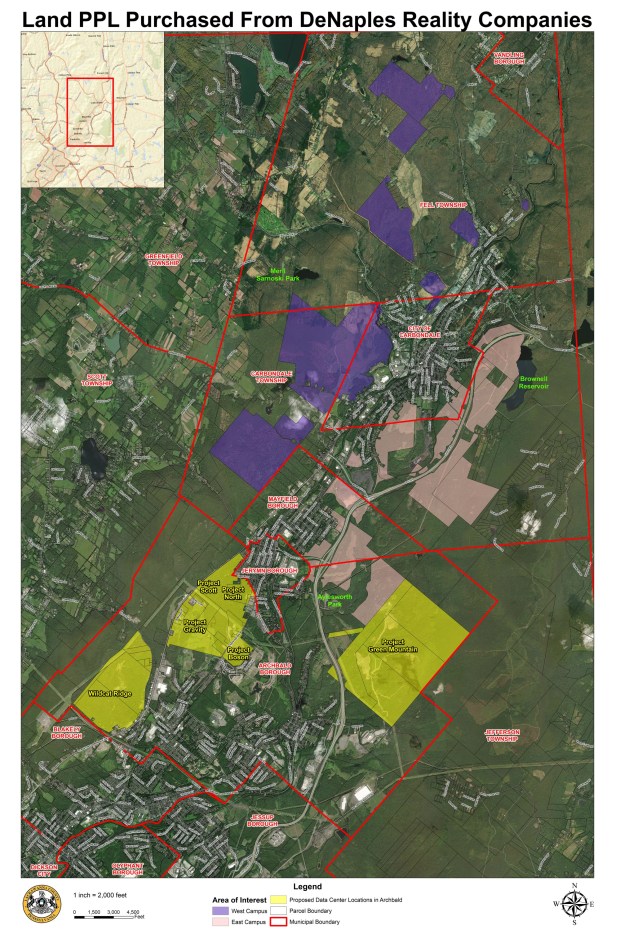 A Lackawanna County Department of Planning map depicting Invitium Energy’s land under agreement to purchase in northern Lackawanna County, in addition to the sites of other data center campuses throughout the county. (COURTESY OF LACKAWANNA COUNTY COMMISSIONER BILL GAUGHAN)
Zoning
The property falls into Archbald’s resource conservation zoning district, which the borough’s March 2023 zoning ordinance defines as, “Areas with significant steep slopes, creek valleys, wetlands and formerly mined lands that may not be suitable for intense development. To provide for lower intensity residential and recreational uses, with uses encouraged to be clustered on the most suitable portions of a tract.”
Archbald’s resource conservation district permits public utility facilities as special exceptions. Special exceptions follow a very similar process as the conditional use designation used to regulate data centers in Archbald, except the zoning hearing board decides on the project rather than borough council. While Archbald’s zoning ordinance regulates public utility facilities, it also defers to a public utility exemption in the Pennsylvania Municipalities Planning Code, or MPC, which provides the legal framework for municipal zoning.
According to the MPC, a public utility could be exempted by the Pennsylvania Public Utility Commission if, after holding a public hearing involving witness testimony and cross-examination, the commission determines the “present or proposed situation of the building in question is reasonably necessary for the convenience or welfare of the public.”
Commissioner’s reaction
Lackawanna County Commissioner Bill Gaughan called the acquisition near the county’s Aylesworth Park “another disturbing chapter in the attempted industrial exploitation of our region.”
In a texted statement, Gaughan said corporations are carving up the valley, buying up enormous tracts of land and laying the groundwork for a sprawling network of data centers, power plants, substations and transmission lines.
“And for what? So some of the wealthiest corporations on Earth can generate even greater profits while the people who actually live here are left to bear the consequences?” the commissioner asked. “We have already lived through one era when powerful industries treated our communities as expendable. I refuse to stand by and watch history repeat itself.”
There is a difference between development and plundering, Gaughan said, adding, “What we are witnessing looks increasingly like the latter.”
“PPL and the data center industry need to understand something: Lackawanna County is not a corporate dumping ground. Our mountains are not theirs to destroy, our neighborhoods are not theirs to disrupt, and our children’s future is not theirs to negotiate away,” Gaughan said. “We spent generations recovering from the damage from the coal barons. We should not sacrifice the next generation to power machines that may ultimately replace the very people being asked to make that sacrifice.”