
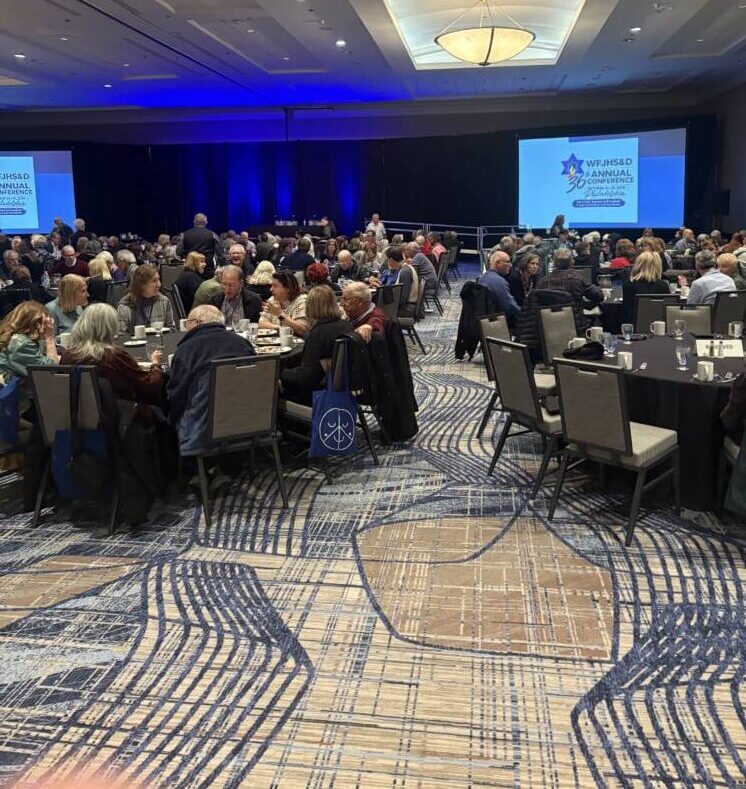
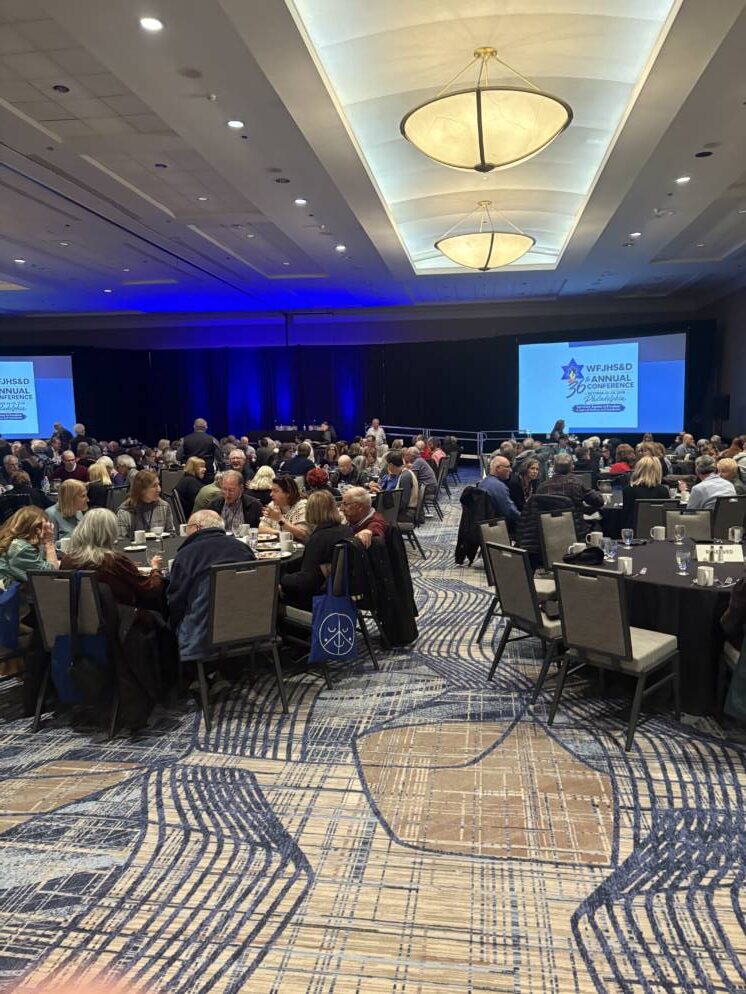
 A Holocaust awareness session at the Sheraton Philadelphia Downtown. (Photo credit: Jon Marks)
Jon Marks
Everyone had a story to tell at what they call the largest “family reunion” in the world.
That’s what the World Federation of Jewish Holocaust Survivors and Descendants’ 36th annual conference, which took place here Oct. 23-26 at the Sheraton Philadelphia Downtown, has become.
“This conference is basically a family reunion,” explained executive committee member Esther Finder, both of whose parents survived their time at Auschwitz before eventually meeting after the war. “This organization was started by child survivors who sought each other out.
“Someone they could be with to replace family they might’ve lost. Someone who understands what they went through. This was started by people who were under 16 at the end of the war. Some of them were infants.
“When they wanted to talk about the war, the older survivors, the camp survivors might have said to them ‘You didn’t suffer. you weren’t in the camps or you were little. What do you remember?’
“They didn’t feel seen or heard, so they came together as a family. They shared their stories and their pain and tears.”
About 400 people gathered to share those stories, ranging from the dwindling number of actual Holocaust survivors, to their children, grandchildren, even great-grandchildren. Philadelphia was chosen to host this year as part of America’s 250th celebration, following Paris last year and Toronto in 2024.
The purpose each time doesn’t change. “I think it’s important because people have to remember,” said Miriam Schupachevici, 90, who escaped from Poland with her family, before settling in Israel, then came to America in 1981. “Because we are passing away and there are not going to be any more survivors.
“So the current generation and the ones that come after have to remember. Otherwise we suffer for nothing.”
Her family, at least, knows the score. “People deny this,” said her daughter, Chaya Amar, who said her children are well-versed in what happened to their grandmother, not to mention the 6 million lost. “People deny Oct. 7.
“People deny the Jewish country. We have four generations. It’s hard to get them to believe things like this. But after Oct. 7 people started believing. ‘Yeah it could happen again.’”
While Miriam, like many others in attendance, did not spend time in actual concentration camps, that doesn’t make them any less Holocaust survivors. Having to flee their homelands under siege while witnessing atrocities, their lives were anything but normal.
“I was in Split, Croatia, which was Yugoslavia at the time,” recalled Sarah Meller, beginning to tell a harrowing tale of the sequence of events that eventually brought her to America. “We were six, four children and my parents.
”The Italians occupied the city and let us live there with restrictions for a couple of years. Then one year into the war, the Blackshirts, the fascists, came one day and burned down the synagogue.
“They made a big bonfire in the piazza right outside and threw everything in the middle, the Torah and holy books.”
Fearing the worst the family fled and went into hiding up in the mountains, eventually snaking their way down when partisans were able to signal a British destroyer which offered them refuge.
“There was one rowboat hiding from the Germans which would take us out to the destroyer,” she continued. “So many people wanted to get on. My mom said to the man on the boat ‘If you put me and my two daughters on I’ll give you everything I have.’
“When we got there I looked up. It was so high. They threw ropes down and we had to climb up. When I put my feet on that ship I said ‘Thank you dear God. I am saved.’”
Meanwhile Bella Hauser has a story of her own, which is more about her late husband of 56 years than herself. “My mother escaped from Poland to Russia, where there were 7,000 Jews,” she said. “If it hadn’t been for Russia I would not be here today.
“But my husband lived in five concentration camps, including Auschwitz and Treblinka. His mother was killed when he was 10. His father tried to run away and was shot.
“He learned a trade and became a builder. He was in the carpenter’s union all his life. I met him in Israel and we were married 56 years.”
They would have a son and daughter, who had a difficult time learning their parent’s stories. “He would never bring it up,” she said. “He had a number [on his arm], so they could see.”
That’s a familiar refrain for second-generation survivors. “In school we used to learn about the Shoah,” said Chaya Amar. “But my parents did not want to share much information, especially my father.
“He always said ‘You’re never going to believe what I have to tell you.’ I think he didn’t want to remember it himself. It’s in the past and he did not want to dig into it.”
The WFJHS&D Conference featured not only survivors, but educators and psychologists engaging in a series of panel discussions and other activities. There was also an array of exhibits including a number of books written by survivor members’ families. “I never knew anything about my grandfather until I read all these letters he wrote,” said Nathan Drew, author of “The Counterfeit Poles, a Memoir with Letters of Survival under Nazi Occupation.”
Esther Linder added that not all survivors were treated equally by the group that organized the first conference here in 1985.
“My parents didn’t qualify because they were 16 at the beginning of the war,” she said, noting that both of them survived Auschwitz and her resourceful father was in 12 camps working odd jobs before being freed. “So they’re not child survivors.
“There’s a huge difference for people my parents’ age who had a childhood and had a foundation of love, respect and stability. Child survivors didn’t have that. They were tossed around in the backwash of war.”
For Jake Sztejman, president of the Children of Jewish Holocaust Survivors Association, the conference, where Philadelphia Mayor Cherelle Parker gave a welcoming address, has been a success. But maintaining it hasn’t been easy.
“Fundraising is very, very difficult right now,” said Sztejman, whose parents met in Siberia after his dad left Lodz, Poland, and mother left Kyiv in Ukraine. “Because it’s an international organization and the events take place in different cities throughout the world.
“Luckily this year we were able to secure some funding to cover attendance by survivors.”
Organizers announced that next year’s conference will take place in Dallas.
Jon Marks is a freelance writer.