
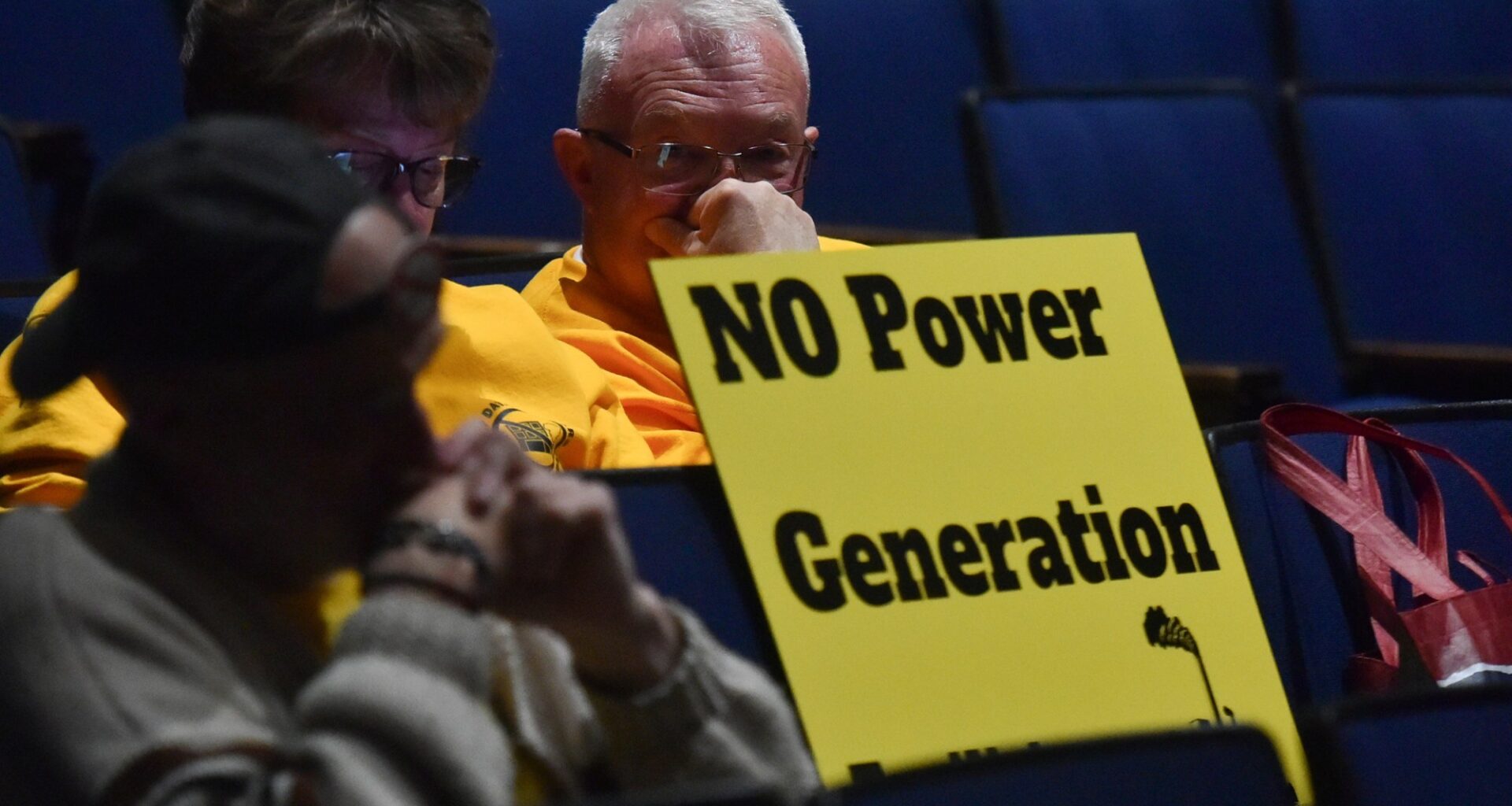
ARCHBALD — Data center opponents and representatives with Essential Energy clashed again Tuesday as they debated whether evolving plans for a 400-megawatt power plant prove the project won’t pose a significant hazard to the public health and safety — echoing concerns at the heart of council’s recent denial of the Wildcat Ridge Data Center Campus.
The monthslong impasse surrounding the conditional use application to construct a natural gas power plant on Eynon Jermyn Road near parks, homes and schools continued as Archbald residents, members of Stop Archbald Data Centers and power plant expert witnesses gathered in the Valley View High School auditorium. Archbald Borough Council’s seventh conditional use hearing consisted of testimony and cross-examination on a two-part site safety report provided by KCI Technologies in Mechanicsburg. The hearing went on for more than three hours.
Essential Energy LLC, a firm affiliated with Kriger Construction Inc., applied in March to construct the natural gas power plant on a portion of the former Highway Auto Parts junkyard. The location is across the street from the nearly 620,000-square-foot Project Boson data center, another project proposed by a Kriger Construction-linked company.
Tuesday’s hearing opened with continued cross-examination of KCI Technologies Technical Lead of Power Generation Andrew Markle, who authored a two-part report that has been the subject of multiple hearings since July. Following Markle’s questioning, engineer W. Casey Deller, a vice president at KCI Technologies who reviewed and sealed the documents as the responsible charge of the report, provided further testimony on the report and the engineering process behind it, including discussions with local first responders.
Deller then faced his own cross-examination, which will resume when council convenes for its eighth hearing in December.
Borough officials and data center opponents have scrutinized Essential Energy’s changing plans and a lack of specifics. Power plant representatives claim they are proving a power plant can be safely operated on the site. They contend that specific plans and information, such as the model of turbines used to generate electricity, will come at a later stage in the development process — after council approves the project’s conditional use application.
Councilman Larry Marchetti asked Markle when council could expect to see something that isn’t fluid.
“It seems the standard answer is this will be done in the future. We’ll figure this out in the future. We’ll do this in the future,” said Marchetti, who inquired about changing risks with changing numbers of turbines. “But in real time, at this moment in time, you’re asking us to make a decision — a go or no go decision — and I don’t understand how that’s possible with things constantly changing.”
There isn’t a “chasm of difference” between the number of turbines the power plant could have, Markle said, instead pointing to the total megawatts as giving a sense of a power plant’s impact.
Although Essential Energy is proposed on industrially zoned land that conditionally allows power plants, its location has driven much of the debate, including its proximity to Staback Park, the Highlands Archbald residential community across the street, and the Valley View School District’s intermediate, middle and high schools on Columbus Drive.
Last week, Archbald Borough Council unanimously denied Wildcat Ridge’s proposal for 14 data centers on the mountainside above Eynon and Sturges. As part of the denial, the borough cited its zoning ordinance’s requirement that an applicant must establish with credible evidence that it complies with all applicable requirements of the ordinance. Data center opponents frequently reference a specific requirement that an applicant must prove “the proposed use shall not create a significant hazard to the public health and safety, such as fire, toxic or explosive hazards.”
Both Stop Archbald Data Centers and Essential Energy officials cited that statute Tuesday night.
Council will hold its eighth hearing Dec. 10 at 5 p.m. in the Valley View High School auditorium, 1 Columbus Drive, Archbald.
‘Path to compliance’
At the start of Markle’s cross-examination, attorney Justin Richards of Elliott Greenleaf PC in Wilkes-Barre, who represents Stop Archbald Data Centers, questioned him about differing testimony and plans regarding how many turbines the power plant would use, going from four turbines to one to two, and how that factored into the safety report.
Markle told Richards the design is refined as they work.
“What is happening is we submit a design at the time that we are getting engaged at that point, and then as we’re working in parallel, we are getting more certain types of design looks,” he said. “So it evolves as we go.”
The number of turbines “has little to do with the overall risks and hazards that exist with these plants,” Markle said.
Richards questioned Markle if his opinion is that Essential Energy would comply in the future with all of Archbald’s zoning requirements.
“You would promise that this project will comply in the future, correct?” the attorney asked.
“That they can follow a path to compliance,” Markle replied.
Richards countered that the Commonwealth Court has ruled that an intention or promise to comply with zoning requirements isn’t enough to show a development is entitled to conditional use approval.
“Are you aware that the Commonwealth Court has stated that a self-serving declaration of a future intent to comply is not sufficient to establish compliance with the criteria contained in the zoning ordinance?” Richards asked.
“No,” Markle said.
Stop Archbald Data Centers co-founder Tamara Misewicz-Healey continued the cross-examination, including about how residents in the Highlands community would evacuate during an emergency. The Highlands only has one route in and out of their neighborhood, and it’s in the direction of the power plant site, she said.
“Yes or no, just so I’m clear, did you assess an emergency evacuation route for the Highlands community in the event of an emergency on Essential Energy?” she asked.
“I did not,” Markle said.
Misewicz-Healey also pressed power plant representatives throughout the night on risks associated with the power plant in a location near parks, homes and schools versus a site removed from the community.
“The severity of the events becomes more when you’re closer to people, closer to residents,” Markle said, pointing to their mitigation measures. “We use the defense-in-depth, so what we have is we have mechanisms that act immediately. We have the operations response. We have the first responder response, so these are all taken so that things are mitigated to a risk that is reasonable.”
‘Later part of the process’
Highlands resident Karen Timmons asked Markle whether he was aware that Eynon Jermyn Road is the only entry and exit for hundreds of families in her community.
He said he was aware.
“I don’t know how all hundreds of us could get out of that one entry and exit point onto the Eynon Jermyn Road, and there really isn’t right now a second access route unless you’re saying maybe the owner-operator would build another road that would take us out another way?” Timmons asked.
“That’s a possibility,” Markle said. “It’s left to a later part of the process to evaluate the options, but you can’t leave it with just one point of egress and ingress.”
Some of her neighbors have chronic health conditions with mobility issues, including some who are homebound, Timmons said.
“Are you testifying that your plant operations will not endanger their safety or the safety of other vulnerable groups?” she said.
The plant can be built in a way that they would have a very low risk of having to evacuate, most likely having to shelter in place instead, Markle said.
Highlands resident Meg Nudelman raised concerns about mine fires beneath the power plant site. She asked Markle whether he would feel confident to approve the project with the information given so far if he were on council.
“Yes, because we’re talking about whether or not it can be done, and these these types of power plants exist all over the country,” Markle said. “There’s hundreds, if not thousands, of them.”
Reduce the risk
With questions guided by Essential Energy attorney Frank Hoegen of Hoegen & Associates in Wilkes-Barre, Deller then expounded on Essential Energy’s safety report and the engineering behind it.
Deller read an excerpt from Archbald’s zoning ordinance regarding a proposed use being prohibited from creating a significant hazard to public health and safety, such as fire, toxic or explosive hazards, concluding Essential Energy would not create that hazard. He frequently pointed to the Lackawanna Energy Center in Jessup as a comparable power plant that first responders are already familiar with.
“Through the proper and reasonable design of a facility of this type, the implementation of an emergency response plan, the collaboration and involvement of first responders, as well as working through the alternate permitting and review process with both Archbald Borough, as well as state and federal agencies, we feel that a facility of this type can meet those standards, and ultimately will have to meet those standards in order to receive the permitting that it needs to construct or to come under operation,” Deller said. “These facilities are not new.”
Council Vice President Joseph Altier III wanted to know how they can discuss emergency crews safely responding to an emergency when plans are fluid without an exact site plan.
“Everything is substantially the same or very similar,” Deller said.
In her cross-examination of Deller, Misewicz-Healey pressed the engineer on what quantifiable data they provided in their report to satisfy Archbald’s requirements for credible evidence.
Deller told her it was based on “engineering judgment, basis of design and engineering standards, typical systems.”
“We are detailing out the specific risks and how those specific risks are addressed in plants and facilities of this type and size,” he said.
Misewicz-Healey countered that it was “qualitative and vague.”
“Maybe it’s semantics between qualitative and quantitative,” Deller replied.
Misewicz-Healey also questioned Deller on the project’s hazards based on its location near residents.
“Would you agree that zoning the power plant with all the same engineering and safety features out of the community, away from residents, would help reduce the risk to the community?” Misewicz-Healey said.
“It would be safer to you, but it might be less safe to someone else,” Deller said. “It would be safest if you put it, you know, on the moon. So, of course, from a risk perspective, if you put it in an isolated area, there’s going to be less risk. … No project is without risks. Our job is to minimize the impacts from any potential risk, or to mitigate those risks, so they don’t become a hazard or impact people.”

Andrew Markle, technical lead of power generation for KCI Technologies of Mechanicsburg, and Frank Hoegan, Essential Energy attorney, answer questions. from Stop Archbald Data Centers Attorney Justin Richards during the hearing with Archbald Borough Council at Valley View High School in Archbald Tuesday, October 27, 2026. (SEAN MCKEAG / STAFF PHOTOGRAPHER)

Archbald Borough councilmember Larry West, council vice president Joseph Altier III, and council president Louis Rapoch listen to the Essential Energy hearing at Valley View High School in Archbald Tuesday, October 27, 2026. (SEAN MCKEAG / STAFF PHOTOGRAPHER)

Stop Archbald Data Centes Attorney Justin Richards questions Andrew Markle, technical lead of power generation for KCI Technologies of Mechanicsburg, and Essential Energy Attorney Frank Hoeganto the Essential Energy hearing at Valley View High School in Archbald Tuesday, October 27, 2026. (SEAN MCKEAG / STAFF PHOTOGRAPHER)

Andrew Markle, technical lead of power generation for KCI Technologies of Mechanicsburg, and Frank Hoegan, Essential Energy attorney, prepare for the hearing with Archbald Borough Council at Valley View High School in Archbald Tuesday, October 27, 2026. (SEAN MCKEAG / STAFF PHOTOGRAPHER)

Andrew Markle, technical lead of power generation for KCI Technologies of Mechanicsburg, and Frank Hoegan, Essential Energy attorney, answer questions during the hearing with Archbald Borough Council at Valley View High School in Archbald Tuesday, October 27, 2026. (SEAN MCKEAG / STAFF PHOTOGRAPHER)

Andrew Markle, technical lead of power generation for KCI Technologies of Mechanicsburg speaks during the hearing with Archbald Borough Council at Valley View High School in Archbald Tuesday, October 27, 2026. (SEAN MCKEAG / STAFF PHOTOGRAPHER)
Show Caption
1 of 6
Andrew Markle, technical lead of power generation for KCI Technologies of Mechanicsburg, and Frank Hoegan, Essential Energy attorney, answer questions. from Stop Archbald Data Centers Attorney Justin Richards during the hearing with Archbald Borough Council at Valley View High School in Archbald Tuesday, October 27, 2026. (SEAN MCKEAG / STAFF PHOTOGRAPHER)