
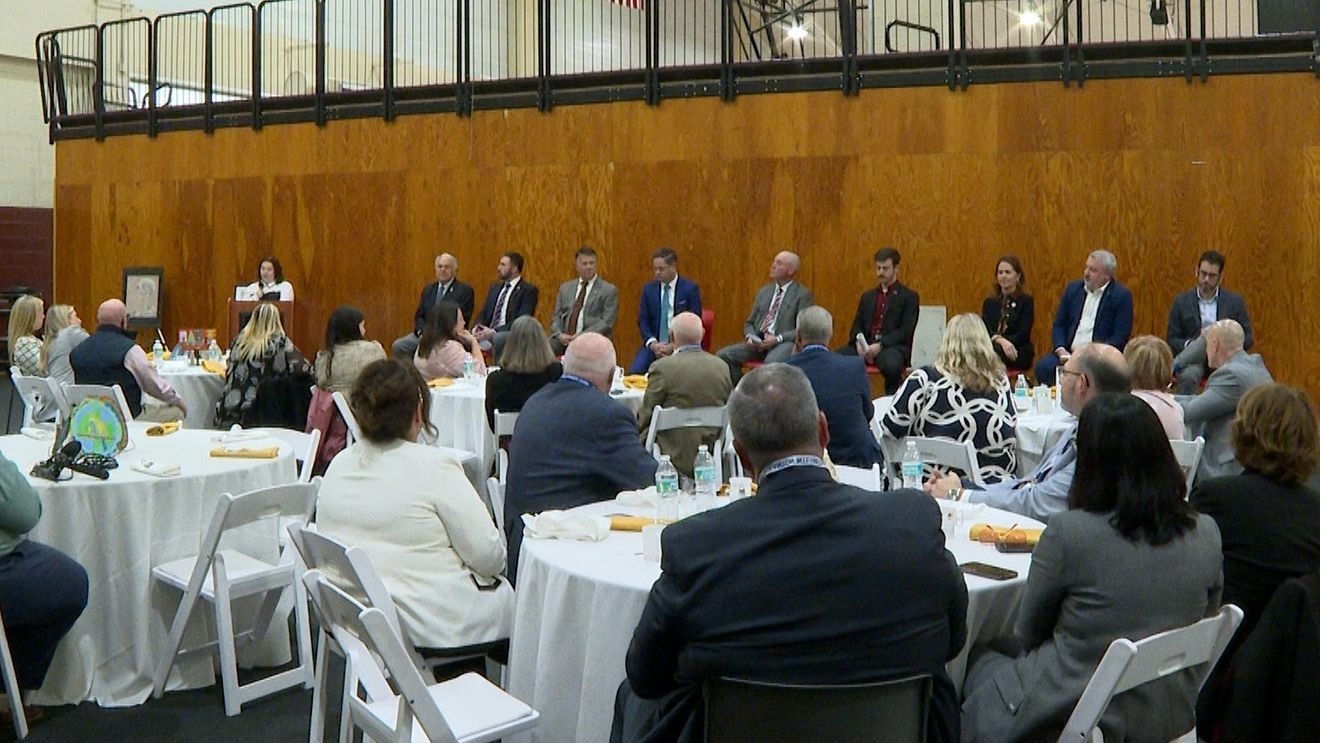
SCRANTON, LACKAWANNA CO. (WOLF) — From funding challenges to special education and cyber charter schools, local lawmakers and school officials gathered in Scranton Wednesday to address some of the biggest issues facing education across the region.
Funding was a major topic of discussion. Scranton School District Superintendent Dr. Erin Keating said she knows firsthand the challenges of limited funding, recalling times when making payroll was uncertain. Now, she says the district is in a much healthier financial position following its financial recovery.
“I know what it’s like to work on a $17 million budget and literally have conversations with your business manager where in April or March you’re going, ‘Do we have enough money to make through June for payroll? Are we okay? What can we do? Do we have to look at cuts?’ And I knew the budget time was just not a really good time to be in. I had been in Scranton when we started recovery. And now being back in strength in a much more healthy fiscal position, we’re $264 million budget,” said Keating.
School mandates were another key topic, with lawmakers stressing the importance of district feedback. Senator Marty Flynn pointed to the new statewide bell-to-bell cell phone ban as an example.
“Governor Shapiro just signed into law, the Cell Phone Ban, that is going to ban cell phones in the classroom. We had to look at the downstream effect that that would have on the school districts and the classroom. Pretty much everybody bipartisanly agreed that we need to take them out of the classroom, and the learning environment. These are the kind of things that we need input on,” said Flynn.
With the growing demand for special education, Representative Bridget Kosierowski raised concerns about the increasing number of students entering school with medical diagnoses, stressing the need for better identification of their needs as districts face rising special education costs.
“I think we have to do a better job with our family doctors, pediatricians, nurse practitioners, and actually diagnosing these little ones. The school district children are coming with a list of diagnostic ICD codes. It’s very difficult. I think we’ve gotten into a situation here in the medical field with diagnostic codes for children coming off to school is growing at a great rate,” said Kosierowski.
Cyber charter schools were another concern. Representative Jim Haddock addressed the challenges of students returning to public schools after falling behind, while Representative Eddie Day Pashinski stressed the financial strain charter schools place on districts.
“It becomes your responsibility to get that student, that’s not up to speed. You have to come up with a plan. You have to spend the extra money and your held to accountability. They are not. That’s another bill we have to hold them accountable, if they failed the student. We’re hoping to maybe get money back from them,” said Haddock.
“We also have to be able to balance, because the thing we deal with is there’s never enough money for everything that we’re required to do or asked to do. So, your role is extremely important to demonstrate all the good that you do with the money that you have and know that our charters are taking money away,” said Pashinski.
Superintendents and board members from nine school districts were also in attendance, along with representatives from the Northeast Intermediate Unit and the Career Technology Center of Lackawanna County.