
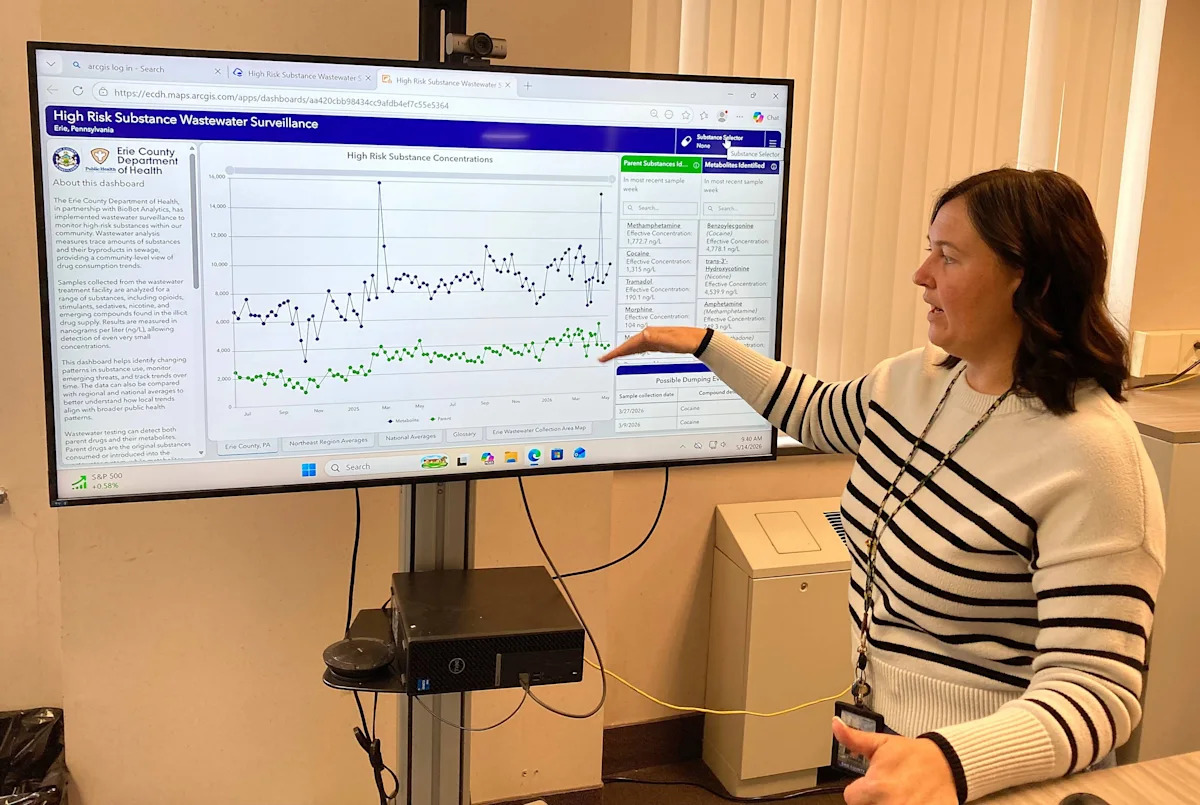
Erie County health officials saw an early summer surge in the amounts of cocaine and methamphetamine in Erie’s wastewater, indicating an increased use of the illicit drugs.
Concentrations of methamphetamine rose by 25.9% in samples taken between June and August 2026 when compared to the same months of the previous year. Overall, the amount of high-risk substances rose during that period by 14.7%.
“It confirms what we have been hearing, that cocaine use has been consistent and methamphetamine use is going up,” said Erin Mrenak, Erie County Department of Health director.
The health department has been monitoring the amount of high-risk substances like cocaine and fentanyl in Erie’s wastewater since June 2024, and started publishing the data on its website in June 2026. It also published a report on the data in September.
The report showed that cocaine and methamphetamine are, by far, the illicit drugs found in the highest quantities in wastewater samples. But county health officials are also concerned about the amount of fentanyl found in samples.
“We are seeing fentanyl picked up in samples at low amounts, but it’s so lethal that even a little fentanyl in the wastewater can be a lot,” said Lauren Mathis, an epidemiology research associate for the county health department.
Samples taken over the past two years also show an increasing amount of naloxone, the medication used to rapidly reverse an opioid overdose. The rise could indicate an overall increase in opioid use, according to the report.
From June: Erie County dashboard tracks amount of cocaine, fentanyl in wastewater
Though the data is published by the county health department, it only represents data from the area served by the Erie Wastewater Treatment Plant: the city of Erie, Wesleyville, Lawrence Park Township, parts of Millcreek and Harborcreek townships, and portions of several other municipalities.
Still, the Erie County Office of Drug and Alcohol Abuse relies on the data to use its resources in a more focused manner, said director Jeanette Redenius.
“It helps us determine which tools we bring to events, such as Narcan and drug testing kits,” Redenius said. “It’s one piece of the puzzle to help us provide strategic planning.”

Lauren Mathis, an epidemiology research associate with the Erie County Department of Health, shows overall trends on the department’s new high-risk substance wastewater surveillance dashboard. The website, which shows the amounts of various drugs in Erie’s wastewater, will go online June 1.
It also helps Redenius and her staff to respond quickly to developing trends, such as the rise in fentanyl use, and get that information to local treatment providers.
“We have also seen an increase in polysubstance use, a mix of drugs where we aren’t sure what people are taking and sometimes even the individual using the substance is not aware of what they are taking,” Redenius said.
Wastewater also shows when drugs are flushed down a toilet or sink
Because monitoring includes some drugs in their regular form and/or as a metabolite, the form they take after they are consumed, county health officials can tell when a significant amount of drugs has been flushed down a toilet or a sink.
Three possible dumping events have been identified since monitoring started in 2024. They include:
Fentanyl on Oct. 13, 2025
Erie sees drug usage rise during the summer, possibly caused by tourism
Mathis noted that the amount of several drugs in Erie’s wastewater tends to rise in the summer and decline in the fall. It’s different from the national and regional trends, where drug usage appears to rise in the fall and decrease in the spring.
“We definitely see more in the summer and it’s almost all substances,” Mathis said. “We’re not sure why. Is it tourism or travel based?”
Contact David Bruce at dbruce@gannett.com. Follow him on X @ETNBruce.
This article originally appeared on Erie Times-News: Erie wastewater data shows rise in illicit drug usage