

Solar activity increased significantly over the past 24 hours due to a long-duration X1.2 solar flare at 09:19 UTC on November 10 from active Region 4274 (beta-gamma-delta).
The eruption produced a Type II radio sweep with an estimated velocity of 1 321 km/s (821 miles/s), a Type IV emission, and an asymmetric halo coronal mass ejection (CME). The event was also accompanied by an F10.7 cm radio burst of 860 solar flux units and a Castelli-U radio burst, driving S1 – Minor Solar Radiation storming.
The CME associated with the X1.2 flare is expected to arrive early on November 12, following an earlier CME from the X1.7 flare on November 9 that is forecast to arrive late on November 11. Together, these events are expected to produce enhanced solar wind conditions with speeds likely to exceed 700 km/s (435 miles/s).
X1.2 solar flare on November 10, 2025. Credit: NASA SDO/AIA 304, Helioviewer, The Watchers
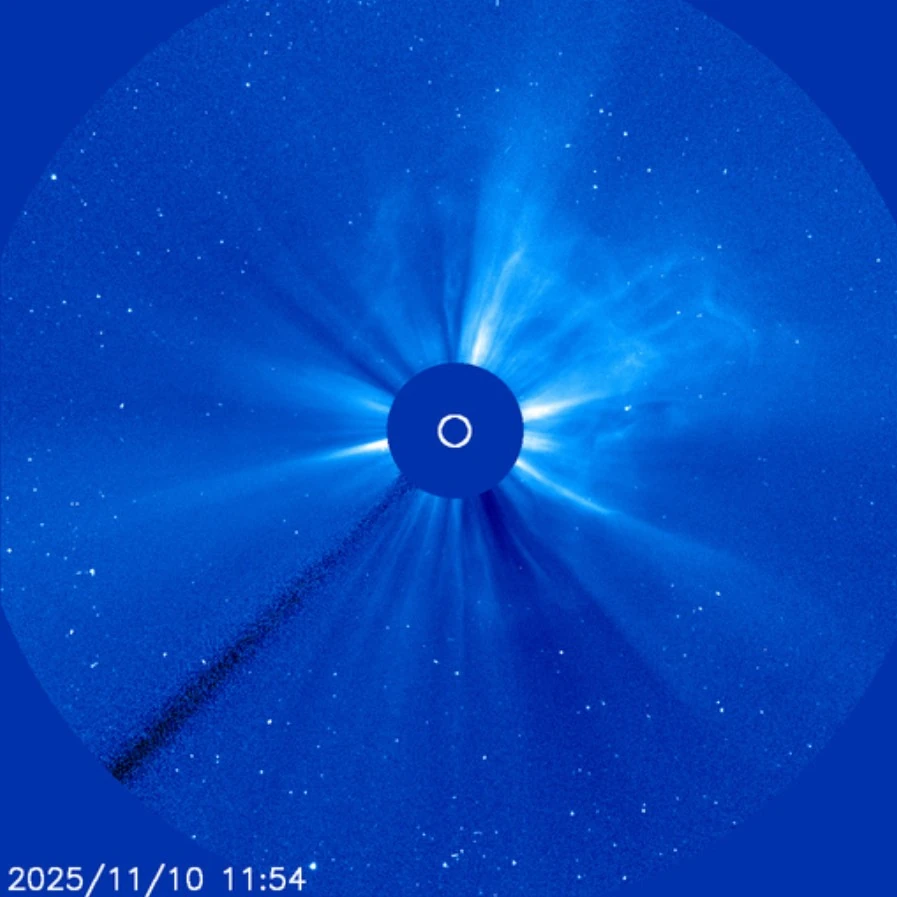 CME produced by X1.2 solar flare on November 10, 2025. Credit: ESA/NASA SOHO/LASCO C3
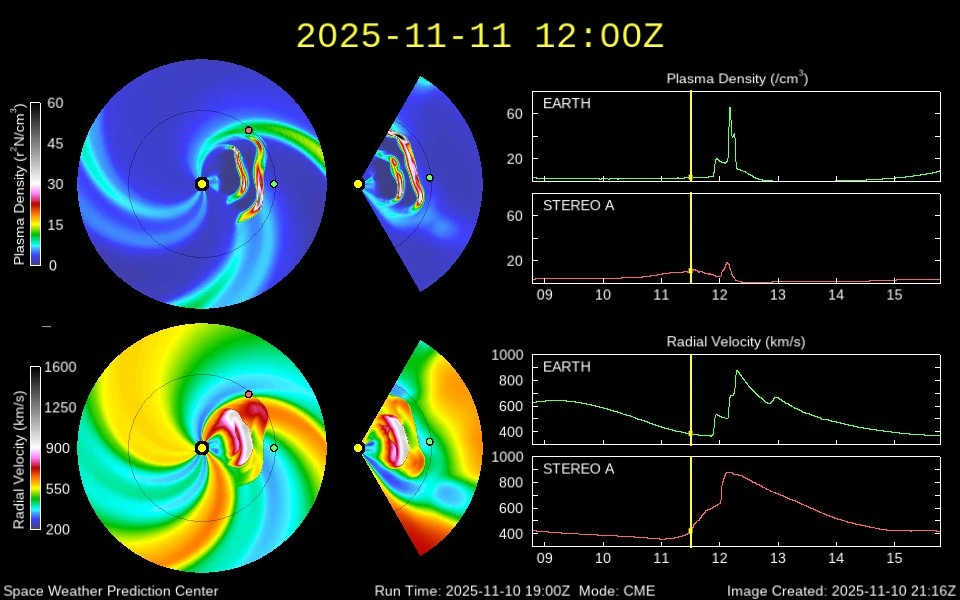 Image credit: SWPC
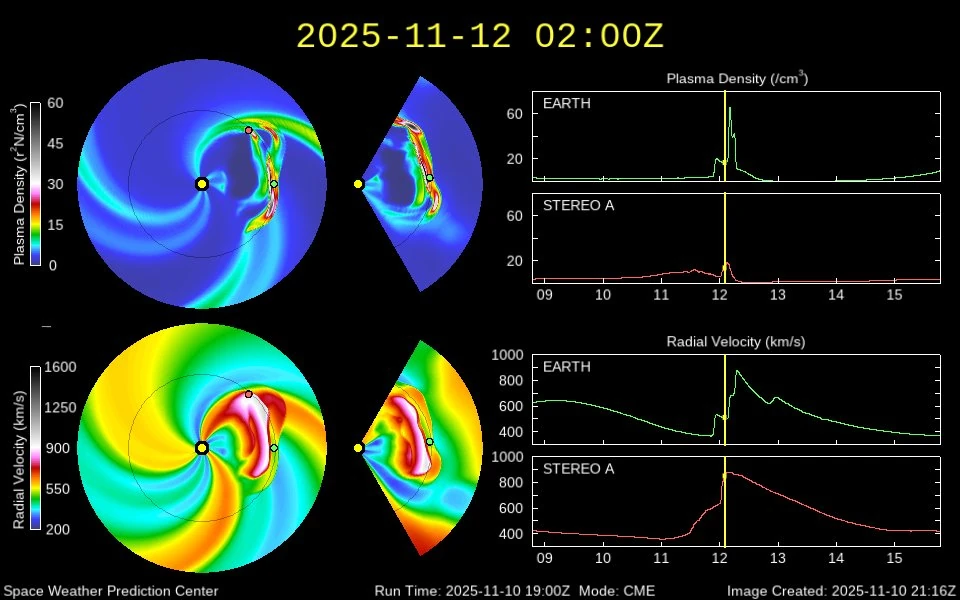 Image credit: SWPC
SWPC forecasts G2 – Moderate geomagnetic storm levels by late November 11, increasing to G3 – Strong levels on November 12. Conditions are expected to gradually subside to unsettled to G1 levels by November 13 as CME effects wane.
Geomagnetic storms of G3 intensity can induce voltage irregularities in power systems, cause intermittent high-frequency radio navigation problems, and produce auroras visible at mid-latitudes. During similar events, aurora has been observed as far south as Oregon, Pennsylvania and Iowa, depending on the orientation of the interplanetary magnetic field (IMF) Bz component and local viewing conditions.
Region 4274 continues to evolve magnetically, showing a ‘beta-gamma-delta’ configuration with evidence of rotation and shearing within its southern sector. The region retains potential for additional X-class flares through November 13. A new region, 4280 (beta), was numbered on November 10 but remains comparatively small and less active.
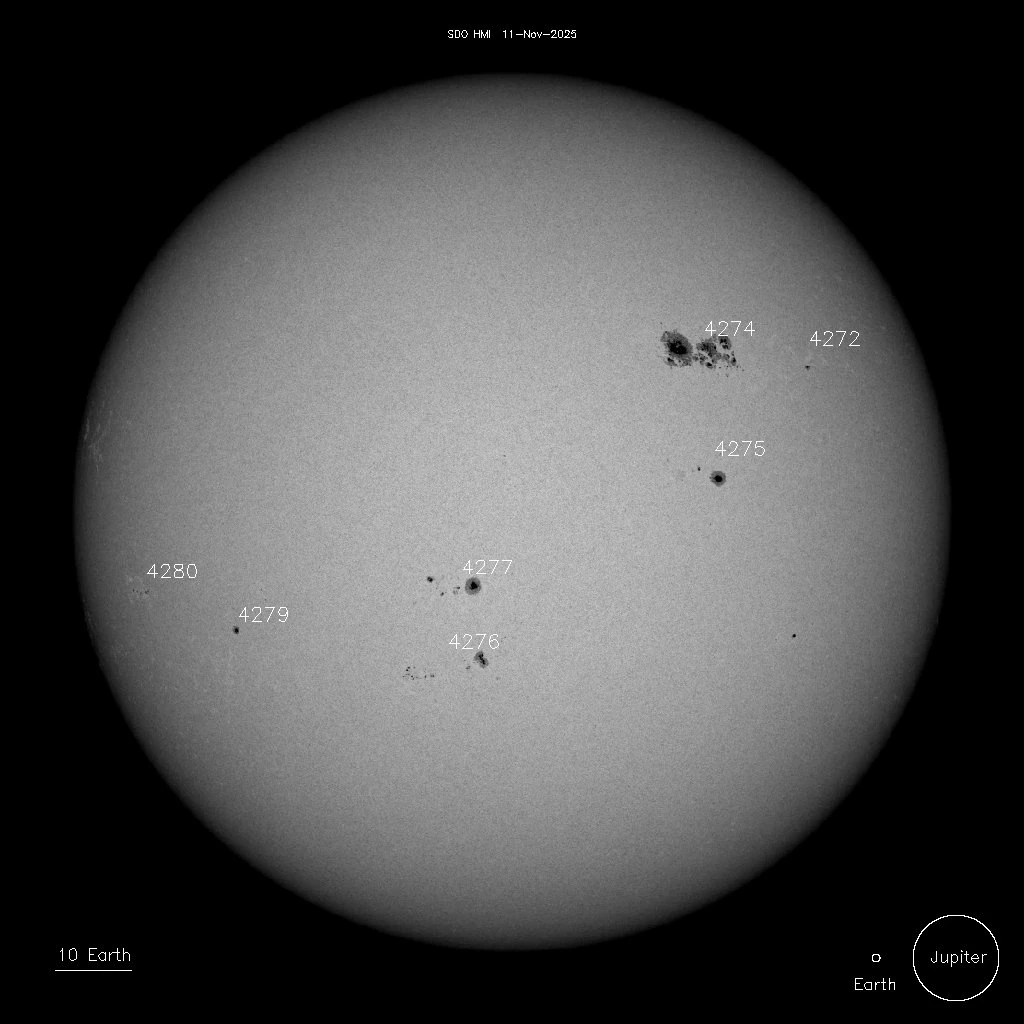 Sunspots on November 11, 2025. Credit: NASA SDO/HMI
The greater than 2 MeV electron flux reached 4 280 pfu on November 10, while the greater than 10 MeV proton flux peaked at 28.2 pfu — S1 – Minor Solar Radiation Storm storm levels. Proton enhancement is expected to persist through November 11 before gradually declining after CME arrival.
The solar wind during the previous 24 hours was moderately elevated under the influence of a high-speed stream, with speeds between 475 and 597 km/s and total field strength varying between 1 and 8 nT.
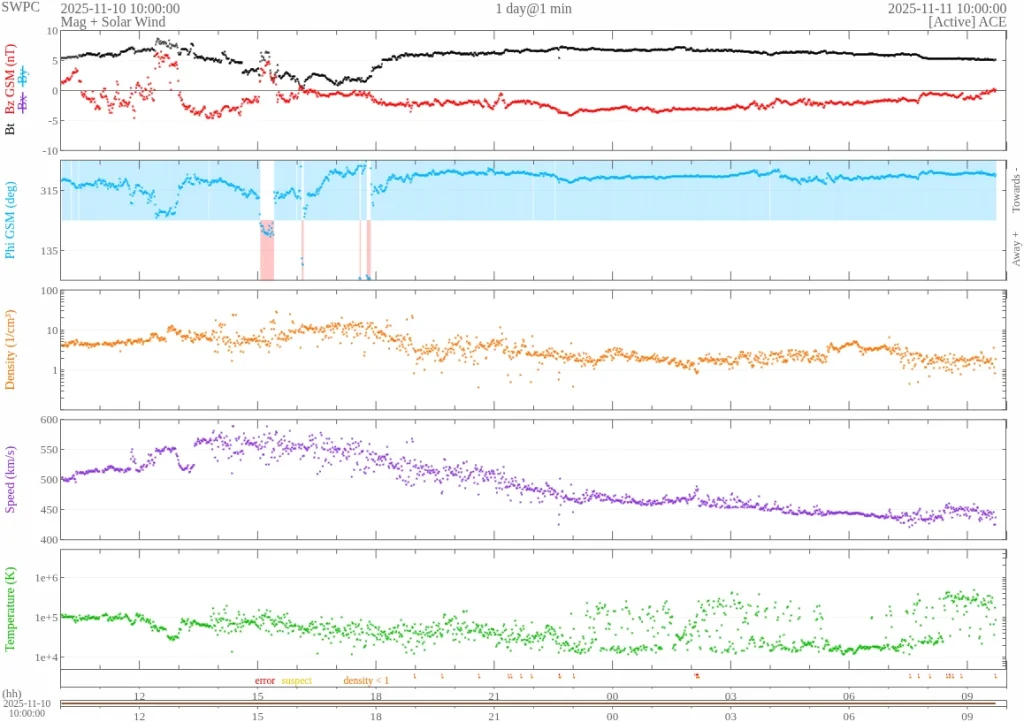 Image credit: SWPC
The Bz component fluctuated between +7 and −4 nT, with the interplanetary magnetic field oriented predominantly southward.
References:
1 Forecast Discussion – NOAA/SWPC – 00:30 UTC on November 11, 2025