
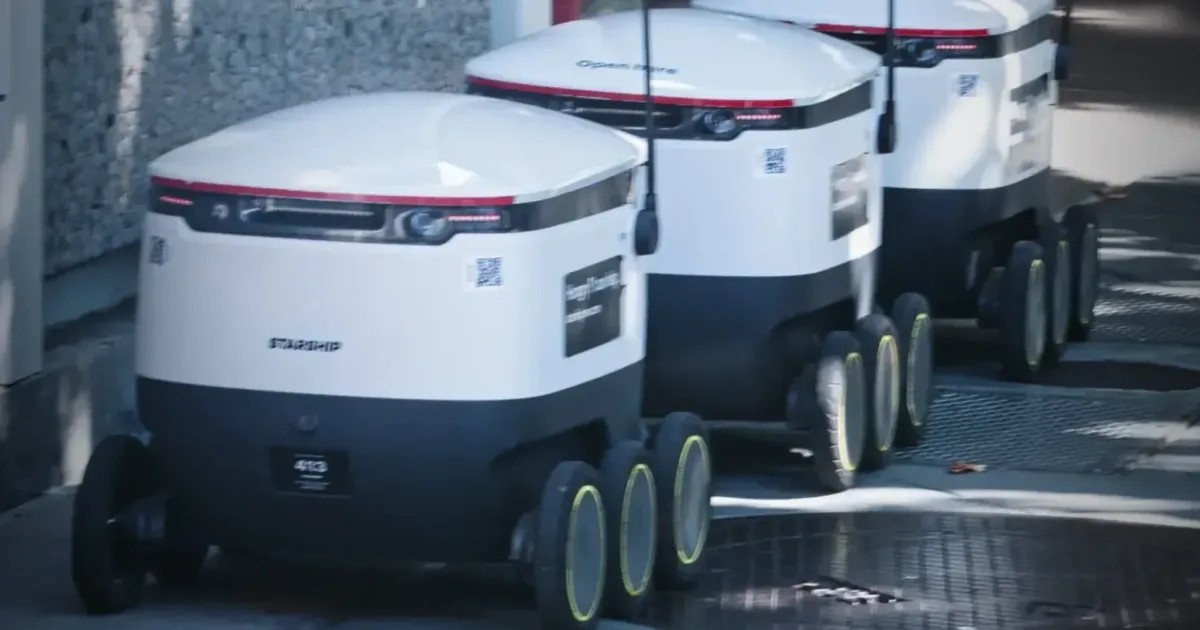
The food delivery robots canvassing Center City streets deserve our admiration and attention. As one who opposes illegal immigration, and even some legal kind of immigration (from underdeveloped countries), I look on these bots as Pope Leo looks on the hordes of unruly migrants crashing the borders of Europe: In other words, I welcome the stranger.
I welcome these bots with open arms, despite the fact that since their introduction to city streets in March 2026, these friendly little gizmos have been sat on, kicked and even attacked with graffiti just as people who threw snowballs and beer bottles at Santa Claus at Franklin Field on December 15, 1968. While the Santa incident can be attributed to Eagles fan frustration (the Santa in question actually took it in good stride), a bot can’t fight back or reply, as Santa did, with a comment like, “You’re not getting anything for Christmas.”
But why the hostility to these little delivery bots that move about respectfully, come to a full stop when they sense a human presence close to them, or make ceremonious U-turns when some thug blocks their path? What is it about the Philly mentality that takes offense? With their little flags and slits for “eyes,” one can almost sense a personality in them. The bots’ self-control is to be admired as well, since they are capable of going up to 12 and 25 mph on certain unobstructed roads, but stick to 5 mph in Center City.
We cannot forget that infamous robot beheading incident in 2015. CNN reported that, “HitchBOT, the cheerful hitchhiking robot that had made cross-country trips across Canada, the Netherlands and Germany, had intended to travel across the United States as well. Instead, it survived all of 300 miles on the mean streets of the U.S.A.
“Two weeks after beginning its U.S. trip in Boston, the robot was vandalized in Philadelphia, the team overseeing the robot said in a statement.”
That killed the robot forever.
HitchBOT was dependent on the kindness of strangers, as it couldn’t move on its own but required humans to take it from place to place. That did not happen in Philadelphia. Instead, the robot was literally beheaded one night by a person or a group of persons.
That’s a weird kind of “connecting with strangers” jihad.
Then there was the case of the former UPenn professor emerita, 78-year-old Carolyn Marvin, who was arrested and hauled off in handcuffs after blocking the path of a food delivery bot on the 1200 block of Filbert Street. Marvin, a little woman with white hair in “activist” jeans and who could easily double as a typical boomer female No Kings supporter, told The Daily Pennsylvanian it was her First Amendment right to block food delivery bots whenever she felt like it because she opposes “ruthless corporations.”
Talk about virtue-signaling.
“I oppose ruthless corporations casting aside human workers they don’t want to pay — in this case delivery folks at the bottom of the wage pile — to enrich their bottom line. These real people are workers with no defense against these corporations except our care for their situation,” she wrote.
Marvin promised to continue to fight the little bots whenever she’s out and about. That means standing and blocking the path of a bot and not moving for as long as it takes, until the bot makes a U-turn or the food it is carrying spoils.
In March 2025, another form of “robot” came to Philadelphia, the Portal, a round porthole-like device with the capability of allowing anyone looking into it to see and talk with people in other cities across the globe. The live-stream sci-fi creation mostly attracted a lot of waving and jumping up and down. Philadelphians could jump up and down with Lithuanians, Brazilians or the citizens (and non-citizens) in the UK. Waving and jumping up and down became the main method of Portal communication.
When the Portal first arrived in the city, it was stationed in LOVE Park. It lasted five months there but had to be moved because of repeated acts of vandalism.
Like the attacks on the little food bots, the Portal attracted people who wanted to “kill” it at all costs. A person or group of people smashed the screen with a rock and another group attacked it (at night) and disassembled the wires which connected the Portal to other parts of the world.
Police later said copper wire thieves were responsible for disemboweling the thing. That makes sense. Drug-addled copper wire scrappers steal copper wire all over the city. In Port Richmond, they have decimated many of the new street lamps along Richmond Street under I-95. They also attack old Verizon and Peco wires. Sometimes scrappers are able to dig underground for thicker, more valuable specimens.
The confiscated copper wires are then burned down to their essential elements in isolated city spaces like the Conrail freight yard in Port Richmond. The acrid smoke from these burnings often causes neighbors to call police, but these cat-and-mouse games rarely result in arrests.
With the wires cleansed of rubber casings, the drug-addled scrapper heads to the local scrapyard — where copper is highly valued — and cashes in. The scrapyards are generally closed on Sundays and close early on Saturdays, so the weekends are when the drug-addled scrappers are in desperate need of money to keep from getting sick.
The Portal, which opened with great fanfare in the city, was moved from Love Park to Christmas Village, but even this was no solution. Vandals continued to attack it until it was finally moved to City Hall Courtyard where it stands today, at least until October 31, when it will be shipped out of the city, forever. The city needs a wealthy donor with $30,000 to spare to offer to take care of the upkeep and maintenance of the thing. Smart, potential donors, however, have other ideas about how to spend their money and aren’t coming forward.
Out of all the cities in the world that have a Portal, Philadelphia holds the distinction of being the only city where the Portal was vandalized and partially destroyed.
What a great legacy for the city!
Usually when I pass the Portal in City Hall Courtyard one can find a few people — mostly children or high school age — jumping up and down in front of a blank lens showing empty streets on the other side of the globe. Have the people in other countries lost interest? It seems so.
Philly Chit Chat, the city’s primary outlet for red-hot gossip, mourned the passing of the Portal and called it “a treasured part of 2026, connecting people around the world.”
The sad part is, Philly is squeamish about being “connected.” While it may welcome migrants as a sanctuary city, it has no time for anything or anyone it deems a threat. Little Uber robots with fake eyes and flags, and even the Portal itself when it was first installed, were classified as public enemy number one.