
 PITTSBURGH —
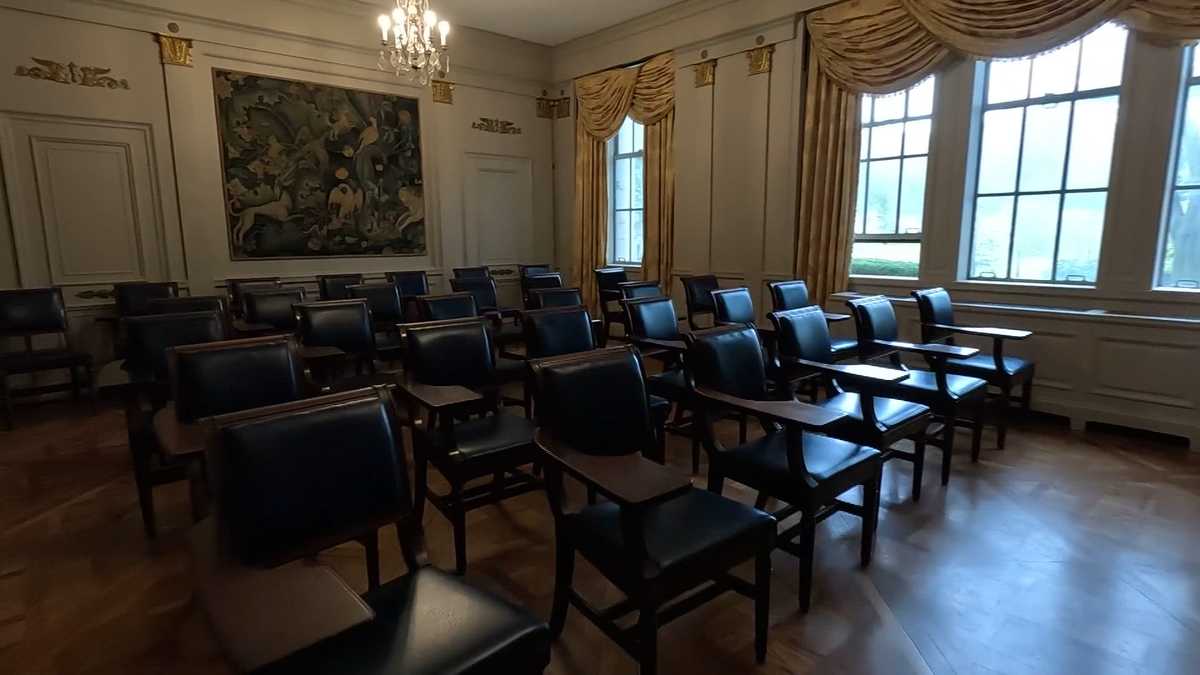
Inside the University of Pittsburgh’s Cathedral of Learning, the French Nationality Room stands as a testament to French culture, history, and architecture, offering a space for cultural programming and education.
“The color of the room is to match, like, Greek stonework and the capitals. All the gilding and stuff come from Egyptian motifs,” said Roberta Hatcher, chair of the French Nationality Room Committee.
The room’s Empire-style architecture, which emerged during Napoleon’s reign, is unmistakable. But for Hatcher, the room’s impact goes beyond its design.
“My favorite part is not so much the room itself, but seeing the students come back from France, having studied abroad with our scholarship. That to me is the most exciting thing,” Hatcher said.
The room serves a dual purpose, offering a space for cultural programming and French studies while providing a window into French history.
“The window overlooking the Heinz Chapel, because it really is reminiscent of the St. Chapel in Paris,” Hatcher said.
“It’s exactly the same shape. And the French one has more stained glasses,” said Benedicte Barlat, president of the French Cultural Center of Pittsburgh and a member of the French Room’s committee.
Barlat, who moved to Pittsburgh from France in 1987, said she sees connections to French history throughout the city.
“There are cultural bridges, as we call them,” Barlat said.
One such “cultural bridge” is Brunot Island, located in the middle of the Ohio River. The island is named after Felix Brunot, who came to the United States during the Revolutionary War with his foster brother, General Lafayette.
“He came to help alongside Lafayette, not as a soldier, but as a surgeon,” Barlat said. “He settled on the island. And it’s still there. So the Brunot Island was his home.”
The French Nationality Room also holds a hidden history of how it came to exist. Joanna Conings, a graduate student studying French and Italian at Pitt, uncovered a collection of handwritten and typewritten letters dating back to 1929.
“I started looking through the archives, thinking, okay, well, who decides what French culture is and who decides who gets to decide what French culture is and what it should look like materially,” Conings said.
The first letter was sent by Rachel Hunt, a socially prominent philanthropist in Pittsburgh, agreeing to visit the room at the invitation of Ruth Crawford Mitchell, the founding director of the Nationality Rooms.
“Before it was even in anyone’s mind, it was in two women’s minds—Rachel Hunt and Ruth Crawford. No one else was really talking about it,” Conings said.
The women corresponded about the room’s design, even seeking input from a French architect. One letter suggested the decorations commemorate the educational impact of “the famous universities in France.”
“They needed the support of the French government at one point, because you can’t just do a French room and not get the French government involved. So they needed the support of the ambassadors. But those ambassadors—it’s women who are making sure that those letters arrive on the right desk, and then they were the ones pushing for that project to keep going,” Conings said.
Eventually, the letters included French Ambassador Paul Claudel, and Conings’ research shows a shift in the correspondence to a male-led, government-influenced project, seemingly overshadowing the women’s foundational efforts.
“What I called the ‘affective labor,’ because the relationships between these women who were part of the laborers, they were foundational. They are actually the walls that are keeping this room together,” Conings said.
More than 80 years after its completion, the French Nationality Room continues to fulfill its purpose, connecting cultures and inviting French-speaking and learning.
“Allez le d’or et le noir!” Barlat said, translating to “Let’s go black and gold!”
“I used to say as a teacher that it’s good to have language lessons, but if at least they had a culture lesson—a class where you would learn the cultures of different countries so you can respect these countries, what they do, and how they celebrate things and simply who they are,” Barlat said.