
When Christine Craig Seppi’s son was in second grade, she could see how hard he was working to read. But progress was harder to find.
The family tried different kinds of tutoring. After third grade, he was tested for dyslexia, but reading remained a struggle. Then, the summer after fourth grade, he began working with tutors at the Children’s Dyslexia Center. They used an approach called Orton-Gillingham, which teaches reading skills in a structured way.
Seppi says her son began making progress.
A former English teacher, Seppi wanted to understand what had changed. The following summer, she went through the center’s training herself, hoping she could share what she learned with his school.
Instead, she discovered how much she hadn’t known about the way children learn to read. She found herself thinking about students she had taught who might have had dyslexia, too.
“I hadn’t known how to help them at all,” she says.
Her son Jonathan is now 37 and has a master’s degree from Carnegie Mellon University. Seppi is still helping children learn to read as a private tutor and past president of the Pennsylvania branch of the International Dyslexia Association.
Her family’s experience points to a question that brought educators, librarians, advocates and community leaders together at Carnegie Library of Pittsburgh’s second annual Children’s Literacy Summit, held Oct. 24 at CLP-Homewood: What does it take for every child to have the opportunity to become a reader?
The answer, speakers said, involves books and bedtime stories, as well as trained teachers, specialized instruction and a network of people ready to help when reading doesn’t come easily.
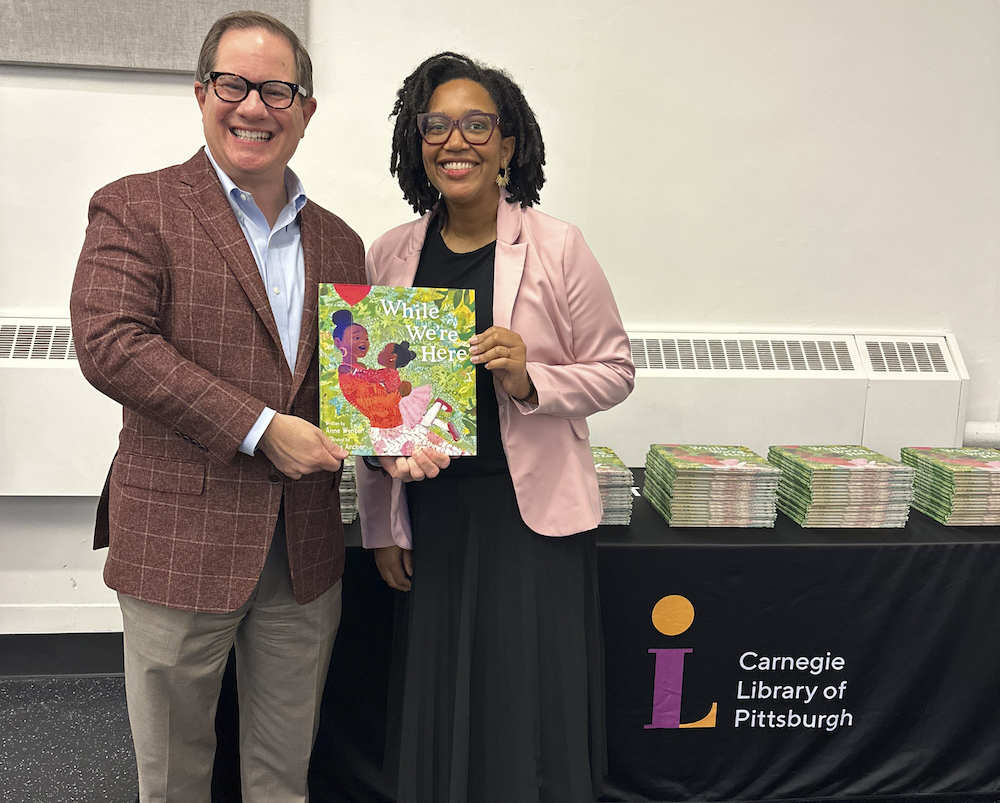
 Author Anne Wynter was among the speakers at this year’s CLP Children’s Literacy Summit.
Turning conversation into community
Last year’s inaugural summit asked, “Whose Job Is Children’s Literacy?” This year’s gathering took that question a step further: “Whose Job Is It Now? Moving Children’s Literacy from Conversation to Community.”
Following the first summit, Carnegie Library began meeting regularly with literacy-focused organizations across the region, forming a collective called the Literacy Leaders. The Grable Foundation has supported the collaboration and the summit, CLP President and Director Andrew Medlar said in his welcome remarks.
Medlar described a network that reaches children far beyond the library.
The Allegheny County Library Association has installed book vending machines at the county jail and Family Division, he said, while Literacy Pittsburgh has expanded its ERAS tutoring program to additional schools.
Reach Out and Read distributed more than 6,000 books in Western Pennsylvania over the past year, Medlar said. United Way of Southwestern Pennsylvania’s spring Big Book Drop helped get more than 40,000 books into children’s hands before summer break.
CLP has also added a reading specialist and expanded its partnership with UPMC Magee-Womens Hospital to share selections from the library’s annual Best Books for Babies list with new parents.
The work can be measured in books and library cards, but Medlar also pointed to smaller moments: a librarian connecting a child with a story about a favorite animal, a teacher offering extra time or a grown-up reading a beloved book for the tenth time.
“We may each play a different role in a child’s life,” he said, “but we can all help create those moments.”
 A breakout session on Trusted Messager Training was presented by the United Way of Southwestern Pennsylvania.
More than a book
Collin Diedrich knows how complicated those moments can become for a child who struggles to read. The co-founder and executive director of the Learning Disabilities Association (LDA) of Pennsylvania has dyslexia and other learning disabilities.
As a student, he says, he dreaded reading aloud. His parents could afford a special education tutor who worked with him from approximately third grade through high school. Only later did he begin to understand how much access to that help depended on his family’s circumstances.
“I didn’t understand that my privilege allowed me to get all this extra support that wasn’t available to most kids,” he says.
Diedrich went on to earn a doctorate in molecular virology and microbiology, and conduct HIV and tuberculosis research in Cape Town, South Africa. He began writing and speaking about being a scientist with learning disabilities, challenging the belief that difficulty with reading means a person isn’t smart.
After returning to Pittsburgh, he looked for ways to volunteer with children with learning disabilities and ADHD. He later co-founded the Learning Disabilities Association of Pennsylvania to make reading support accessible to families who might otherwise be unable to afford it.
Diedrich says the organization offers group early literacy instruction for children reading at kindergarten through second-grade levels, along with individualized intervention for people who need more intensive support. This early literacy program operates at libraries, schools and community organizations.
Instruction is free for children from lower-income households, he says, with sliding-scale fees for families above the organization’s income thresholds. The intervention program also serves adults.
Getting books to children is essential, Diedrich says, and some readers will need additional instruction to make use of them. That’s why he values bringing literacy organizations together.
“Reading intervention is our goal, and we provide that support, but it costs money,” he says. “You also need books to read.”
What struggling readers need adults to understand
Seppi says that it is easy for adults to misunderstand a child who is having difficulty. Some children become quiet and try to hide, she says. Others make classmates laugh to draw attention away from their struggles. Still others act out, and some children may decide that “it’s better to be the bad kid than the dumb kid.”
All of this could conceal how much effort a child is already putting in.
At the summit, Seppi led a shortened version of a dyslexia simulation designed to give participants a sense of the challenges some children experience with reading, spelling and writing.
The activities made tasks like decoding words and taking notes more difficult. Seppi says participants came away recognizing how much energy such work can demand.
“They realized that struggling to read is emotionally draining as well as intellectually hard,” she says.
For families wondering whether a child needs additional help, Seppi suggests paying attention to persistent difficulty learning letters and their sounds, or trouble putting those sounds together. A child might understand a story when someone reads it aloud, but become distressed when asked to read independently.
But Diedrich cautions parents against trying to diagnose a learning disability based on a few signs. Instead, he suggests talking with a child’s teacher and reaching out to organizations such as LDA of Pennsylvania, which he says can help families connect with evaluators.
Even getting that far can be difficult. Parents may worry about stigma, he says, and evaluations can be expensive. Support groups can give families a place to ask questions while they consider next steps.
Making room for stories
At home, Diedrich suggests showing children all the ways adults read throughout the day, whether they’re following a recipe, checking a sports schedule or looking something up online.
Invite kids to help, he says, and continue reading books aloud together as they grow.
Seppi encourages parents to follow a child’s interests. That might mean sharing a favorite book, finding a story the child wants to read independently or listening to an audiobook.
Audiobooks can give children access to stories and vocabulary beyond what they can yet read on their own, she says. Knowing what a word means can make it easier to recognize when it has been decoded correctly.
Seppi offers her own experience learning German as an example: She can pronounce some words, she says, but sounding them out doesn’t necessarily mean she understands them.
For younger children, she suggests playing with rhymes and the sounds in words. Parents might ask a child to break “haystack” into two words, then try putting words together again. If a child gets stuck on a word they may be able to sound out, Seppi suggests starting gently (“What’s the first sound here?”), then asking what else they notice about the word.
And if taking turns reading together has become upsetting, families can take turns reading just one sentence or read aloud at the same time. When frustration takes over, a break can help. “You can’t make it all awful,” Seppi says.
Finding help together
Families looking for local resources will have another opportunity to connect with literacy organizations at a Reading Resource Fair on Nov. 14 at Carnegie One Braddock, led by the Allegheny County Library Association. Medlar said the fair is intended to help families learn about available services and support.
Connections like that, Dietrich says, are what make gatherings like these useful. A librarian may help a child discover a book they love. A parent may notice that reading remains difficult. A teacher or literacy organization may help the family find specialized support. “Literacy is the responsibility of all of us,” he says.