
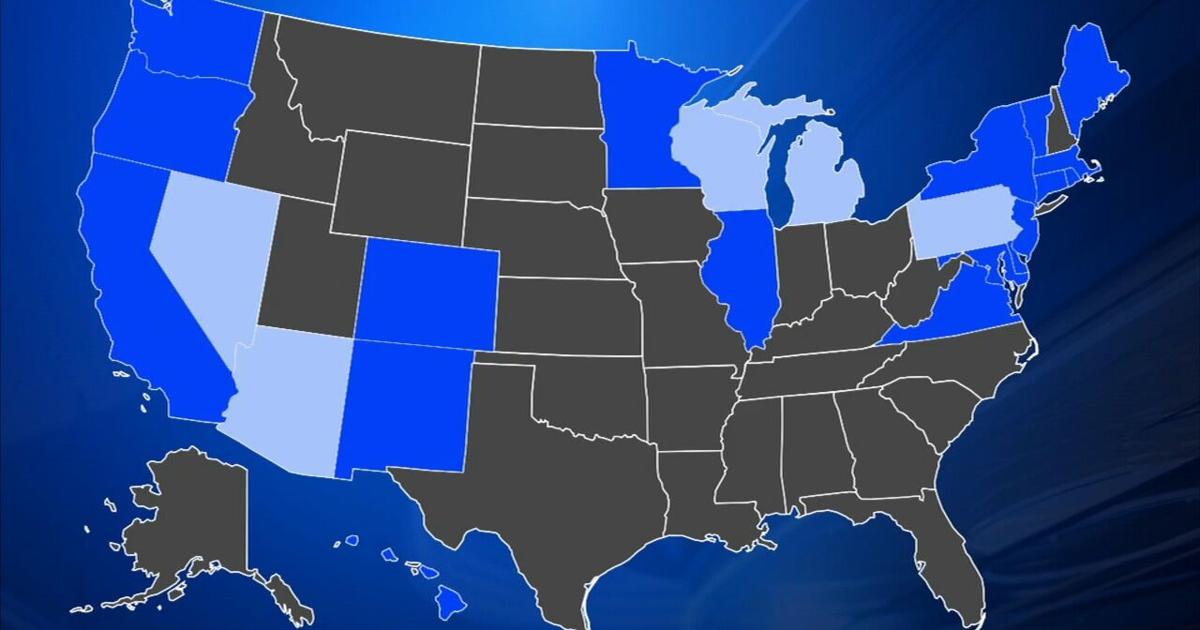
What is the National Popular Vote Interstate Compact?
Right now, it’s a group of 18 states and the District of Columbia with a combined total of 222 Electoral College votes.
It was launched in 2006 by the non-profit organization National Popular Vote.
Compact states have agreed that when they get enough member states to reach 270 votes, they will give them to presidential candidates who win the popular vote.
November 3rd, five states, including Pennsylvania, elected a Democratic trifecta, meaning all three chambers are democrat controlled. Those states have a combined 61 electoral college votes.
If they joined the compact, it could essentially nullify the Electoral College.
‘It would immediately come under court challenge. Is it constitutional? Is the compact constitutional? Some legal scholars claim that it would only be constitutional if Congress endorsed it,” said Professor Chris Borick with the Lehigh University Opinion Observatory.
According to the non-partisan election research organization Fair Vote, there have been numerous attempts by Congress to reform the Electoral College dating back to 1950. All have failed.
Borick says the compact is basically a constitutional loophole created after decades of many Americans’ dissatisfaction with the Electoral College.
“I reference the loss of Al Gore and Hillary Clinton,” said Lori McFarland, Lehigh County Democratic Chair.
McFarland says locally, the party hasn’t talked about the compact, but it’s on her to-do list.
“All the other elected positions are elected that way,” said McFarland. “Why not the president?”
It should be noted that all of the states in the compact are either democrat controlled or lean democrat.
“I don’t like the idea because that would cause the state electors’ votes to go against its own voters’ choice,” said George Rivera, Lehigh County Republican Chair.
Under the compact agreement, a candidate could lose in a given state, but receive its electoral votes because the candidate won the popular vote.
Rivera says it’s a decision that shouldn’t be made by lawmakers.
“If we were to do this, it should be a ballot question,” said Rivera.
We reached out to the Shapiro administration to get the governor’s take on the issue but did not hear back.
Copyright 2026 Maranatha Broadcasting Co., Inc.. All Rights Reserved.