
By Roberto Paglialonga
Three years ago, Hamas led an attack against Israel, triggering the subsequent war in the Gaza Strip. On 9 October 2025, the two groups signed a ceasefire agreement, but one year later, around 100 humanitarian NGOs operating in the Palestinian enclave describe it as a “facade ceasefire”.
The situation has not improved, as hunger, water shortages, lack of adequate healthcare services, daily violence and killings and the displacement of thousands of people continue to persist. This state of constant tension continues to affect life in the West Bank, where extremist Israeli settlers carry out attacks almost daily and incursions by Israel Defense Forces (IDF) troops are frequent. It also directly affects young people and university students, who struggle to continue their studies, sometimes deciding to seek opportunities abroad.
Restrictions on students’ freedom of movement
“The political situation affects us very directly”, said Brother Hernán Santos González, FSC, PhD, a native of Paraguay and a member of the De La Salle Brothers, in an interview with Vatican News during a visit to Rome. He has served as President of Bethlehem University since 2023. “From before [the war], there were many [challenges] for our students, particularly in arriving to the university”, he explained, referring to inspections, checkpoints and roadblocks. “That is a permanent situation. We can call these restrictions in mobility”.
Those who suffer most are students from other cities. “Sometimes the checkpoints are closed”, and those travelling must take extremely long detours to reach their destinations. More than 40 percent of the students come from Jerusalem, while 10 percent come from Hebron and other locations in the southern West Bank.
These are not the only difficulties, however. Economic problems are also a major concern. “Bethlehem is a very touristic city. Since October 2023, there are no [longer] touristic activities in our city and many of the Christian families have actually left that area”, he noted.
Difficulties facing Christian communities
Christian communities throughout the Holy Land, like much of the Palestinian population, are being forced to endure deprivation and harassment. Distrust and fear for the future are increasingly widespread, as Cardinal Pierbattista Pizzaballa, the Latin Patriarch of Jerusalem, noted in an interview with Vatican Media.
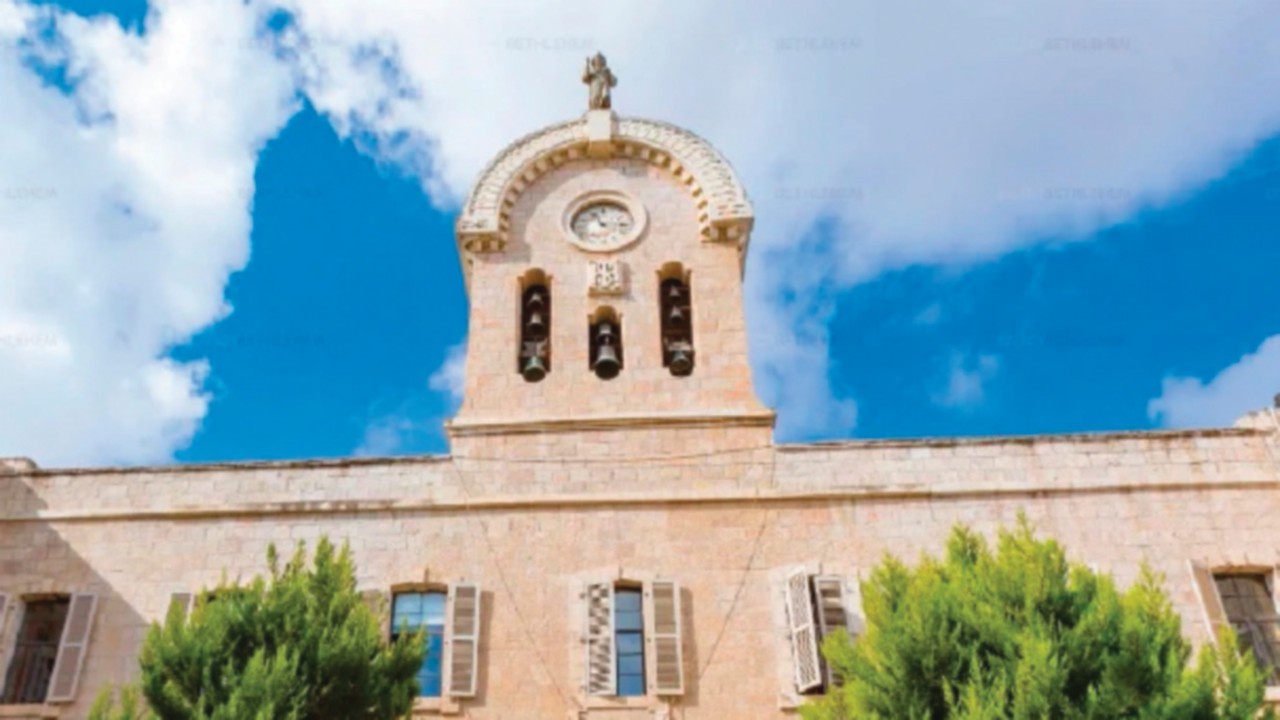
The President of Bethlehem University agrees with Cardinal Pizzaballa. A place of encounter and dialogue, the University was established at the initiative of Pope Saint Paul VI and was inaugurated in 1973. Today, it welcomes approximately 900 students to its first-year programs.
More than 20 percent of the students are Christian, primarily Latin Catholics and Greek Orthodox, while the remaining students are Muslim. Eighty percent of Bethlehem University’s employees, including faculty and staff, are Christian.
“In our everyday life, you can hear from them how sceptical they are about the future… Even the sense of hope is very difficult to talk about”, Brother Santos explained. He pointed to invasions in the middle of the night and how overall feeling “among the people is not good. There is not trust in the situation”.
Fears that the conflict could spread to the
West Bank
These circumstances have revived the fear that the war could spread from the Gaza Strip to the West Bank. “I do think that could happen eventually”, Brother Santos said. “There are other villages, Christian villages, like Taybeh, for example, that are permanently under attack from Israeli settlers”.
The same is true in the Bethlehem area. Near Solomon’s Pools, southwest of the city and just below al-Khader, there is an Israeli settlement in the hills. Its residents, however, are taking control of and occupying increasing amounts of land, gradually encroaching on this part of Bethlehem.
“The occupation of these settlements is getting closer and closer and closer to the cities. There are more and more restrictions and the danger of clashes between violent settlers and the local residents is constant”, Brother Santos stressed.
Working for peace
Yet hope remains alive, as does the concrete work being done to prevent such a scenario. “We always pray for hope. We are trying to promote many, many programs at the university”, Brother Santos explained. “This is not new. We have been advocating for peace, for common understanding, for dialogue for many decades at the university”.
He also noted that many of their former students are now ambassadors for peace and understanding around the world in their respective fields. Despite everything, “we never really lost hope in terms of what we are doing and what the Catholic university can do in the West Bank”, he explained.
Palestinian elections postponed
On 10 October, the Palestinian presidency announced a decision, reported by WAFA news agency — the Palestinian News & Information Agency — to postpone elections originally scheduled for the end of November, to September 2027. The announcement sparked considerable controversy and negative reactions, including within the international community.
The President, however, argued that it is important to “understand how difficult it is to deal with the entire political situation in Palestine now. Stability could be taking a little bit more time to get to a better place”.
Brother Santos therefore sees “some kind of wisdom in this decision because the situation in the West Bank is still critical. I do think that to move forward to a more democratic way of doing things, we need to take many steps to be there. But at the moment, the political situation of the region is very unstable and critical”.