
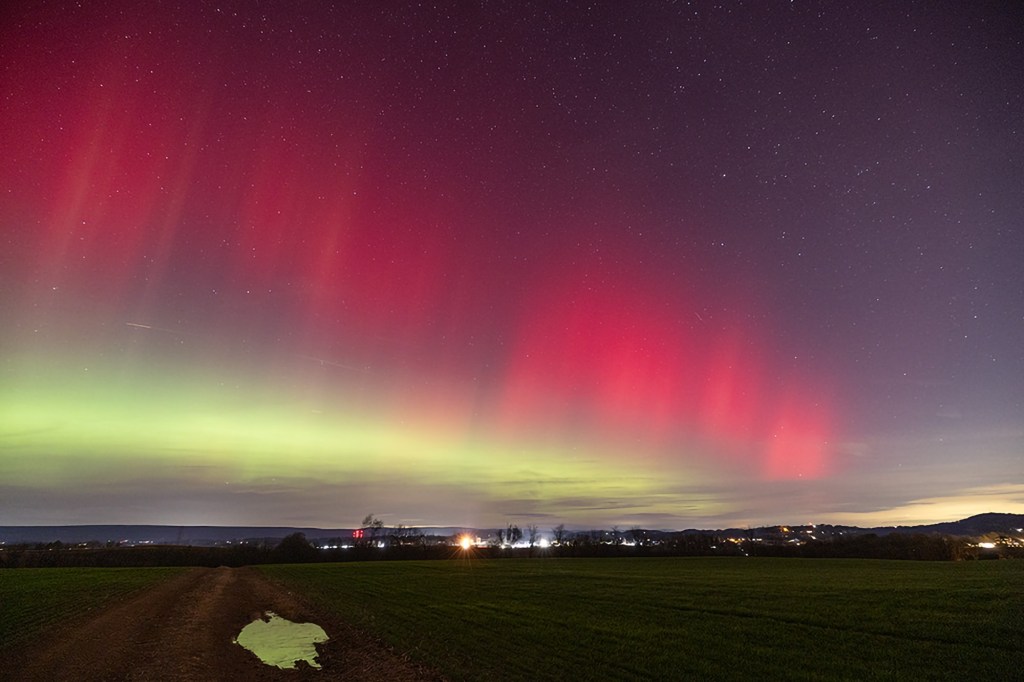
The strong geomagnetic storm that produced some spectacular views of the northern lights, aka the aurora borealis, Tuesday night is continuing today, so those who venture out in the chilly night between 10 p.m. Wednesday and 2 a.m. Thursday may get a glimpse of them in partly cloudy skies.
The National Weather Service is forecasting a low of around 36 in the southeastern Pennsylvania/Philadelphia region tonight with decreasing cloudiness this evening.
According to the Space Weather Prediction Center, a joint venture of the NWS and National Oceanic and Atmospheric Administration, the strong space storm that produces the light display continues and is expected to increase in severity.
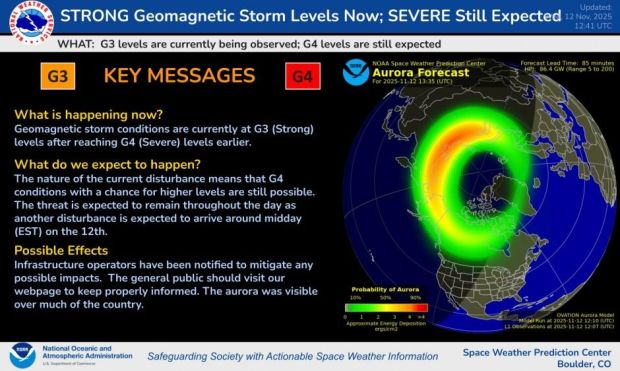 The Space Weather Prediction Center in Colorado is forecasting the geomagnetic storm that produced wide-ranging views of the aurora borealis Tuesday night, Nov. 11, 2025 to continue. The G3-level storm is expected to increase in severity Wednesday to G4 in this screenshot of a graphic created at 12:10 UTC, or 7:10 a.m. Nov. 12. (Courtesy of the Space Weather Prediction Center)
Many stargazers in the region captured photos of the display Tuesday night into Wednesday.
The Space Weather Prediction Center does offer a 30-minute aurora forecast, so potential viewers can stay warm inside until a flare is predicted.
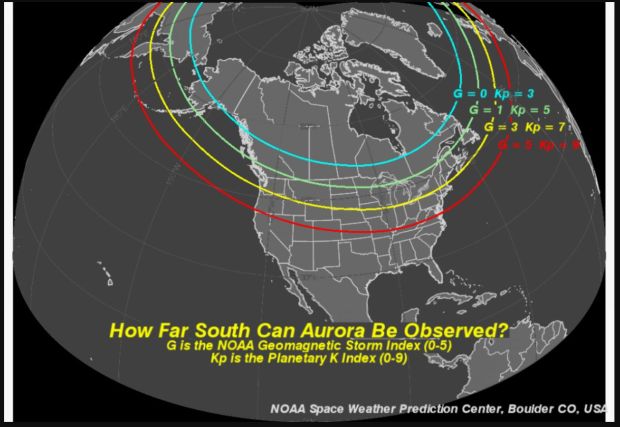
The SWPC has come up with a map indicating how far south the northern lights can be pushed based on geomagnetic storm severity.
Pennsylvania would be on the farthest edge of that map if the storm increases to a G4 level.
Space Weather Prediction Center
A map produced by the Space Weather Prediction Center in Colorado shows how far south the aurora borealis, aka northern lights, may be seen, based on a geomagnetic storm’s severity level. (Courtesy of Space Weather Prediction Center)
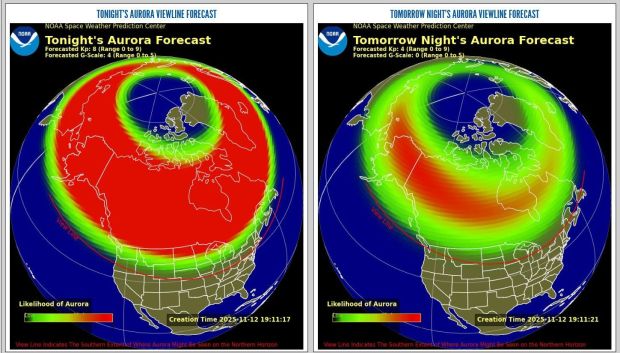 A screenshot of the Space Weather Prediction Center forecast for viewing the aurora borealis, aka northern lights, for Wednesday, Nov. 12, and Thursday, Nov. 13, 2025. Pennsylvania is at the southern most view line Wednesday night and the weather will be partly cloudy. (Courtesy of the Space Weather Prediction Center)