
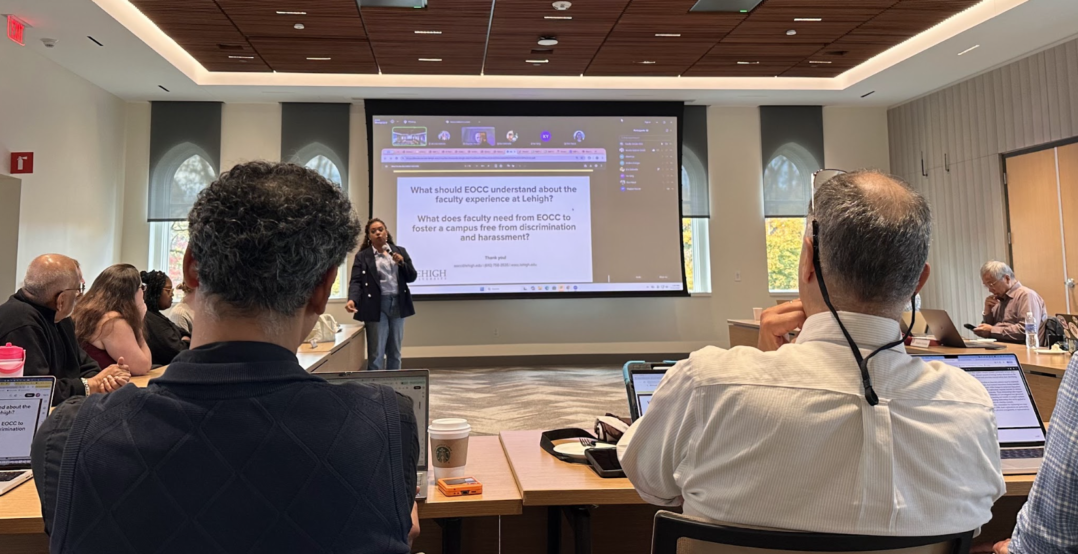
Lehigh’s policy on protected characteristics related to discrimination and Title IX will remain the same regardless of federal rollbacks, said Jessica White, Lehigh’s new equal opportunity compliance and Title IX coordinator, during Friday’s Faculty Senate meeting.
Recent federal changes removed gender identity and sexual orientation from Title IX regulations, but White said Lehigh’s policy won’t change.
At the meeting White said she and the new case coordinator Monica Clear have been conducting a “listening tour” across Lehigh to hear the needs of campus and gather feedback. She said the Senate is another stop on their tour.
The Senate also heard from the Intellectual Property Review Board about potential revisions to Lehigh’s Intellectual Property Policy, passed rules and procedural language on the new Arts and Libraries committee and discussed faculty representation on an Education Innovation and Academic Technology committee during the meeting.
Faculty feedback on Title IX and Equal Opportunity Compliance Office
Faculty Senate Chair Jenna Lay said the Cornell 7 case, a rape case at Lafayette College, the Sigma Phi Delta recruitment text and White’s arrival to Lehigh this summer as reasons for White joining the meeting.
Before White started at Lehigh this summer, the position wasn’t filled for six months.
White told the Senate the Equal Opportunity Compliance and Title IX Office is responsible for any form of discrimination and harassment, including Title IX, Title XI, Title XII and 504.
As she and Clear settle into their roles at Lehigh, White said they’re making sure reporting processes are working as they’re supposed to across campus.
White also said she’s hoping to see an increase in reports as people feel more comfortable to report, and understand the reporting and investigation process more clearly.
“The goal is to make sure our office is aware that (cases are) happening so we can respond, so we can provide the resources,” White said. “We need to be building trust and we need to be building awareness of how to report to our office.”
White said she and Clear will be consulting focus groups and potentially an advisory council to make sure they’re hearing from constituents across campus. She also said the office will be releasing an annual report in January 2027 detailing data they’ve collected and seeing where improvements can be made.
Opening up the conversation to the Senate on feedback they had for the EOCC, White heard from Senator Rosi Reed, professor of physics, who spoke about her negative experience with the prior Title IX office.
Reed said prior reports she filed with the Title IX office weren’t addressed in a timely manner, and other faculty she talked to had similar experiences.
Christopher Liang, professor of counseling psychology at Lehigh, said as someone who had experience with the previous Title IX office, he’s appreciated the changes he’s seen so far, but wasn’t sure others on campus know about them.
White said the annual report in January will address changes and ongoing development, including data from the office’s database where they track the timing of reports and what happens during the cases.
She said communication with groups across campus is extremely important in her role. She also said she recently read a report filed relating to a physical disability, and knowing she wasn’t an expert, she reached out to Lehigh Facilities, Disability Support Services and HR.
She said making sure students are respected and included throughout the whole process, even if they end up transferring schools, is extremely important.
“We want students to feel cared for during the process,” White said.
Intellectual Property Policy revisions
Dominic Packer and Rick Smith from the Intellectual Property Review Board asked for faculty questions and feedback on their proposal for revisions to Lehigh’s Intellectual Property Policy during the meeting.
Packer said the policy hasn’t been revised since 2001, and many of the proposed changes are to modernize the policy so it’s easier to understand and reflects Lehigh’s current practices.
The policy addresses ownership of intellectual property as it relates to university activities, generally referring to inventions created by university members.
Of the eight changes the review board is proposing, Packer said six clarify Lehigh’s existing intellectual property practices, while the remaining two directly affect researchers.
The first change makes it clear there must be disclosure of an invention to Lehigh before there’s a public disclosure.
Packer said this has always been necessary under the Bayh-Dole law for federally funded inventions, and Lehigh’s Office of Technology Transfer can expedite review when necessary, including within 24 hours.
He said this review is necessary so the university can put proper protections in place for federally funded inventions.
The second change regards Lehigh declining patent protections. In the 2001 policy, if Lehigh declines a patent protection, ownership “shall be reassigned to the creator upon request.”
The review board is proposing to change the language to “may be reassigned,” because Packer said the government automatically takes the title to a federally funded invention if Lehigh declines to protect the patent.
Packer said the review board may add a line about AI to the policy, but because current U.S. patent law currently addresses AI as a tool for invention that can’t be named solely as an inventor, it’s not a top priority of the board.
Several senators raised concerns over what “teaching materials” specifically referred to in the Intellectual Property Policy and questioned what rights the university has over those materials.
Senator Mike Spear, professor in the computer science and engineering department at Lehigh, brought up a hypothetical example of the university taking his lecture materials and making them an online AI course.
Packer said this outcome is extremely unlikely, but he will raise the issue of what the university is allowed to do with teaching materials to the Office of the General Counsel.
“In reality the odds of Lehigh choosing that are near zero, but you could imagine it happening, not here but at other places,” Packer said.
He said the review board will also clarify what “teaching materials” specifically refers to in the policy.
Lay said Packer will take the Senate’s feedback and come back with changes, and the review board will also be opening up feedback from the university community in three weeks.
New committees
Following October’s Faculty Senate meeting where a second reading of the Arts and Libraries Faculty Committee was discussed, the Senate passed a third reading at Tuesday’s meeting, approving the committee.
Lay told The Brown and White after the meeting the Senate had to restructure their corresponding committee after Lehigh separated the Library and Technology Services into Arts and Libraries and Information Technology Services this year.
“Our committee was in parallel with the university unit structure, so we are trying to make sure we address all the elements of the previous committee,” Lay said.
In October, Senators expressed concern that language removed from the Arts and Libraries committee rules and procedures would’ve taken faculty voices out of conversations about academic technologies.
In response, Lay said a rules and procedures level committee called Educational Innovation and Academic Technology will be created to address information technology and academic technology.
Senator Al Bodzin, professor in the College of Education, brought up his concern that faculty from smaller colleges are becoming overburdened with the number of committees they’re expected, or would want to have representation on.
Lay said this is part of the reason the Senate has a working group analyzing the committee structure at large.
Rules and procedural language updates
Lay said following an administrative error addressed in October’s meeting regarding the Senate’s rules and procedures, they will be working to make R&P more transparent on the website and include version history in the Google Docs they’re included on.
She told the Senate every time the board improves rules and procedures, they’ll make a new version on the Google Doc available for anyone to see. Since the Senate was created eight years ago, Lay said there’s ambiguity in rules and procedures that’s confusing, including faculty senate membership, processes when faculty need extended leave and what counts as a term.
Since some of the ambiguities impact current Senate leadership, Lay said former Senate Chair Peter Zeitler, professor of earth and environmental sciences, will be working on clarifying changes to rules and procedures to make it more clear.
Zeitler said the parts he plans on updating are the size and composition of the Senate, the terms of senators and senator leadership, and how Senate meeting procedures are described.
“It was very clear in someone’s mind how that was to be done, but it wasn’t written in one concise way,” he said. “I’m working on removing ambiguity so it’s completely clear — this is the size of the Senate, this is what happens if you resign.”
In response to last meeting’s dramatic vote regarding the Explore Lehigh program where Lay had to use two votes, one as Chair and one as Senator, Lay said she and other members on the executive committee reviewed Robert’s Rules and Senate rules and procedures.
Lay said they discovered the rule about the chair using two votes only applied to executive committee votes, and there wasn’t a rule around general votes.
Since R&P doesn’t address general votes, Lay said in the future the Senate will abide by Robert’s Rules, which grant the chair one vote in the case of a tie.
Additionally, Lay said only senators present in person or on Zoom for a meeting are allowed to vote. Last month, senators who weren’t present for the meeting still voted after receiving an email with the voting link. Lay said the votes will now only be sent electronically to senators who are present at the meeting.
The next Faculty Senate meeting will take place on Friday, Dec. 4 in the Clayton University Center Boardroom.