
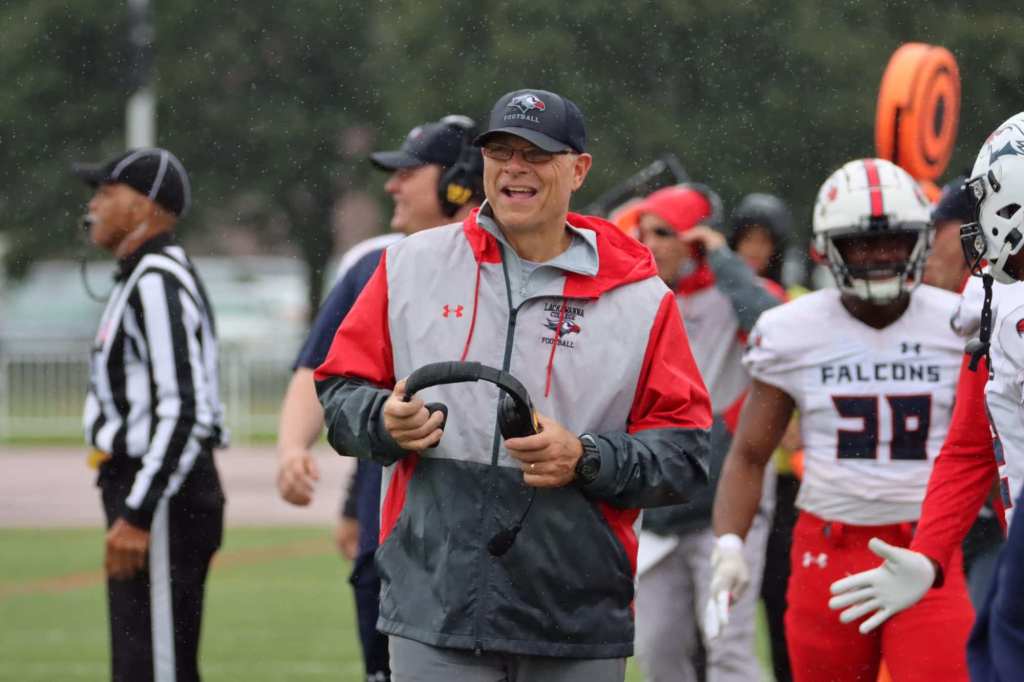
COURTESY OF LACKAWANNA COLLEGE
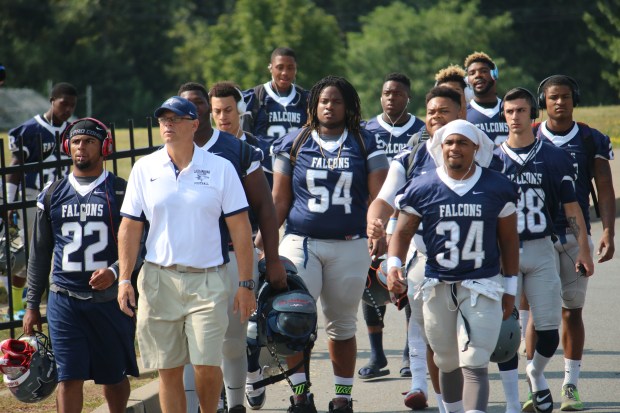
COURTESY OF LACKAWANNA COLLEGE
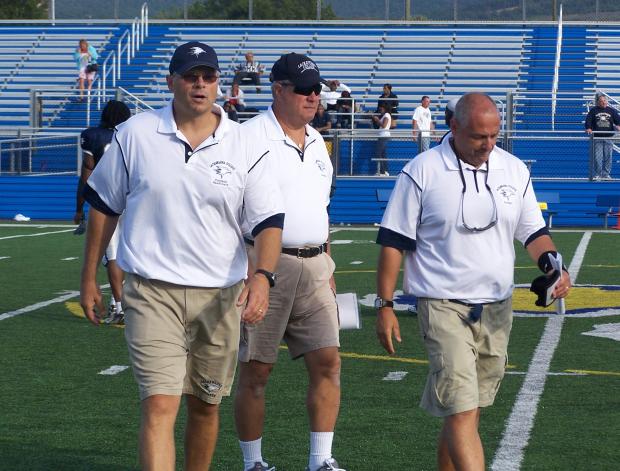
COURTESY OF LACKAWANNA COLLEGE
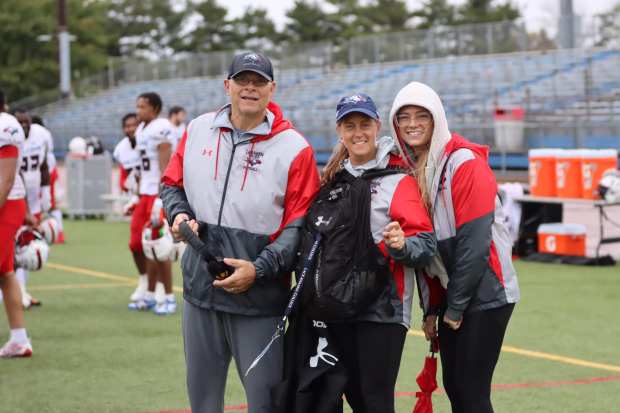
COURTESY OF LACKAWANNA COLLEGE
Show Caption
1 of 4
COURTESY OF LACKAWANNA COLLEGE
It began in February when his thumb started twitching involuntarily.
Probably just a cramp, Mark Duda figured.
However, when it persisted, the energetic Lackawanna College football coach thought he better get it checked. He went to his doctor, who sent him to a neurologist. Tests revealed the early stages of Parkinson’s disease.
While beginning treatment, Duda made it through spring practice and the summer, but noticed he became more fatigued and stiff and couldn’t do things the same way he did. However, he committed to coach this season and once Mark Duda commits to something, by God, he does it.
Still, the rigors of the season made Duda realize he couldn’t continue. For 32 years he ran out of the tunnel with his team. This year, he sent the team out the tunnel and walks around to the sidelines.
That is why last week the 64-year-old from Plymouth made the difficult decision to go public with his diagnosis and announce that Lackawanna’s game Thursday at 7 p.m. against Snow College at Scranton Veterans Memorial Stadium will be his last.
“I’ve always tried to do the right thing. For the institution and the players, this is the right thing,” Duda said. “That’s why I’m doing what I’m doing. If anybody thinks I’m not going to miss it, obviously they didn’t spend any time with me at all.
“So we’ll be out there one last time and I won’t forget it, win or lose.” .
Lackawanna’s football program is Mark Duda. When it began 33 years ago, he was the defensive coordinator on coach Wally Chambers’ staff. The next season, he became head coach and has been since. He is the active leader in wins in NJCAA with 213 against 100 losses. He guided the Falcons to 13 NJCAA bowl appearances, coached 55 NJCAA All-Americans and had a number of players go on to the National Football League such as Bryant McKinnie. Mark Glowinski, Kevin White, Jermaine Eluemunor, Jaquan Brisker and Ji’Ayir Brown.
Never did he imagine the program would become what it has.
“When we first started, we had 55 kids who lived in apartments, the school was in South Side with two parking spaces, there was no weight room to speak of. None of that stuff existed,” Duda said. “As time went on, we slowly built a program that was more than legitimate. The students are the product of every college and our guys were such glowing examples of what you can do with hard work. They became stars and they became pros. No one could have envisioned from that meager start that we’d ever become what we’ve become.”
More important than the wins, though, are the relationships Duda has with his players past and present. That was evident last weekend when players from different eras came back for Homecoming at Lackawanna.
Players like Tyler McMeans, an offensive lineman in 2003 who went on to the University of Miami and now works for the Las Vegas Police Department. Or defensive back Renard Cox, who was at Lackawanna in 1996-97, then went to the University of Maryland and played in the NFL, Canadian Football League and NFL Europe. The cornerbacks coach at Virginia State University, he drove up to Lackawanna for the Friday event, then drove back right after for his team’s game Saturday afternoon at Virginia Union.
“When guys come to Lackawanna, they want to play football, but they have no direction,” Duda said. “To see these guys succeed has to be the most important thing I can ever accomplish. It’s awe-inspiring and so many of them, it’s overwhelming.”
Last Monday, Duda met with the current team to inform them of his diagnosis and his decision, lest they find out about it secondhand on social media. As if that wasn’t difficult enough, Duda’s mother Margaret died the day before at the age of 90.
“It’s a whole lot of stuff at once,” Duda said.
After the emotional team meeting, every player gave Duda a hug. Then as the word gradually spread, he was overwhelmed by emails and texts and phone calls from people from all over the country.
“After a while it was hard to answer them all,” he said. “The outpouring of concern was really incredible for me.”
Parkinson’s disease is a progressive neurological disorder that affects movement, balance and coordination caused by the gradual loss of dopamine-producing nerve cells in the brain.
While there is no evidence, Duda’s Parkinson’s likely is the result of the game he loves and devoted his life. All those hits and tackles he made at Wyoming Valley West; at the University of Maryland, where the 13 sacks he recorded during his senior season was a school record until 2015; and with the NFL’s St. Louis Cardinals, for whom he played 55 games during five seasons and recorded 9.5 sacks. They’ve added up and taken their toll.
“When I played, we had six weeks of training camp and we hit twice a day every day, and our helmets certainly were not what they are today,” Duda said. “Now, these guys hit very little and their helmets are so state-of-the-art and so much safer and I’m very glad about that. I couldn’t be happier that our players have equipment that is superior to what ours was.
“But some of my friends have the same ailments. I cannot believe it’s coincidental. We had no concussion protocols. Our concussion protocol was smelling salts. Somebody asked me how many concussions I had and frankly, I do not know. Because they weren’t really diagnosed. You played. You played the day you got one and you played the game after you got one.”
Thursday’s game is not only Duda’s last as head coach, but Lackawanna’s final one at the junior college level. The school in June announced that it is moving up to NCAA Division II and joining the Pennsylvania State Athletic Conference.
Parkinson’s robbed him of the opportunity to coach at that level. But Duda is going to stay on for a while at the school as an adviser and help with the transition as well as the search for his successor.
When he received his diagnosis, Duda was devastated, having to give up something he loves to do. Parkinson’s is an insidious disease that affects people in different ways. Some weeks will be good, some weeks not so good.
He read everything and asked as many questions as he possibly could to have a better understanding about it. He is under a doctor’s care and doing everything he is told to do. That has him optimistic that he can continue to function at a high level.
“I know what I’ve got to do now, I know what my plan of action is, I know what’s good for me and I’m going to try to do my best along the way so I can have the most fruitful remainder of my life that I can,” Duda said.