
One man returned to the very spot in Belgium’s Ardennes Forest where an artillery shell landed just feet from his machine-gunner position during World War II.
Another stepped inside the house near the pivotal battleground city of Bastogne where, 81 years earlier, an enemy artillery shell exploded and cost him his right hand.
A third became the first member of his extended family to visit the grave of his brother-in-law, a medic killed while escorting a wounded soldier to a field hospital.
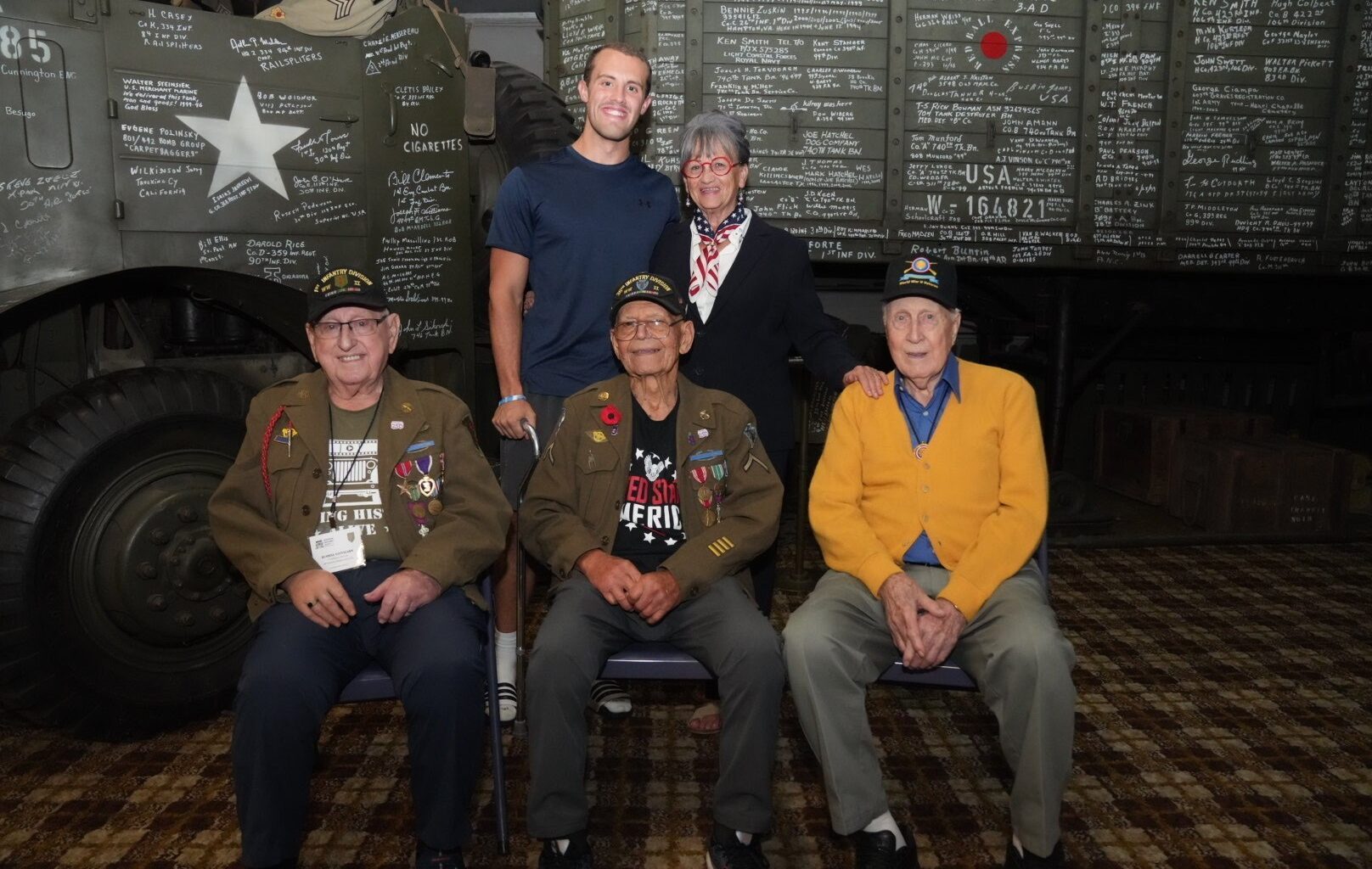
The three veterans, all more than 100 years old, spent six days revisiting key Battle of the Bulge sites in Belgium and Germany under the guidance of a Berks County man who wasn’t even born in the 20th century.
Tyler Boland, 22, of Spring Township organized the trip, leaning on European friends for help with research and logistics.
Boland’s passion for preserving the memories of World War II veterans is well documented. He interviewed veterans for his Wilson High School senior project and later set a goal of recording interviews with 100 veterans, posting them on his YouTube channel, Keeping History Alive.
He’s surpassed that goal many times over. He said he’s met nearly 1,400 veterans — all of whom he asks to sign a book — including those whom he hasn’t interviewed. His Keeping History Alive Facebook page shows 265,000 followers.
After graduating from high school, he hosted a backyard cookout for more than a dozen of World War II veterans he has interviewed. In 2024, while an Albright College student, he led a procession of 50 World War II veterans aboard vintage military vehicles during Wyomissing’s Fourth of July Parade.
His latest project, he said, began with a phone call in July.
One of the veterans had dreamed about the men he served alongside during the war and wanted to return to Europe. Boland had been encouraging him to make the trip for three years, repeatedly offering to handle the arrangements. This time, the veteran agreed.
Boland raised about $30,000 through GoFundMe and private fundraising events, secured a 56-seat bus through a friend in Belgium, had each veteran’s unit insignia displayed on its side and housed the entire group of about 20, including veterans, family members, historians and helpers, in a single Airbnb.
The group departed Oct. 1 for Brussels.
The men, Frank Stellar, 102; Russell Sattazahn, 100; and Truman Christian, 101, are in remarkably good shape, Boland said. Wheelchairs seen in some photos were used as a precaution, not necessity, he explained.
The six-day tour was divided into three segments, with each two-day rotation focused on one veteran.
Frank Stellar
Stellar of Lebanon was an Army Air Corps cook who, when the Battle of the Bulge created a desperate need for manpower, was retrained and assigned to the 36th Infantry Division.
COURTESY OF TYLER BOLAND
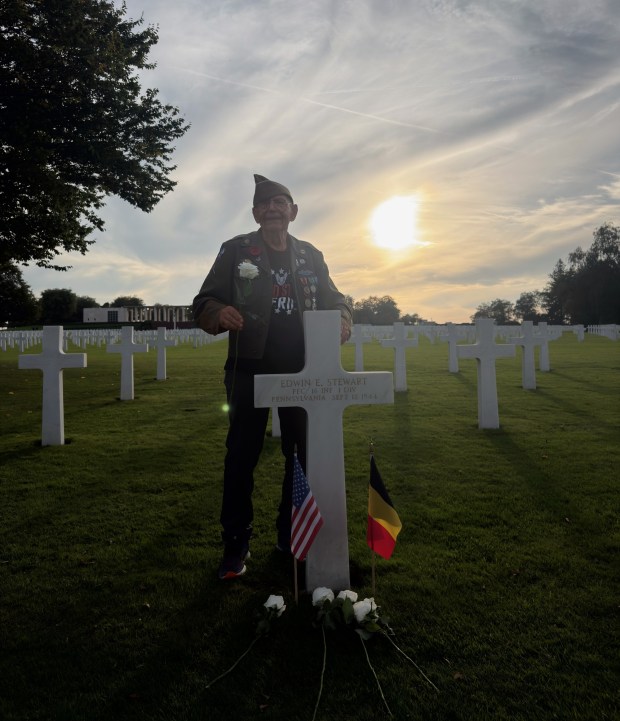
Frank Stellar at the grave of brother-in-law, Edwin Earl Stewart in Henri-Chapelle American Cemetery, Belgium, on Oct. 1, 2026. A medic with the 16th Infantry, 1st Division, of Pennsylvania, Steward was killed Sept. 18, 1944, was killed while carrying a wounded solider to the aid hospital in Aachen when a German mortar round hit not far from where he is buried. (COURTESY OF TYLER BOLAND)
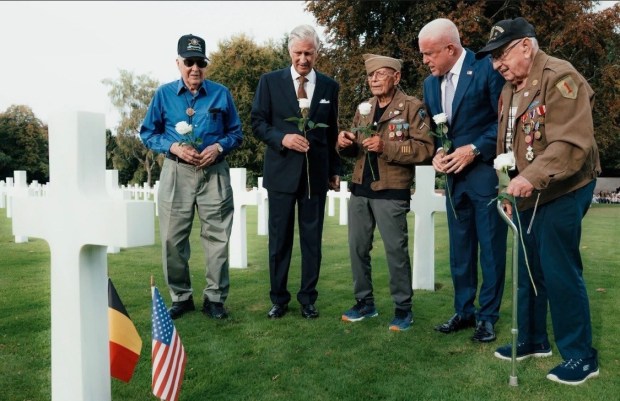 At Henri-Chapelle American Military Cemetery on Oct. 1, 2026, Frank Stellar, center, gathers with fellow World War II Pennsylvania veterans Truman Christian, far left, and Russell Sattazahn, far right. He’s flanked by King Philippe of Belgium and the U.S. Ambassador to Belgium, Bill White. Stellar and Phillipe laid a wreath at the grave, which is flanked by the U.S. and Belgian flags. (COURTESY OF TYLER BOLAND
Stellar’s brother-in-law Pfc. Edwin E. Stewart, a medic, was killed at Aachen in September 1944. No one in the family had ever stood at his grave until this trip.
Boland reached out to the Belgian Consulate, which coordinated a ceremony. On Oct. 2, King Philippe met the veterans at Henri-Chapelle, where the king and Stellar laid wreaths at Stewart’s grave.
“It wasn’t like a ceremony we were invited to,” Boland said. “They put it on for us.”
Stellar’s itinerary also included a visit to the exact location in Aachen where his brother-in-law was killed, a place he had never seen.
Truman Christian
Christian of Camp Hill, Cumberland County, served as a machine gunner with the hard-hit 106th Infantry Division, the “Golden Lions.”
COURTESY OF TYLER BOLAND
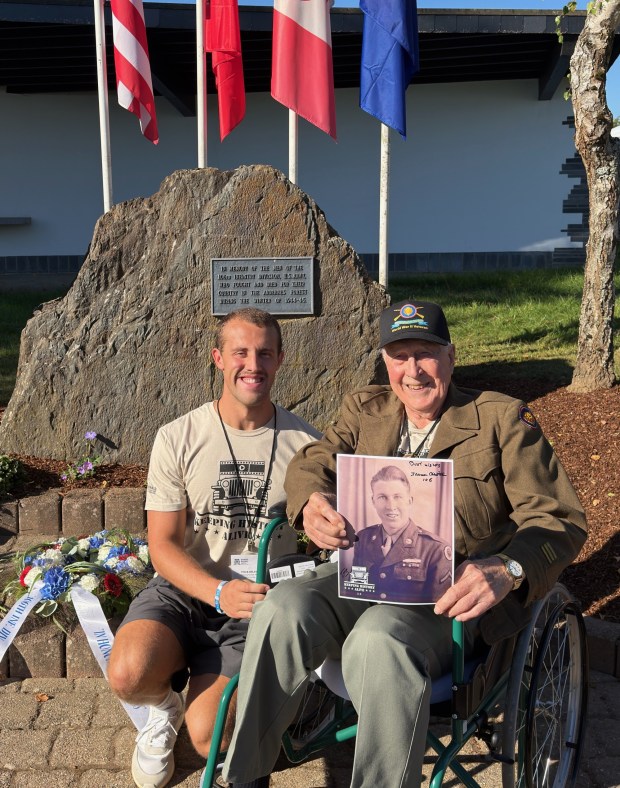
At the 106th Infantry Division memorial in St. Vith in eastern Belgium, Tyler Boland, a Wilson High School alumna and 2026 Albright College graduate, kneels beside Truman Christian, 101, who holds an autographed portrait of his younger self. The brand-new division was surrounded after only eight days in combat; roughly two-thirds of it was captured or killed, and Christian was one of the few who escaped. He is believed to be the last member to return to this memorial. (COURTESY OF TYLER BOLAND)
The 106th suffered some of the heaviest losses during the opening stages of the Battle of the Bulge. Christian had not returned in more than 70 years.
He was welcomed in St. Vith by the mayor, and caretakers of his unit’s memorial held a small ceremony in his honor. Boland and his team believe Christian may be the last living veteran of his unit to return to the battlefield.
COURTESY OF TYLER BOLAND
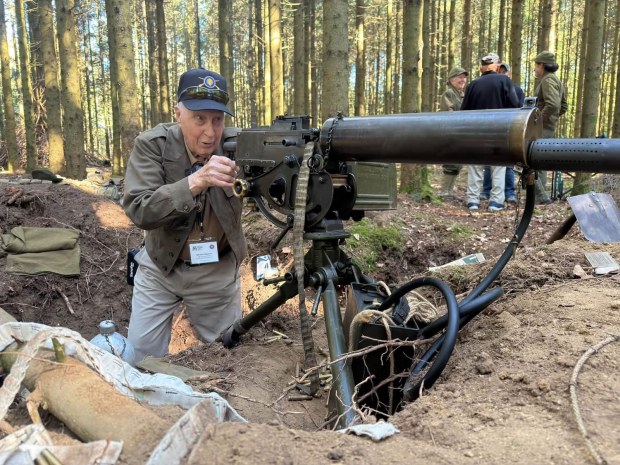
Truman Christian of Camp Hill, Cumberland County, aims a .30-calber machine gun, the same type of weapon he manned during the Battle of the Bulge 81 years earlier, during his visit to eastern Belgium this fall. The 101-year-old stood in the very Ardennes Forest foxhole outside of Coule where he was positioned on Jan. 13, 1945. (COURTESY OF TYLER BOLAND)
Using a Jan. 10, 1945, report listing a unit’s coordinates, Boland and his European researchers narrowed Christian’s position in the Ardennes Forest outside Coulee to about a square mile. Within that area, they identified 20 remaining foxholes. Three had been machine-gun positions.
Christian was shown the three likely locations and immediately identified the foxhole that had been his.
More than 80 years later, shallow depressions still mark many of the former positions, Boland said.
Reenactors connected to one of Boland’s friends dressed in period uniforms and brought the same type of machine gun Christian had carried during the war. They placed it in the foxhole before bringing him to the site.
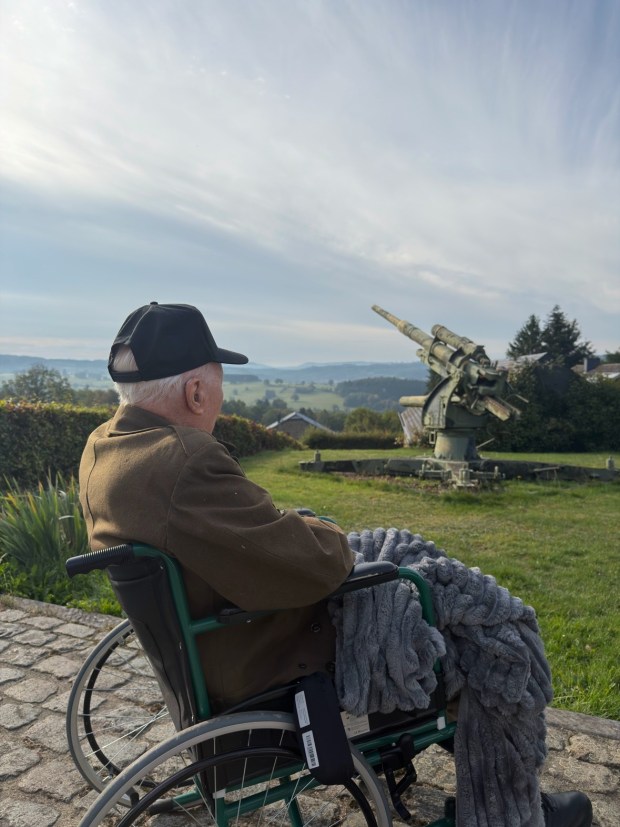
In the Ardennes woods, Boland took Christian to what research indicated was the location of a German artillery strike. In the foxhole directly in front of Christian’s, his best friend, Pvt. Alphus Caraway of D Company, 424th Infantry Regiment, 106th Infantry Division, was killed when an artillery shell landed nearby in January 1945.
COURTESY OF TYLER BOLAND
Truman Christian of Camp Hill, Cumberland County, gazes on the valley and the German 88 artillery gun, one of four that still remain in the Belgium municipality of Trois-Ponts, on Oct. 1, 2026. The guns shot into the valley on Christian’s position in January 1945 during the Battle of the Bulge, with one shell killing his best friend Caraway who was just feet away. (COURTESY OF TYLER BOLAND)
It was the first time Christian had returned to that location since the war. It was also the first photograph of Caraway he had ever seen.
Boland tracked down Caraway’s family, who provided the portrait. That night, they surprised him with a FaceTime call from Caraway’s nephew.
The nearby road has since been labeled “Caraway Lane” on Google Maps, Boland said.
Christian’s itinerary included visits to the 106th Infantry Division Memorial in St. Vith and several other unit memorials in the area. His son Larry accompanied him on the trip.
Russell Sattazahn
Sattazahn of Schaefferstown, Lebanon County, served in G Company, 18th Infantry Regiment, 1st Infantry Division. He was wounded at Uckerath, Germany, on March 24, 1945, and received the Bronze Star and Purple Heart.
COURTESY OF TYLER BOLAND
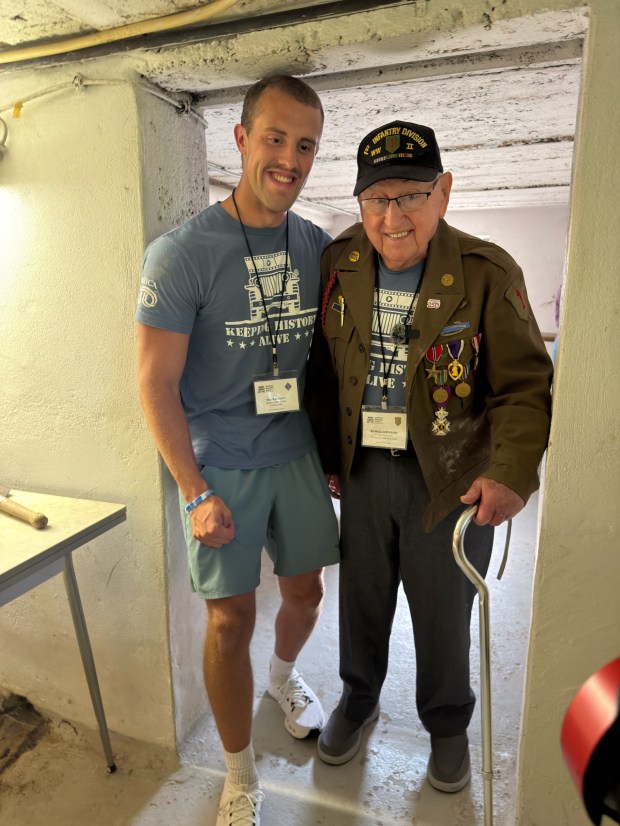
Tyler Boland helps Russell Sattazahn, in his 1st Infantry Division cap Purple Heart medal, through a basement doorway at Uckerath, Germany, 81 years after Sattazahn was badly injured there. Sattazehn was pushing through this doorway in March 1945 when a tank fired the second of two shells on the abandoned building. The blast blew off his right hand, and his face and left hand took shrapnel. (COURTESY OF TYLER BOLAND)
Sattazahn crossed the Roer River during the Allied advance into Germany, and Boland took him to the exact crossing point as well as to the location where he crossed the Siegfried Line. His granddaughter traveled with him.
The centerpiece of Sattazahn’s portion of the trip was a house in Uckerath, just outside Bonn.
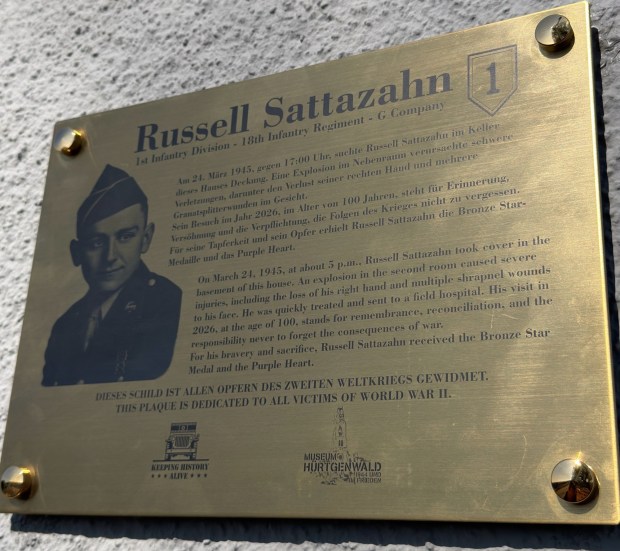 A plaque outside a German home pays tribute to local veteran Russell Sattazahn, who was wounded there during World War II.
On March 24, 1945, Sattazahn and his fellow soldiers were ordered to cross an exposed field as they advanced on the town. German machine gunners were covering the area.
Convinced he would be shot while crossing the field, Sattazahn instead sprinted to an abandoned house. As many as a dozen American soldiers took shelter in its basement.
A German tank spotted them entering and fired two shells at the house. The second struck the left corner just as Sattazahn pushed through a basement doorway. The blast blew off his right hand and peppered his left hand and face with shrapnel.
Pfc. William Rohrbaugh of York was fatally struck by the same explosion directly in front of Sattazahn and died beside him in the basement that night.
Boland contacted the home’s owners, shared the story and commissioned a local German sign company to create a plaque commemorating what happened there. The plaque is now mounted outside the house.
“When we went to the house and put up the plaque for his great-grandchildren and future generations to see, that was very emotional for me,” Boland said.
On another day, the veterans attended a museum meet-and-greet where local students came to ask questions. More than 400 people attended, with visitors traveling from Belgium, Germany, Poland and elsewhere in Europe to meet them.
“The people over there are so grateful, not that we aren’t here, but we weren’t occupied and they were for four years,” Boland said. “Everywhere we went, they got hugs and kisses. They came home with a suitcase full of gifts from people they’d never met before.”
The children, he said, were especially eager to meet them.
“The school students, obviously they weren’t around back then, but they know the importance, and they’re being taught how important these guys are,” Boland said. “That was really cool to see.”
That gratitude is Boland’s explanation for nearly everything that happened during the trip.
“I owe it to these guys,” he said. “If it weren’t for them, I wouldn’t be here. If I can bring them a little happiness at this point in their lives, that’s the least I can do.”
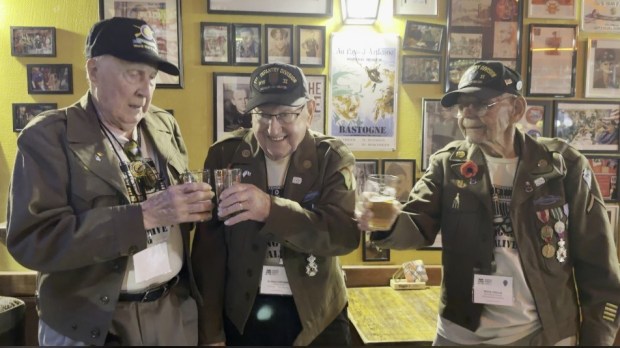
COURTESY OF TYLER BOLAND
Truman Christian, left, Russell Sattazahn, center, and Frank Stellar raise their glasses of Orval beer in Taverne Pub Au Carré — the Memory Wall — in the pivotal Battle of the pivotal Battle of Bulge city of Bastogne, Belgum., on Oct. 7, 2026, to cap their six-day tour. (COURTESY OF TYLER BOLAND)
Boland has studied World War II extensively, but he said nothing compares to standing in those places alongside the men who experienced them firsthand.
“You hear their story and can kind of imagine it,” he said. “But to be in those places with them as they’re telling you about it, I don’t have to imagine it anymore. I can say I was there. I saw what they were seeing.”
The tour was as much cathartic as nostalgic for the men.
A few days after returning home, Christian, the veteran who had resisted Boland’s encouragement for years, told him that standing once again on Belgian soil transported him back in time.
For a moment, Christian said, he could see the battle unfolding around him.