
Listen to article • 0:00 min
Madeline “Mima” Kohn’s late grandmother, Esther Rasch, grew up in Săcel, Romania, a small village once home to a vibrant Orthodox Jewish community.
But like many Jewish Europeans during the Holocaust, Rasch was stripped of her citizenship, forced from her home, and deported to Auschwitz with her parents and nine siblings.
Only she and five of her siblings survived.
After World War II, Rasch migrated to Hillside, N.J., in the late 1940s. She died in 2007 when Kohn was 3 years old, leaving her granddaughter with only faint memories of her.
“I was very close with my Jewish community. That history was really important, but I didn’t actually know anything about their lives before they came to the U.S.,” Kohn, 23, said. “They just appeared here one day, and I think subconsciously, I was exploring that.”
Growing up in Lower Merion, Kohn learned about her grandmother through stories told by her mother, Monica Rasch. But when her mother died in 2015, Kohn lost another connection to her family’s past.
What remained were 50 photographs of her grandmother and a nine-hour video documenting Esther Rasch’s return to Romania in the 1980s. Much of what Kohn knew about her grandmother’s early life came from watching that footage.
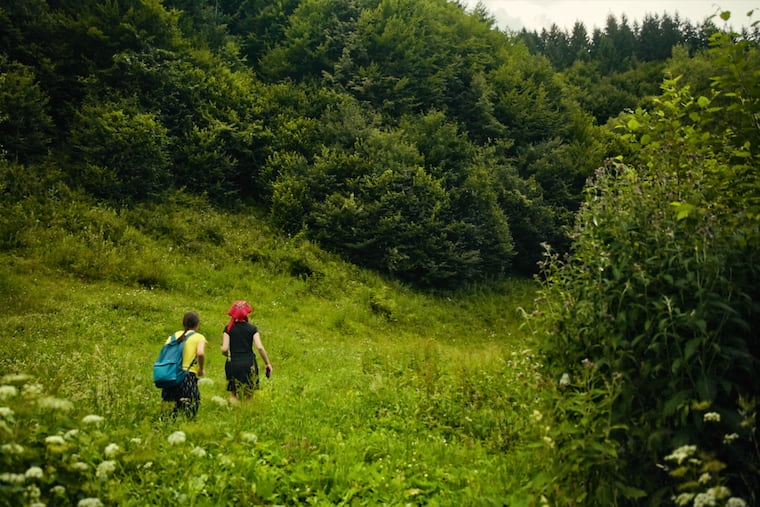
In July 2024, Kohn decided to retrace her grandmother’s steps, traveling to Romania to visit the places she had seen in the video. Her 10-day journey became I Don’t Know What I’m Doing Here, a documentary premiering at the Philadelphia Jewish Film and Media Festival on Nov. 17.
‘We all come from a place’
Kohn, then a 21-year-old student at the University of Pennsylvania, wanted to walk the same pastures, elementary school hallways, and synagogue aisles her grandmother had described in the video.
She hoped to create her own memories of the village and understand why, decades after the Holocaust, her grandmother had chosen to return.
“I had to go to Romania to realize that my grandmother was actually from there,” Kohn said. “So much of the discovery was almost self-evident, but at the time, I didn’t really feel like I could internalize that.”
The film begins with Kohn’s friend, Jacob Pincus, 23, who directed the documentary, flying from Los Angeles to meet Kohn in Cluj, Romania.
With 18-year-old translator Ayana Stefanescu as their guide, they visit shops, restaurants, and historical sites, including the Ethnographic Museum and Elie Wiesel Memorial House.
They walk through the Romanian heat to the Maramureș County Branch of the National Archives, where Kohn discovered her grandmother’s birth and school records.
Although Kohn couldn’t locate anyone who knew her grandmother, or other documents that could speak to her family’s history, she found a sense of “rootedness” in her visit.
“That was something I never felt before,” she said.
“In college, I didn’t feel I had a set professional aspiration. I didn’t know what I was doing here, and I think subconsciously, I knew that I needed some inspiration from earlier generations. I needed to go back and look at something concrete.”
When she was growing up, Kohn said, her grandparents avoided talking about their home countries due to the trauma and loss they endured during World War II.
“I was told, ‘Forget about that chapter. It’s bad,’” Kohn said. “There are a lot of people, especially from my parents’ generation, who refused to go [back] to Germany and Poland because they don’t want to support the economies of these countries, and I deeply understand that.”
But Kohn believes that she and others who are generations removed from the Holocaust can benefit from making these journeys. By avoiding these experiences, she said, they are “cutting [themselves] off from the positive and fulfilling aspects of the history.”
Pincus said that was the most significant theme they wanted to convey in the film.
“We all come from a place,” he said. “It’s not just specific to Romania. We’re all drawn to certain places because we’re from there. That was me at age 16 going to Poland, where most of my family is from. That feeling is what I connected with.”
A ‘gift’ for future generations
For Kohn, the journey began as a historical research project.
She received a $2,500 grant from Penn to travel to Romania, which she used to cover airfare, lodging, research, and a translator.
Making a documentary film was not in the plans until Pincus came along for the journey. The two friends met at age 16 during a Holocaust history trip to Poland, and have traveled together extensively in the years since.
Pincus, who dropped out of film school at the University of Southern California before flying to Romania, brought a 15-year-old point-and-shoot camera, a microphone, and a few film accessories tucked into a toiletry case.
During their trip, he compiled vlog-style testimonies from Kohn and B-roll of the Romanian landscape and historical sites. They soon realized the impact this story could have for an audience, so Pincus spent nearly a year repackaging the footage into a more comprehensive visual experience.
In the time since the trip, Kohn moved to Brooklyn to pursue a career in real estate development, with an interest in urban religious communities, including those across the Jewish diaspora.
At its core, Kohn said, the film is about “chasing belonging and finding familiarity.” And while she left Romania with unanswered questions about her lineage, she and Pincus felt “gratitude” because of the lives they had in the United States.
Pincus said those lives wouldn’t be possible without the sacrifices of earlier generations.
“We’re trying to help people remember that we come from people who sacrificed for us to be alive. And as soon as that’s lost, we are lost,” he said.
For Kohn, that feeling came full circle when she incorporated footage from an oral history video her mother had made into the documentary. Hearing the voices of three generations who share “strikingly” similar views of the world, Kohn said, provided “all the validation I was looking for.”
It also helped her answer the existential question posed in the film’s title.
“I discovered I do have roots. I do have role models, even if I didn’t spend that much time with them. I do have a path. I do belong,” she said.
“I Don’t Know What I’m Doing Here” is screened as part of Philadelphia Jewish Film and Media Festival on Nov. 17, at 7 p.m., at the Weitzman National Museum of American Jewish History, 101 S. Independence Mall E, Philadelphia, phillyjfm.org