
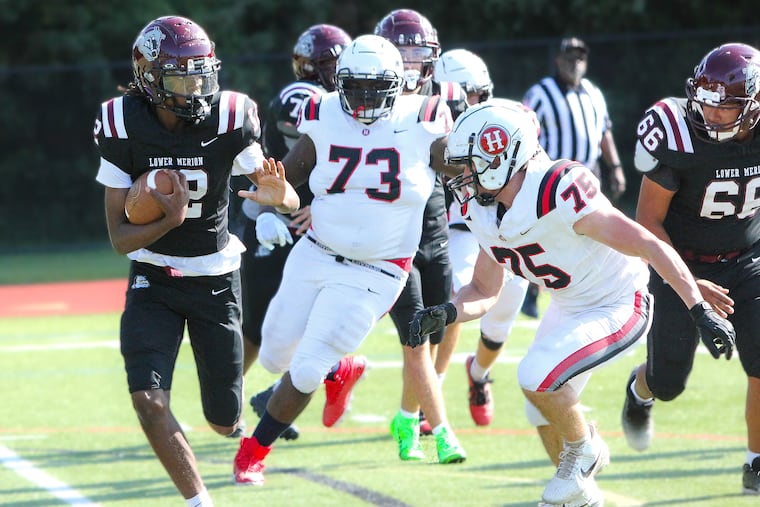
Harriton High School had a tough football season last fall.
The Rams went 0-9 in the Central League, a 12-school athletic conference that stretches across Montgomery and Delaware Counties. By the end of the season, multiple Harriton players were injured. During varsity games against rival schools, opposing teams would start pulling their JV players off the bench by the second half.
It marked Harriton’s 10th season in a row losing every game in the conference.
“It’s defeating,” said Rahul Mistry, the parent of a Harriton football player. “They’re good kids. They work hard. They’re decent athletes. They’re just overmatched.”
Mistry is among a group of parents pushing to merge Lower Merion’s two high school football programs.
While football remains immensely popular as a spectator sport, participation in youth football has declined in much of the country, hindering the ability of many high schools to field full teams. Lower Merion Township does not have a youth tackle football program, making it difficult to cultivate young talent and compete against neighboring communities that do, like Radnor.
Due to dwindling participation, Lower Merion and Harriton High Schools no longer have freshman and junior varsity teams, forcing green, 14-year-old players to run drills with 18-year-old college football prospects and increasing the risk of injury. (Mistry describes this as like having “Villanova go play Ohio State.”)
Last season, Lower Merion High School went 1-8 in the Central League; the Aces’ record in the conference over the last decade has been stronger than Harriton’s.
Now, parents say football in the township is “at a crossroads.”
“We were under-rostered,” Mistry said. “The program really isn’t sustainable at this level.”
The Lower Merion School District declined to make Lower Merion and Harriton’s football coaches and athletic directors available for interviews. Amy Buckman, director of communications for the Lower Merion School District, said the district has “no comment on this issue at this time.”
The parents have collected around 300 signatures in an online petition and spoken at school board meetings in support of merging the two high schools’ programs, a move they say would protect player safety and preserve an age-old tradition.
Why merge the teams?
The parents’ argument goes as follows: Lower Merion lacks a strong youth football program, leaving local kids without a place to learn fundamental skills at a young age. Narberth has a flag football league that runs from first to eighth grades, but as parent Chris McCloud said, it’s “not really designed to encourage kids to play tackle.”
McCloud’s children played CYO Football for St. Margaret School in Narberth, as many Lower Merion kids do. His older son now plays on Harriton’s team, and his younger son plays for St. Margaret and for the Lower Merion School District’s co-op middle school football team at Welsh Valley Middle School.
This fall, Welsh Valley’s team had around 60 kids, which McCloud said would theoretically be enough to field a strong freshman football team if the players were not split in two at the high school level.
With smaller teams, Lower Merion and Harriton’s athletes are playing with fewer breaks and risking injury more often, especially as they face opponents who are more developed. The strain can be particularly difficult for players in offensive skill positions — quarterback, running back, wide receiver.
“There’s a lot more contact that they put their bodies through,” McCloud said.
If Lower Merion and Harriton were to merge their teams, parents say, the district would be able to field a full-fledged football program, one that meets players where they are developmentally and offers age-appropriate training and interscholastic competition. It would also bring back the Friday Night Lights-esque school spirit that is hard to sustain with two dwindling teams, they say. Lower Merion High School does not have a pep band or lights on its field. Combined, the parents hope to share team resources.
Why is youth football participation declining?
Across the country — in New Jersey, Iowa, Maine, New York, Kansas — youth football teams are merging, due to declining participation and, in many places, collapsing student enrollment.
According to a survey from the National Federation of State High School Associations, the 2021-22 school year was the first with fewer than a million players participating in high school football in the United States since the early 2000s. It marked a 12.2% decrease from a 2008-09 peak.
Kathleen Bachynski, associate professor of public health at Muhlenberg College and author of No Game for Boys to Play: The History of Youth Football and the Origins of a Public Health Crisis‚ said a number of factors have contributed. In communities with large immigrant populations, sports with a more international appeal, like soccer, are often more popular.
By far, Bachynski said, nothing has reshaped football participation like the risk of head injury and growing awareness of chronic traumatic encephalopathy, known as CTE, a progressive neurodegenerative disease caused by repeated blows to the head and found in a number of deceased football players, often in high-profile cases.
Importantly, this decline in participation does not cut equally across all communities. More and more, Bachynski said, football players are coming from racially or economically disadvantaged families. In wealthier, whiter communities — Lower Merion is home to five of the 10 most expensive zip codes in Pennsylvania — parents are more likely to put their kids in a different sport or activity that they deem safer. Across the United States, football is still seen as a pathway to a college scholarship or a lucrative professional career, a more enticing prospect for kids seeking a ticket to upward mobility.
“The incentive and, therefore, the risk-benefit calculation looks very different depending on what other options are available to you,” Bachynski said. “A college football scholarship is still a very appealing, attractive thing.”
At an Oct. 20 Lower Merion school board meeting, Heather Farrell, a mother of three boys, two of whom play football at Lower Merion High School, said: “Many folks here do not support the injury risk with football. Many folks here can afford college without athletics as a means of scholarship.”
Some pushback, but overall support for merger
There are objections to merging the teams. A post in a Lower Merion football alumni Facebook group warned that combining the teams would diminish venerable traditions, like the Lower Merion vs. Radnor rivalry game, and give kids less playing time.
If the teams merge, the newly formed team may be ineligible for playoffs. Yet the parents pushing for the merger say losing playoff opportunities is a small price to pay for providing a safer and more fulfilling experience.
A spokesperson for the Pennsylvania Interscholastic Athletic Association, which governs high school sports in Pennsylvania, said that it “supports all schools interested in cooperative sponsorships” but that it would be a school’s decision to enter into one. PIAA District 1, which covers Bucks, Montgomery, Chester, and Delaware Counties, would have to approve the merger before it went before the PIAA board of directors. Michael Barber, the chairman of PIAA District 1, did not respond to emailed questions about whether the district would support the merger.
Per PIAA policy, schools are permitted to merge teams if the combined enrollment of high school-age male students in the district is 300 or less (for boys’ sports). The PIAA can, however, approve mergers for school cooperatives with more than 300 eligible male students if the newly formed team agrees not to compete in postseason competition, or if the schools have demonstrated a “lack of success” or lack of participation in the sport. In the 2022-23 school year, Lower Merion High had 942 male students and Harriton High had 594.
Bachynski said she believes high schools fielding larger teams increases safety in the “very short term” but does not address “the long-term fundamental challenges that football is up against.”
Overall, the parent advocates have seen broad support. Those who signed the petition called the proposed merger “a tremendous opportunity,” a “great idea,” and “a no brainer.”
Advocating for the merger at a school board meeting in October, Lower Merion parent James Stretch called middle school football “a life-changing event” for his son, who is autistic and had struggled to make friends before joining Welsh Valley’s co-op team.
For many, football runs in the family. McCloud played football in high school. Mistry played in college. Farrell’s husband played, and she said she was raised in a New Jersey town with a big football culture. They said the game builds character, teaches discipline, and gives boys a sense of belonging in an isolating world.
“I’m really grateful for what football has given my kids,” Farrell said.
As Mistry put it, “You make better people in this sport.”
This suburban content is produced with support from the Leslie Miller and Richard Worley Foundation and The Lenfest Institute for Journalism. Editorial content is created independently of the project donors. Gifts to support The Inquirer’s high-impact journalism can be made at inquirer.com/donate. A list of Lenfest Institute donors can be found at lenfestinstitute.org/supporters.