
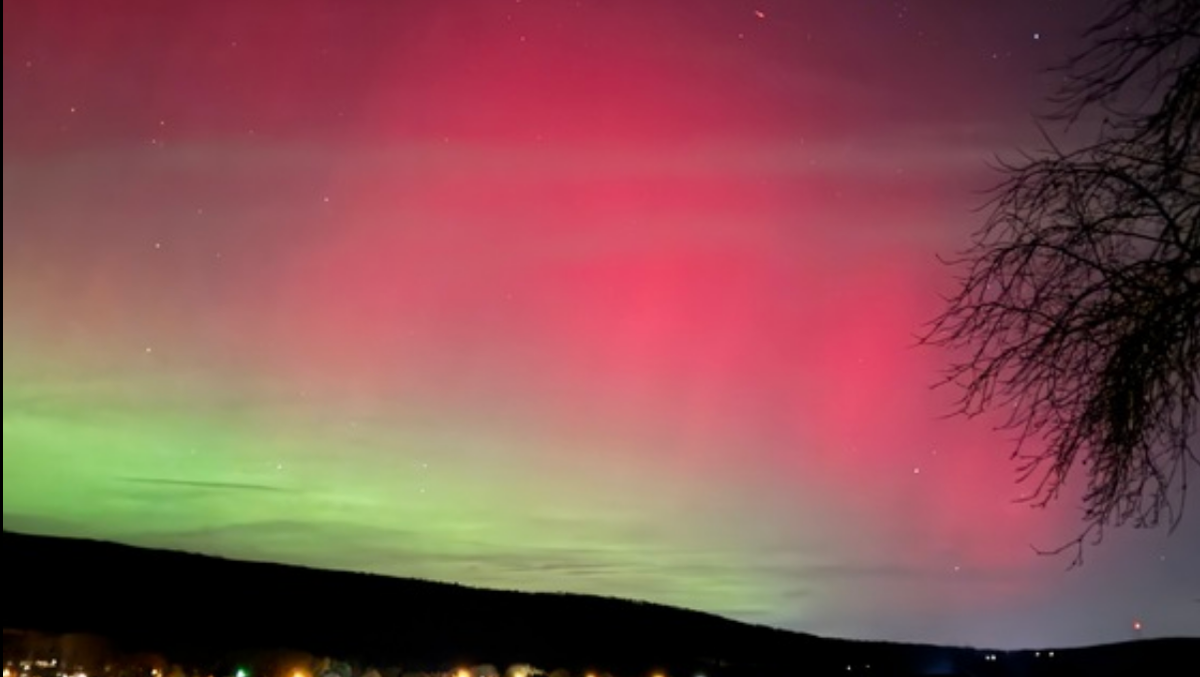
FROM THE HARRISBURG SKYCAM LAST NIGHT, AS WE WERE ALL TREATED TO THE NORTHERN LIGHTS IN THE SUSQUEHANNA VALLEY. YOU SEE, THE CLOUDS KIND OF COVERING PART OF IT. BUT WHEN THEY DID CLEAR, IT WAS QUITE THE SHOW FOR SO MANY OF YOU. WE THANK YOU FOR SENDING IN ALL OF THE PICTURES. WE’LL BE SHOWING YOU MORE OF THOSE THROUGHOUT THE NEWSCAST. IF YOU A
Northern Lights shine over Pennsylvania for the second night in a row

Updated: 5:58 AM EST Nov 13, 2025
The aurora borealis, also known as the northern lights, was visible in Pennsylvania two nights in a row.Video above: Timelapse of the aurora borealis over Harrisburg on Tuesday nightWhat are the northern lights?The northern lights are a captivating phenomenon characterized by colorful dancing waves of light in the sky. When there is a strong enough geomagnetic storm, the aurora can be seen in Pennsylvania.During these storms, charged particles collide with gases in the Earth’s upper atmosphere, producing the spectacle.The stronger the geomagnetic storm or the larger the amount of material ejected by the sun, the farther south the northern lights can be seen during a storm.Visible two nights in a row in PAWGAL viewers shared their photos of the northern lights across the Susquehanna Valley as they painted the night sky both Tuesday and Wednesday. Photos below: Tuesday nightPhotos below: Wednesday nightTips for capturing photos of the aurora borealisTo capture the vibrant colors of the aurora borealis, use the long-exposure setting, also known as night mode, on your camera. Go outside and look to the north, and you may need to look around a bit to capture the color. Depending on the storm’s exact strength, you may only see color through the camera.Did you capture the northern lights and would like to share with News 8? Send us your photos or videos at https://www.wgal.com/upload. How you can see the northern lightsCheck NOAA’s aurora forecast website. It’s a great resource for potential viewing times.If a northern lights viewing is in the forecast, check the WGAL News 8 Storm Team forecast to see if local conditions are favorable. Just because the aurora is active, that doesn’t necessarily mean cloud cover and other local conditions won’t interfere with its visibility.If everything lines up for a viewing, you’ll want to maximize the darkness to really enjoy the show. Your best bet is to head to rural areas with very little light pollution. Find a spot, such as a hill or mountaintop, with a clear view of the northern sky and soak it all in.Northern lights forecastThe Space Weather Prediction Center’s website says the Planetary K-index is used to characterize the magnitude of geomagnetic storms. The Kp index goes between zero and nine.To see the northern lights in parts of Pennsylvania, a Kp index of at least a seven is needed. At a seven, a faint colored glow low on the horizon, usually in the northern sky, is what we see. The farther north you go, the better your chances of seeing the aurora are.Read more about the Space Weather Prediction Center here: www.spaceweather.gov.
The aurora borealis, also known as the northern lights, was visible in Pennsylvania two nights in a row.
Video above: Timelapse of the aurora borealis over Harrisburg on Tuesday night
What are the northern lights?
The northern lights are a captivating phenomenon characterized by colorful dancing waves of light in the sky. When there is a strong enough geomagnetic storm, the aurora can be seen in Pennsylvania.
During these storms, charged particles collide with gases in the Earth’s upper atmosphere, producing the spectacle.
The stronger the geomagnetic storm or the larger the amount of material ejected by the sun, the farther south the northern lights can be seen during a storm.
Visible two nights in a row in PA
WGAL viewers shared their photos of the northern lights across the Susquehanna Valley as they painted the night sky both Tuesday and Wednesday.
Photos below: Tuesday night
1 of 13
PHOTO: Karyn Bennett
2 of 13
PHOTO: Karyn Bennett
4 of 13
PHOTO: Spring Seldomridge-Gouge
5 of 13
PHOTO: Susie Funck
6 of 13
PHOTO: Ryan Kareha
7 of 13
PHOTO: Joanne Hess
8 of 13
PHOTO: Katie Bortner
9 of 13
PHOTO: Julianne Reiner
10 of 13
PHOTO: Kyle Anderson
11 of 13
PHOTO: Kyle Anderson
12 of 13
PHOTO: Tracy L West
13 of 13
PHOTO: Mitchell Powl
Photos below: Wednesday night
1 of 4
PHOTO: David Rheem
3 of 4
PHOTO: Yvette Mendez
4 of 4
PHOTO: Sonja Fischer
Tips for capturing photos of the aurora borealis
To capture the vibrant colors of the aurora borealis, use the long-exposure setting, also known as night mode, on your camera. Go outside and look to the north, and you may need to look around a bit to capture the color. Depending on the storm’s exact strength, you may only see color through the camera.
Did you capture the northern lights and would like to share with News 8? Send us your photos or videos at https://www.wgal.com/upload.
How you can see the northern lightsCheck NOAA’s aurora forecast website. It’s a great resource for potential viewing times.If a northern lights viewing is in the forecast, check the WGAL News 8 Storm Team forecast to see if local conditions are favorable. Just because the aurora is active, that doesn’t necessarily mean cloud cover and other local conditions won’t interfere with its visibility.If everything lines up for a viewing, you’ll want to maximize the darkness to really enjoy the show. Your best bet is to head to rural areas with very little light pollution. Find a spot, such as a hill or mountaintop, with a clear view of the northern sky and soak it all in.Northern lights forecast
The Space Weather Prediction Center’s website says the Planetary K-index is used to characterize the magnitude of geomagnetic storms. The Kp index goes between zero and nine.
To see the northern lights in parts of Pennsylvania, a Kp index of at least a seven is needed. At a seven, a faint colored glow low on the horizon, usually in the northern sky, is what we see. The farther north you go, the better your chances of seeing the aurora are.
Read more about the Space Weather Prediction Center here: www.spaceweather.gov.