
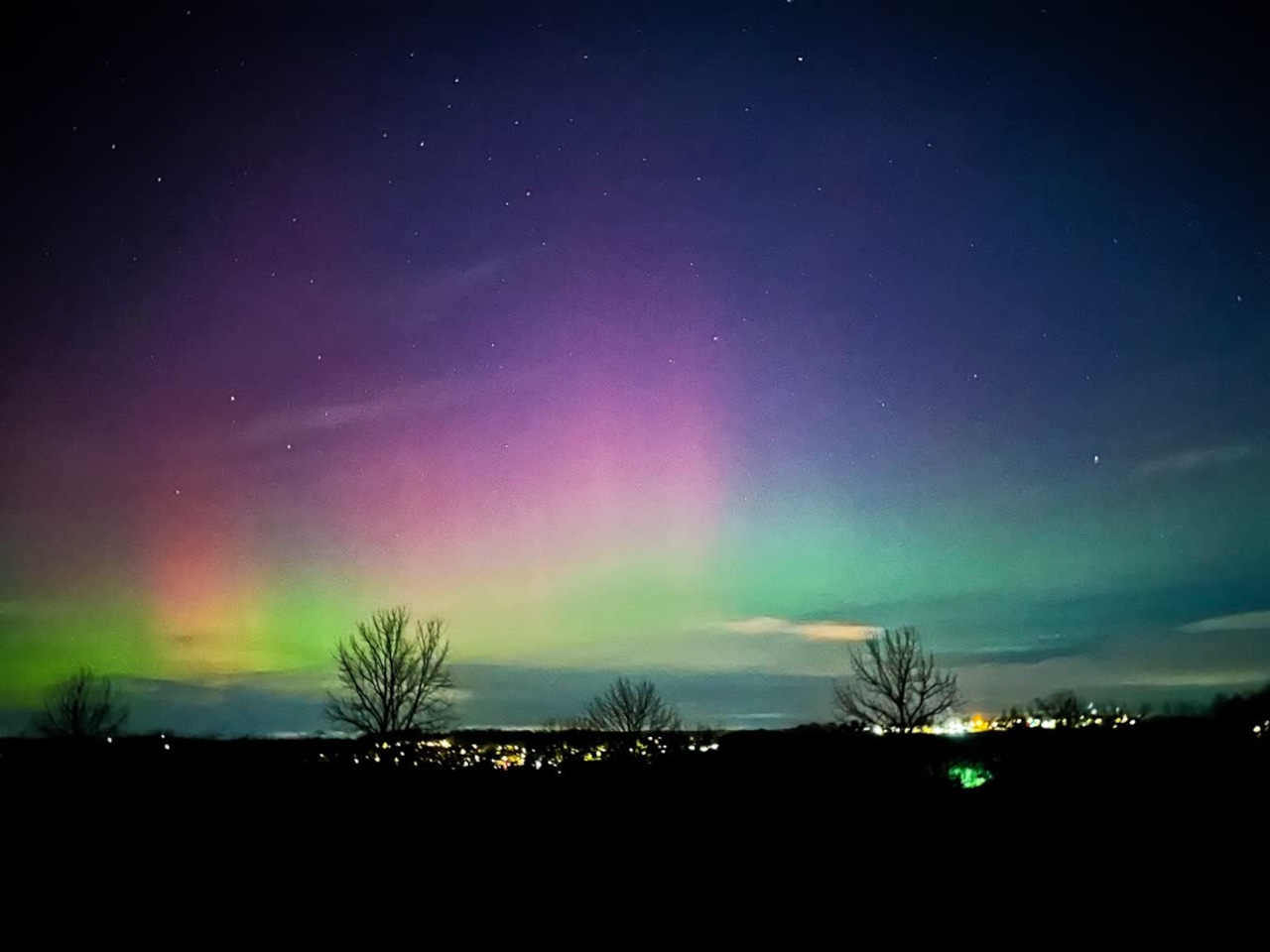
The aurora borealis made an appearance in skies visible from the Lehigh Valley on Tuesday night, for those braving the cold night to take a look.
For Wednesday night, the federal Space Weather Prediction Center has put most of Pennsylvania along with northern New Jersey above the view line for a potential encore.
The view line indicates the southern extent of where aurora might be seen on the northern horizon, according to the SWPC, part of the National Oceanic and Atmospheric Administration.
Some clouds won’t necessarily spoil the show, which is good news since the National Weather Service forecasts mostly cloudy skies Wednesday night over the Lehigh Valley. Low temperatures are forecast in the mid-30s with a breezy west wind, so dress warm if you’re planning on heading outdoors.
Space weather forecasters confirmed that solar storms reached severe levels, triggering these vibrant colorful auroras — or northern lights — in unexpected regions like Europe including Hungary and the United Kingdom. In the U.S., the hues were spotted Tuesday as far south as Kansas, Colorado and Texas.
There were some impacts to GPS communications and the power grid, Shawn Dahl with the National Oceanic and Atmospheric Administration said in a video posted on X.
The uptick in solar activity forced NASA on Wednesday to postpone the launch of Blue Origin’s new rocket carrying Mars orbiters until conditions improve.
Over the past few days, the sun has burped out several bursts of energy called coronal mass ejections. Two have reached Earth, but at least one more is still on the way and could arrive sometime on Wednesday.
Forecasters think this solar outburst could be the most energetic of the three and have issued a severe storm alert. How bright the auroras are and how far south they are visible will depend on when the burst gets here and how it interacts with Earth’s magnetic field and atmosphere.
The sun is at the maximum phase of its 11-year activity cycle, making the light displays more common and widespread. Colorful northern lights have decorated night skies in unexpected places and space weather experts say there are more auroras still to come.
Aurora displays known as the northern and southern lights are commonly visible near the poles, where charged particles from the sun interact with Earth’s atmosphere.
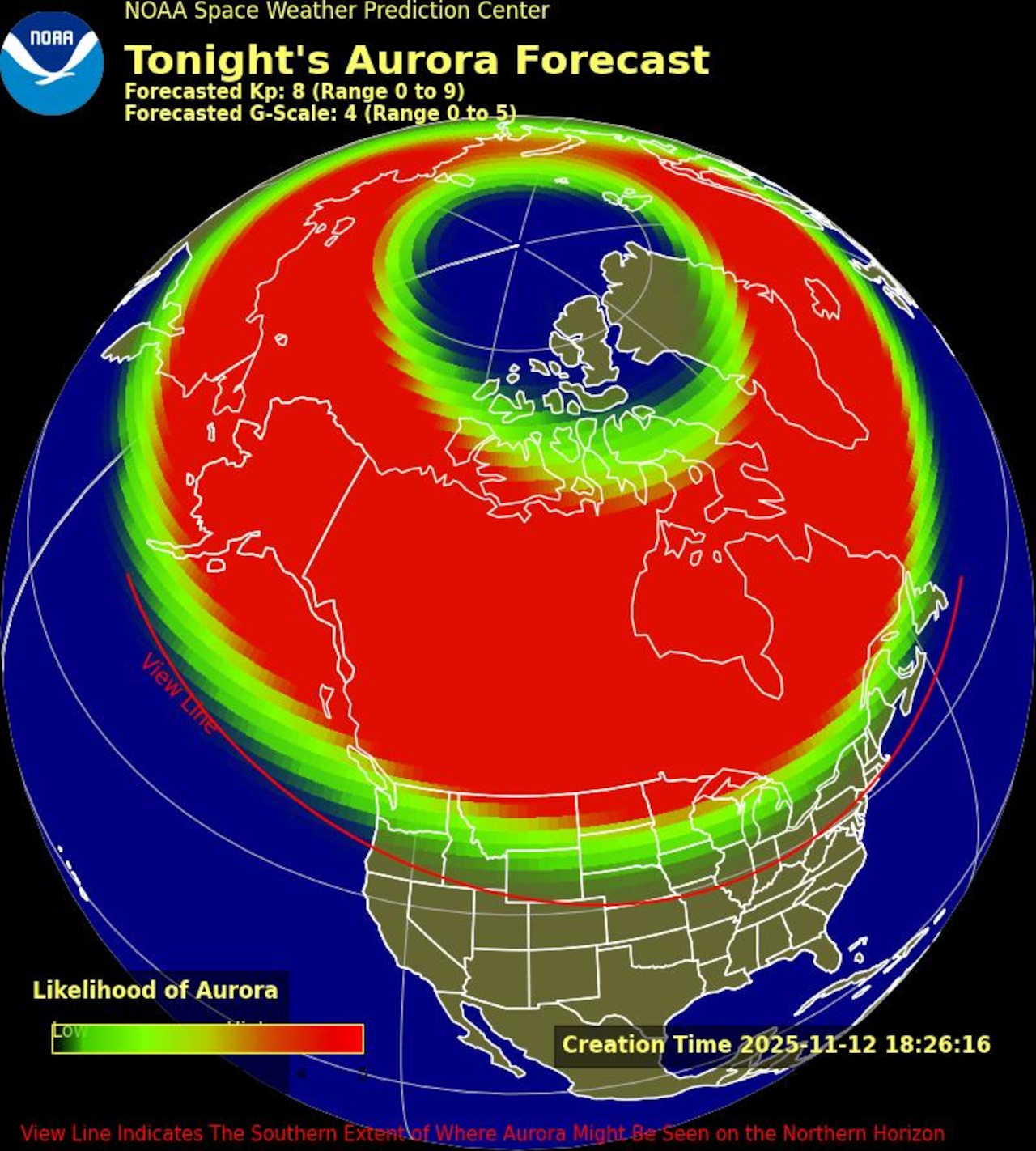 Most of Pennsylvania and northern New Jersey are above the view line for the night of Wednesday, Nov. 12, 2025, as of 3:26 p.m. EST in this aurora dashboard image from the U.S. National Oceanic and Atmospheric Administration Space Weather Prediction Center.NOAA
Skygazers are spotting the lights deeper into the United States and Europe because the sun is going through a major face-lift. Every 11 years, its magnetic poles swap places, causing magnetic twists and tangles along the way.
Last year, the strongest geomagnetic storm in two decades slammed Earth, producing light displays across the Northern Hemisphere. And soon afterward, a powerful solar storm dazzled skygazers far from the Arctic Circle when dancing lights appeared in unexpected places including Germany, the United Kingdom, New England and New York City.
The sun’s active spurt is expected to last at least through the end of this year, although when solar activity will peak won’t be known until months after the fact, according to NASA and NOAA.
Solar storms can bring more than colorful lights to Earth.
When fast-moving particles and plasma slam into Earth’s magnetic field, they can temporarily disrupt the power grid. Space weather can also interfere with air traffic control radio and satellites in orbit. Severe storms are capable of scrambling other radio and GPS communications.
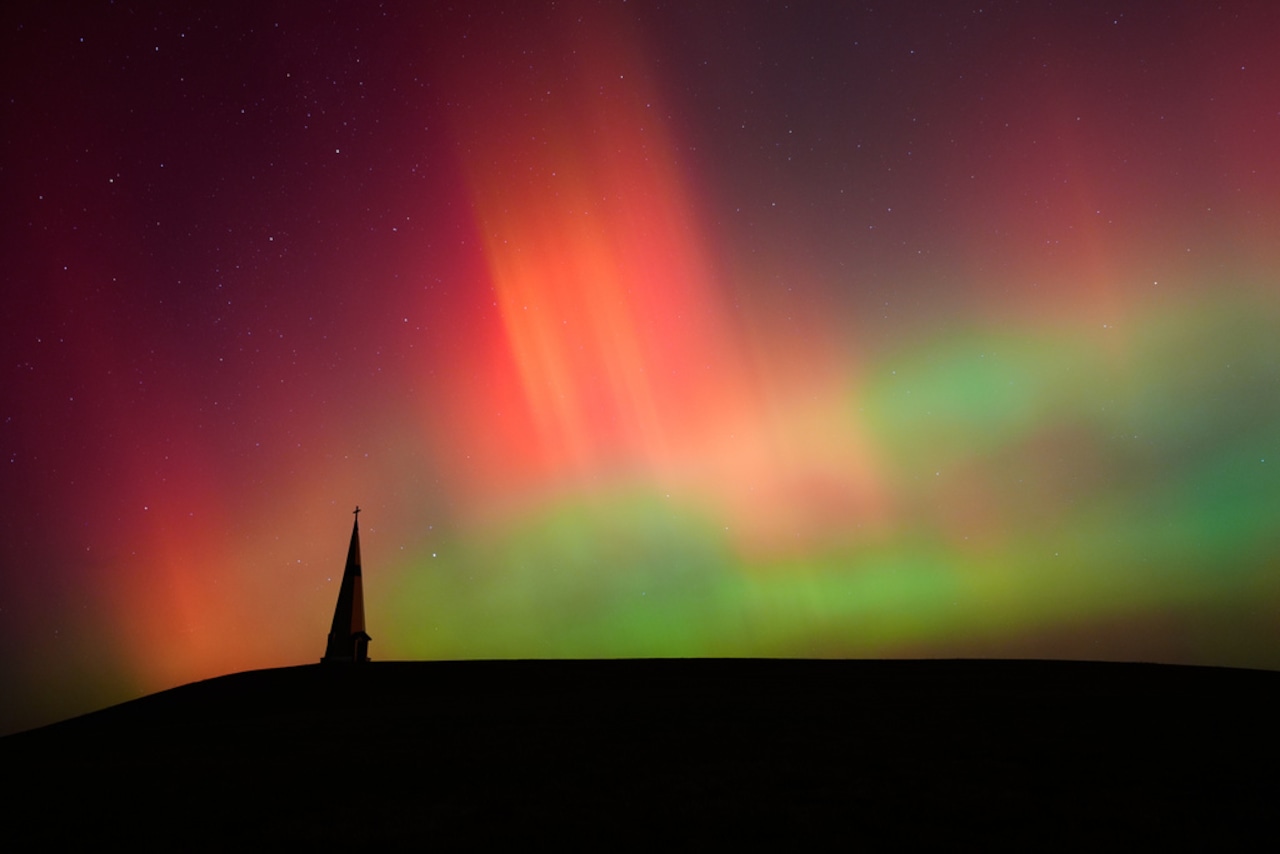 The northern lights fill the sky behind the Saint Joseph the Woodworker Shrine Tuesday, Nov. 11, 2025, near Valley Falls, Kansas.AP Photo/Charlie Riedel
In 1859, a severe solar storm triggered auroras as far south as Hawaii and set telegraph lines on fire in a rare event. And a 1972 solar storm may have detonated magnetic U.S. sea mines off the coast of Vietnam.
Space weather experts aren’t able to predict a solar storm months in advance. Instead, they alert relevant parties to prepare in the days before a solar outburst hits Earth.
Northern lights forecasts can be found on NOAA’s Space Weather Prediction Center website or an aurora forecasting app.
Consider aurora-watching in a quiet, dark area away from city lights. Experts recommend skygazing from a local or national park. And check the weather forecast because clouds can cover up the spectacle entirely.
Taking a picture with a smartphone camera may also reveal hints of the aurora that aren’t visible to the naked eye.
The Associated Press and supervising reporter Kurt Bresswein contributed to this report. Reach him at kbresswein@lehighvalleylive.com.
If you purchase a product or register for an account through a link on our site, we may receive compensation. By using this site, you consent to our User Agreement and agree that your clicks, interactions, and personal information may be collected, recorded, and/or stored by us and social media and other third-party partners in accordance with our Privacy Policy.