
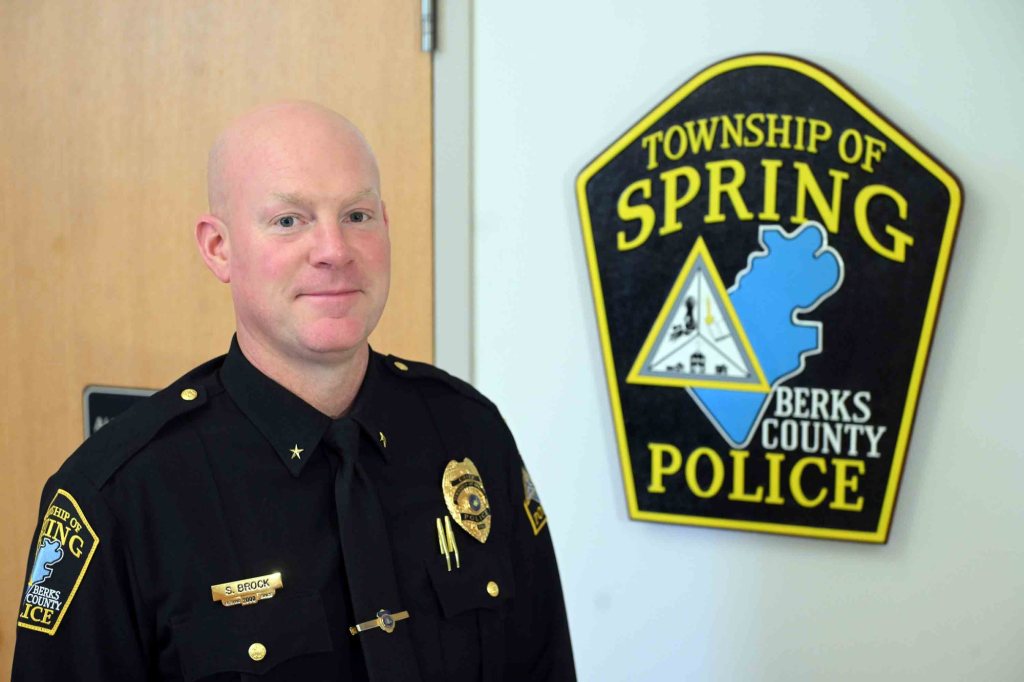
After more than 20 years in law enforcement, Stephen D. Brock reached a crossroads in his career.
In 2021, then-Detective Sgt. Brock faced a decision when a vacancy opened up in one of the Spring Township Police Department’s lieutenant positions.
Brock was happy in investigations, where he’d spent most of his 14 years with the 32-member department. He started as a patrolman in 2007, returning to the Berks County community where he grew up, after eight years with the Wilmington Police Department in Delaware.
His new department immediately tapped into his city policing experience.
Not long after starting in patrol he was transferred to a newly created position focused on investigating narcotics and violent crimes such as robberies and shootings. He became the first dedicated narcotics detective employed by a Berks municipal police department.
It would have been difficult to predict back then that he would one day rise to the pinnacle of the department’s leadership.
That’s what happened this summer when he stepped into the chief’s position. It was a manifestation of his drive, support from his supervisors and good timing.
Seizing opportunities
In law enforcement as in other fields, there are certain paths one must choose to achieve career goals such as leadership positions. Detectives sometimes remain in that role their entire careers, never getting on the track to command staff.
When a sergeant position opened up in investigations in 2018, Brock decided to go for it. Smoothing the way for that decision was that he would still be a detective, albeit with supervisory responsibility.
It was different when a lieutenant position opened a few years later.
“That was a harder one for me to decide on,” Brock said in a recent interview, “because then I would be leaving investigations, and I would be more considered command staff so I wouldn’t be doing as much day to day as I was, and that was a definite struggle for me to decide on.”
On one hand, he loved being a detective. On the other hand, if he would pass on the chance to move up, there was no guarantee he would get another shot.
Around the same time, another Stephen was stepping into the chief’s role. Stephen D. Powell, who was appointed deputy chief in 2020, succeeded Bryan Ross, who retired at the end of 2021 after 14 years as chief.
Powell had most recently served as chief in West Reading after a 22-year career in Reading, where he retired as a captain. He was 55 when he joined the Spring police and made it known retirement wouldn’t be on the distant horizon.
“He was great and I have a lot of respect for him,” Brock said of Powell. “I spoke to a lot of people and they’re like, ‘Hey, listen, if you have the chance to work under him and with him, that’s something you probably should do,’ and I agreed with that.”
The promotion didn’t happen automatically.
“There’s a test and interview and all that kind of stuff,” Brock said. “Luckily, I ended up number one on that list.”
Powell informed township leaders late last year that he planned to retire around mid-summer 2025.
Brock said officials approached him around that time with the idea of setting him up to become the next chief. He was happy to entertain that because he wanted to play a role in shaping the future direction of the department.
On March 24, the supervisors approved the succession plan, promoting Brock to deputy chief with the intent of transitioning him to chief upon Powell’s retirement. Brock signed a five-year employment agreement that took effect in April. It includes an annual salary of $156,000. The contract specifies that his rate would remain the same after his job title transitioned to chief.
“I don’t know if I would have regretted it if I didn’t (pursue the chief position), but I’m happy that I did,” he said. “I’ve been so lucky and blessed to have just had so many different opportunities, great people that I’ve worked with, and great supervisors who have helped me.”
Surprising path
Brock had entirely different career goals when he was growing up. He thought he would teach health or physical education and coach football.
“I thought, ‘That sounds good,’” he recalled. “My mom was a teacher, my dad was a doctor. I didn’t really know anything about policing.”
Nor was there a cop anywhere in the family tree
He majored in health and exercise science at Gettysburg College.
“I was playing football and I’m thinking I’m gonna get a job in teaching and coaching,” he said. “For whatever reason, I started thinking maybe policing would be kind of cool.”
He rode along with police departments, including in Wilmington, where his parents are from, and New York City, where he was taking college summer classes.
When he decided to give policing a try, he figured he could always pursue a career in teaching if law enforcement didn’t work out.
He was hired by the Wilmington Police Department in 2000.
“I loved it,” he said. “I had a great career there. I was involved in lots of different units and stuff, which was awesome.”
After seven years in Wilmington, he started looking at jobs in the Berks area. His son was almost 2 at the time. Brock wanted to move out of Wilmington, but he couldn’t unless he left the department due to its city residency requirement.
“I knew a couple of people that worked in different departments in the area and Spring sounded like it had a really good reputation,” Brock said. “It was a good department.”
He was hired in 2009 and assigned to patrol. At the time, Spring didn’t have a dedicated narcotics investigator. The only options to deal with complaints about drug dealing was to request state police or the county detectives unit to launch an investigation.
Brock, on his own initiative, began gathering intelligence and starting his own investigations.
“I was lucky because when I was at Wilmington, while I was in patrol, I was in some street crimes units and stuff like that, working with street-level drug dealing, gun violence, robbery patterns,” he said.
He led the patrol division in gun and drug arrests for several years in Wilmington.
“I learned pretty quickly, and there was plenty of it, so you got a lot of experience pretty quick,” he said.
By the time he left the department, Brock was a SWAT team member and assigned to the narcotics unit.
Taking initiative
He said his new department’s supervisors supported his initiative, during his first and only year in patrol, to root out drug dealers in the community with the department’s own resources.
“I started doing some things, as best I could from car stops and things like that,” he said. “I created some informants off of these things.”
After a year in patrol, Brock was moved to investigations, becoming what would best be described as a vice and narcotics detective.
“I had the drive to want to do it,” Brock said, “and I had the supervisors here at the time that were like, ‘Hey, we think this is probably valuable.’ We were able to establish a little bit of a unit here, and then that thankfully timed up with when John Adams was getting elected to his first term as district attorney.”
Adams formed a drug task force composed of county detectives and investigators with larger Berks police departments, who were cross-designated as county detectives. It availed small investigative units broader resources such as manpower and expertise in procedures and techniques.
Adams said Brock’s investigative background sets him apart from most police chiefs. In addition to his serving on the drug task force, Brock has been one of the leaders of the Berks County Human Trafficking Task Force.
Brock took over as chief in August. Working closely with Powell during the past three years, he said, was invaluable preparation.
“It was good because we really worked side by side for three years, basically every day, so we’ve worked on everything together,” he said. “He taught me a lot and, hopefully, I helped him as much on certain things.”
Brock said he’s focused on maintaining the department’s high standards amid a lot of turnover with retirements.
The department’s future looks bright, he said, especially with a wave of recent hiring to replace retiring officers, plus a new position that will bring the full complement to 33 officers by the start of the new year.
Brock said he will push for more expansion over the next few years as call volume will increase with the development of the Broadcast District, a large retail/residential complex that will be built on a vacant tract in the far northwest corner of the township.
“We have, I think, nine officers with less than five years’ experience here, all of whom are doing great,” he said. “So that’s a real plus, because going into the future, as we continue to hire some, we’re going to have a really young department.”
Brock, recalling how he benefited from support from above throughout his career, said he makes clear to the rank and file that they have nothing to worry about as long as they’re doing their job. In an age when police officers are often the subject of complaints, many without merit, that message is reassuring.
“The message from us is just go out and do your job,” he said. “Do the right thing. Be professional. We’ll support your training. We’ll support your initiatives. If complaints come in, we’ll deal with it.”
While conceding there can be a few drawbacks to living in the community you serve, Brock said his strong connection to the township is a net positive.
“I have friends and family here, you know, so the community is important to me,” he said. “It’s not someplace I’m just commuting to — this is where I live and where I work. I coach football across the street, I see people at the grocery store, I see them everywhere.
“I think it’s a really great community, and I want to keep being part of that, to support it and protect it.”